


































The New York Book Fair's Shadow Show
April 12th, 2013
|
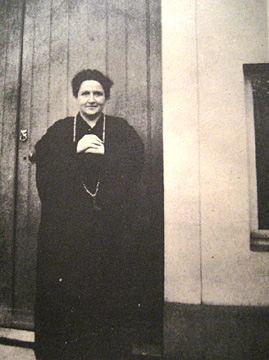
A first edition of The Autobiography of Alice B. Toklas, offered for $3500 by Resser-Thorner Antiques, Manchester, New Hampshire, was not only signed by Toklas and by the book’s author, Gertrude Stein, it also had Man Ray photographs of the two women and their apartment at 27 rue de Fleurus. Stein, who is shown here, inscribed and dated the inside front cover “Rose is a rose is a rose is a rose at Harvard March 19/34.”
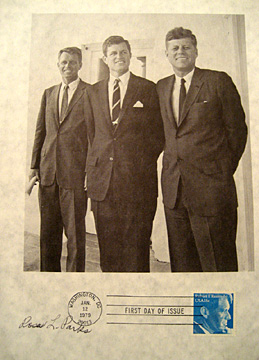
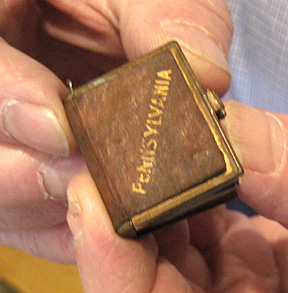
This first-day cover, dated January 12, 1979, and signed by civil rights activist Rosa Parks, was $100 from Resser-Thorner. The 15-cent stamp features an image of Robert F. Kennedy. It’s turning out to be a big year for Kennedy material, given the upcoming 50th anniversary of the November 22, 1963, assassination of JFK. We saw a fair amount at this show and the fair uptown. This miniature leather-bound guidebook, Pennsylvania, with tiny images of scenic spots inside, was $100 from Colebrook Book Barn.
Garry Austin of Austin’s Antiquarian Books, Wilmington, Vermont, brought an array of Teddy Roosevelt materials, including a 10" x 11¾" bronze bas-relief portrait plaque by James Earle Fraser (1876-1953). Offered at $475, the plaque was produced in 1920 by the Decorative Arts League of New York. It is inscribed “Aggressive Fighting for the Right is the Noblest Sport the World Affords.” Although Austin has given up managing this show, he still manages the Buffalo Niagara International Antiquarian Book, Paper & Ephemera Fair and the Antiquarian Book & Ephemera Fair in Albany, New York. |
The Manhattan Vintage Book & Ephemera Fair, New York City
The Manhattan Vintage Book & Ephemera Fair—billed as the “shadow show” of the New York Antiquarian Book Fair—took place on April 12 and 13 in the Altman Building at 135 West 18th Street in the downtown neighborhood of Chelsea. It featured no dealers from Paris, France as the uptown show does, but there were two from Paris, Tennessee, Dennis Melhouse and Dennis Hatman of First Folio.
More than half of the 44 other dealers were from Manhattan and Brooklyn. Many more had addresses within sleeping distance—i.e., they didn’t have to rent hotel rooms. Proximity keeps expenses down and allows them to cater to the trade.
Established in 1886 as the carriage house for the B. Altman department store, this location has been the site of the show for the past five years, which is as long as it’s been managed by John and Tina Bruno of Flamingo Eventz. It was started about a decade ago in the same location by Garry Austin and Bruce Gventer. Initially known as the Carriage House Fair, the show moved in 2007 to 336 West 37th Street and got a new name, the West Side Loft Book Fair, before Austin and Gventer gave it up.
“We had been wanting to get into the book show business in New York, so we saw that as a golden opportunity to resurrect it,” John Bruno said. Returning to the downtown location, he added, “has worked out very well. We’re very pleased with it. It can be a bit of a bear once in a while getting crosstown, but the truth is, Manhattan has so much [public] transportation, you can get from point A to point B very easily.”
Just under 100 people were waiting to enter when the doors opened on Friday night, or so we heard, since we couldn’t make it there that night. Maybe we missed seeing some good material, but we noted plenty on Saturday. In antiques-related businesses for 25 years, Bruno called “bogus” the idea that you won’t find anything worthwhile after the first hour or two of a show. “You can go on the last day to a seven-day event and find a treasure in plain sight,” he said. “There are treasures to be found every minute of every show.”
The savvy dealers keep putting out “good, fresh merch,” he continued. One reason is because the practice keeps one’s reputation “up there.” Another is because “it attracts the quality customer.” On my journey around the floor, I did happen to follow in the footsteps of a “quality customer” from the American Antiquarian Society in Worcester, Massachusetts. She had been manning a table at the fair uptown the day before. As for quality stuff being unearthed after the opening, we bumped into a dealer, who despite being set up here, had found at a late stage of the show a little trade catalog for big-game rugs, the kind with jagged-toothed heads. It was a very cool thing.
As at the Antiquarian Booksellers’ Association of America venue, we saw here many other items with a strong graphic element. Even many of the best books we saw had visual appeal. For example, there was a first edition with dust jacket of Ruth Prawer Jhabvala’s The Householder, her third (but first well-known) novel, which led to her collaboration on nearly 40 films with Ismail Merchant and James Ivory; Fore-Edge Painting: A Historical Survey of a Curious Art in Book Decoration by Carl J. Weber; and the irresistibly titled The Sexual Life of Savages in North-Western Melanesia by Bronislaw Malinowski.
The books at this congenial boutique event were mostly out-of-print (as opposed to rare) books. They’re much more affordable than what we saw uptown, that’s for sure. (See story on p. 34-E.) But given their availability on the Internet, they can often be a harder sell. In the words of Peter Luke of New Baltimore, New York, prompted partly by my fascination with a piece of ephemera in his booth, “My advice to book dealers is to never buy another book again. Everything else flies off the walls and shelves.”
For more information, phone (603) 509-2639 or see the Web site (www.FlamingoEventz.com).
|
|
|
|
|
|
|
|
|
|
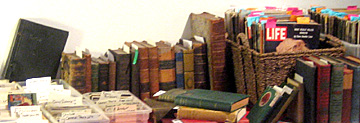 Gisella Davis was set up at the show to sell this inventory of Donna Lee Davis, her deceased mother, a dealer who did business on eBay as Old We Love.
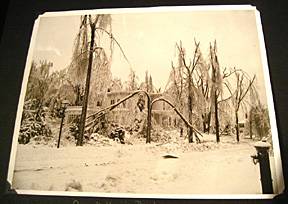 This is a page from a vernacular photograph album of an ice storm that took place in Van Hornesville, New York, on December 28-31, 1942. The album, including 80 images, some 3" x 4", others 8" x 10", plus related ephemera, was $675 from Kaplan & Kopelson Books, New York City.
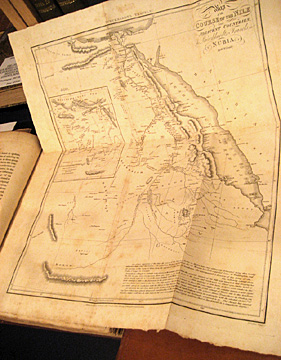 John Lewis Burckhardt’s Travels in Nubia was priced at $1500 by the Country Bookshop, Plainfield, Vermont. Published in London in 1822, this second edition includes two folding maps (one shown), a full-page map, and an etched frontispiece portrait of the author.
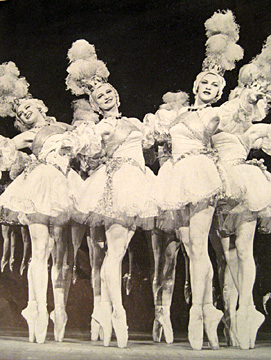 Pictured is a page from a pictorial booklet, illustrated with production photographs. It was 25 cents when first published for Radio City Music Hall by M.M. Geffen in 1940. It was $40 from First Place Books, Walkersville, Maryland.
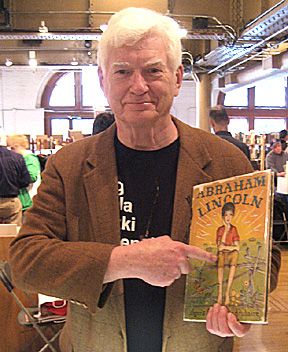 Bill McCullam of Cattermole Books, Newbury, Ohio, specialist in 20th-century children’s literature, wanted $400 for this first edition of Ingri and Edgar Parin d’Aulaire’s Abraham Lincoln. Published in 1939, it was a Caldecott Medal winner. McCullam was wearing a tee-shirt that said “I Don’t Speak Icelandic” in Icelandic.
Originally published in the July 2013 issue of Maine Antique Digest. © 2013 Maine Antique Digest