







See All Ads

$2.975 Million Sale Opens Antiques Week in New Hampshire

David Hewett | October 2nd, 2012

The 10¾" long paint-decorated slide-lid box is dated 1795 and attributed to John Drissel of Lower Milford Township, Bucks County, Pennsylvania. This red-orange box was part of the Richard and Rosemarie Machmer collection that Pook & Pook sold on October 24, 2008, when it brought $49,140 from dealer Greg Kramer. It was at Northeast as part of the Ciccotelli collection. Dealers Phil Bradley and Deanne Levison fought for it with Bradley the winner at $83,780.

The 12" long paint-decorated slide-lid candle box inscribed to Joseph Oberhoffer of Lancaster County, Pennsylvania, is dated 1851 and has been attributed to Jonas Weber (1810-1876) of Leacock Township, Lancaster County. It had been in the collection of dealer Greg Kramer prior to the Ciccotellis' ownership. A phone bidder took it at $73,160.

The Märklin toy paddle-wheeler Baltimore was an attic find, and when the Northeast Auctions crew discovered it, they knew they'd found a treasure, one of them told us. The auction price validated their opinion. A battle between two people in the room led to the $40,120 purchase by Lititz, Pennsylvania, dealer Rich Garthoeffner.

The 10½" high paint-decorated tin coffeepot went to dealer David Schorsch at $40,120. Ciccotelli collection.

The Pennsylvania fan-back Windsor chair in green paint is a product of Lancaster County, 1790-1810, and bears the painted inscription "G. Rau No. 2." A related example was sold by Northeast Auctions at its August 2000 sale of the Virginia Ramsey-Pope Cave collection. This example sold for $5850 at Pook & Pook's April 2007 sale of Dr. and Mrs. Donald Shelley's Americana collection. This time around, it went at $5428 to David Schorsch. Ciccotelli collection.

The 14¼" long covered oval storage box by Jacob Barb Jr. of Shenandoah County, Virginia, has faded red or bittersweet paint and is dated "...This 24th day of August in the year 1831..." on the underside of the lid. It went to David Schorsch at $68,440. Ciccotelli collection.

Northeast Auctions was close on most of its estimates for the art glass but missed the mark on this 7¼" high Tiffany Studios Favrile vase of 1903-04. It had the engraved "L.C.T." mark, the "6989 A" registration number, plus a paper label. Estimated at $2200/3200, it sold for $14,160.

The Rhode Island Queen Anne dressing table/lowboy in walnut (left) has a high cutout shaped skirt and graceful cabriole legs and is 29" high with a case width of 31". It has an Israel Sack history, was sold by Sotheby's in 1987 for $22,000, and was sold again by Sotheby's in 1992 for $19,800. This time around, it sold for $14,160.

The Connecticut Queen Anne dressing table in cherry and sycamore (right) was a trifle rough with a chipped drawer lip and a few repairs, but it brought $21,600 when it was sold at Sotheby's in 2005. This time it was bought in at $9000 (est. $12,000/ 18,000). These examples illustrate what's happened to formal brown furniture in the last few years.

Northeast Auctions, Manchester, New Hampshire

by David Hewett

Photos courtesy Northeast Auctions

Northeast Auctions kicked off the eight days known as Antiques Week in New Hampshire, an annual event that Americana dealers and collectors look forward to all summer, with a three-day sale at the Radisson Hotel in Manchester. The August 3-5 auction in the hotel's glassed-in exhibition rooms opened at 3 p.m. on Friday with 296 uncataloged lots and closed on late Sunday afternoon with lot 1658, a Samson Worcester-style four-piece porcelain tea service.

In between those numbers, Northeast moved $2.975 million of merchandise. It was a lower figure than last year's total of $4.544 million, but better than the 2009 and 2010 totals of $2.62 million and $2.753 million. Sales fell off in 2009 and 2010 as the decline in all markets widened. In 2011 Northeast landed the folk art collection of Helen and Steven Kellogg, and that consignment did bolster the total.

For this year's sale, Northeast Auctions owner Ron Bourgeault went hunting for a killer folk art or country collection, and he found one in the Philadelphia apartment of Rick and Terry Ciccotelli.

Collector James Richard Ciccotelli died on August 25, 2011, after a 30-year battle with cancer. His widow, Teresa Thibeault Ciccotelli, picked Northeast Auctions to handle the collection after being successfully wooed by Bourgeault.

The word was that Bourgeault guaranteed the folk art collection for a price of $1 million. We asked him if that figure was correct. He answered, after some hesitation, "You know me, when I want something I go after it aggressively. I loved that collection so much that I did everything I could to get it. As to the million-dollar number, that's a fish tale, and as in all stories concerning fish, the size varies wildly with the teller. The million-dollar figure is erroneous."

The 75-lot collection sold for a total of $1.067 million. Bourgeault was smiling broadly after it sold and later confirmed that it had been a winner for the company. He said, "You know, I think it's healthy to sell Pennsylvania stuff outside of Pennsylvania; it keeps people on their toes."

Northeast's opening Friday session has never been a barn-burner. Usually it consists of a hodgepodge of general merchandise, more country than formal, listed on double-columned photocopied sheets available only hours before the sale.

There were some bargains throughout that day's sale, especially in the furniture line—how else would you describe a $236 price (including buyer's premium) for a Federal cherry slant-lid desk and $82.60 for a Queen Anne candlestand with a circular molded-edge top and tripod base?—along with the genuine treasures.

One of those treasures was a Märklin lithographed tin toy paddle-wheeler Baltimore in untouched, "right-out-of-the-attic" condition, albeit with some damage. It sold for $40,120. (For reference, at James Julia's May 4 and 5, 2011, toy and doll auction, a paddle-wheeler Brooklyn in untouched condition sold for $60,375.)

After the $1.067 million Ciccotelli folk art collection sold, Northeast offered another 441 lots from a separate catalog on Saturday. Among those lots were the better furniture offerings and several outstanding objects that attracted collectors and dealers alike. Furniture, though, continued to sell at rock-bottom levels. Specific pieces with outstanding qualities did well, but there still is no solid collector market for average pieces or even slightly better-than-average examples.

For example, a Pennsylvania Chippendale dressing table/lowboy in mahogany with strongly shaped and carved skirt and ball-and-claw feet (est. $10,000/ 15,000) drew no bids and was bought in at $6500. The very next lot, a Philadelphia mahogany bonnet-top highboy with carving attributed to Nicholas Bernard, having an impeccable provenance and consigned by the George Washington Foundation (which consigned 32 lots), drew only one opening bid from Pennsylvania dealer Kelly Kinzle and sold to him for $59,000 (est. $90,000/150,000).

Back to the Ciccotelli sale. Most of the items had been bought either at Pennsylvania auctions or from this country's leading dealers in that material. The names of David Schorsch and Eileen Smiles of Connecticut led the lists of provenances, appearing with 24 lots. Others, such as Greg Kramer, David Wheatcroft, Thurston Nichols, Philip Bradley, Austin Miller, and Steven Still, also appeared.

Schorsch spoke fondly and candidly about Rick Ciccotelli on the morning of the sale. "It breaks my heart to see his collection lined up on shelves on display here. He had them just where he wanted them throughout his apartment, and it was obvious he loved them. He was a wonderful person, maybe the most modest person I ever met. I talked to this guy every day, and I miss him terribly.

"He lived with cancer for thirty years, and only then did he become an expert at folk art. He did all these things-he taught, he went to the Wharton School, and he accomplished other things-and this was all after he learned he had cancer. He wouldn't talk to you about 'I have this, or I have that.' He said at one time, 'I have enough money; that's not so important. I love this stuff.' I can truly say that he bought with his heart."

Schorsch backed his comments with action. He bought 11 of the Ciccotelli lots, among them the paint-decorated tin coffeepot that Schorsch had bought in 2006 at Northeast Auctions' sale of the Susan and Raymond Egan collection, where it brought $38,000. This time Schorsch paid $40,120.

He also bought a 7½" high miniature painted Windsor chair for $17,110 (underbid by dealer Deanne Levison); a paint-decorated slide-lid box for $23,600; a paint-decorated oval box by Jacob Barb Jr. for $68,440; and a wonderful 16" x 66" painted sign for "Hudson the Tailor" in red, black, and gold for $11,800. Schorsch had spoken before the sale about how much he liked that sign, so we asked him whether it was going into his personal collection. "No," he said, "I bought it for a friend."

Philip Bradley of Pennsylvania also made a substantial number of purchases (ten). Bradley took the ink and watercolor religious text by "The Striped Tulip Artist" at $24,780; the 1795-dated slide-lid box attributed to John Drissell at $83,780; and the presentation drawing attributed to Samuel Gottschall at $41,300. Bradley also paid $31,860 for a 12" long carved wooden lion, circa 1830, and $36,580 for the 1802 bookplate for Elizabeth Huth, attributed to David Kriebel.

Austin Miller of Ohio got the striking portrait of a little girl in a red dress holding a basket of flowers, possibly by Jacob Moore of the Prior-Hamblen school, for $14,160. David Wheatcroft of Massachusetts had to pay nearly four times the $8000 high estimate for a circa 1820 miniature stoneware jug decorated with a cobalt blue bird on a branch and the initials "E.J." It cost him $34,220.

All of the names mentioned so far as buyers of pieces from the Ciccotelli collection have been dealers, but there were successful collectors in the room, and we had no way to identify the numerous telephone bidders or those who had left bids.

One collector took two signs: the signboard for "D. Thurber 2nd/ Shoe-Maker" for $17,110 and the "H. Martindale" boot maker sign for $1652. A devoted collector from Pennsylvania picked up some of the more expensive lots. He paid $18,880 for the circa 1875 oil on canvas portrait of the Cedar Spring Farm of William Sherlock, a painting that had remained in private hands until 2010.

The Pennsylvania collector also took the presentation drawing attributed to Christian Alsdorf, paying $6608. A phone bidder claimed the set of six blue paint-decorated Lancaster County, Pennsylvania, plank-seat Windsor chairs made by John Swint, paying $30,680.

Some of the Ciccotelli fabrics did very well. A raveled hooked rug with owls, birds, and cats—one of a pair found at a Lancaster, Pennsylvania, farm sale by David Wheatcroft and last sold by Schorsch and Smiles—sold to Bradley for $18,290. An elaborate pen wipe, in the shape of five hearts in a circle, with five birds in the center, sold for $4602. "The best pen wipe in the country!" Bourgeault called out as it sold.

The Ciccotelli collection helped the auction total immensely. Subtract the $1.067 million brought by the Ciccotellis' 75 lots, and you're left with 1584 lots that sold for $1.9 million. The Ciccotelli lots averaged $14,226 each; the other 1584 lots averaged just under $1200 each.

Not that there weren't some super pieces among the other offerings. Take, for example, the three lots pictured on the catalog page coming just three pages after the Ciccotelli stuff. After those lots sold, Boston collector Bud Patten said, "There's your story right there, the catalog page that brought over one hundred thousand dollars!"

The price was only part of the story. The tale behind the price is what's really important.

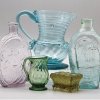
Lot 599 was a 4 7/8" high free-blown pale blue glass cream jug or pitcher. It had an applied ridged loop handle ending in a curled terminal, and within the knop (a bulged circle of glass) just above the circular foot was an American one-cent copper coin dated 1794.

Thus the small jug could be no earlier than 1794, and what was visible of the coin indicated that it had been used before it was placed within the knop. Family tradition was that the pitcher had been in the Philadelphia area and had been a gift to a New Jersey man (b. 1819) from his grandmother. Originally it had been made for the man's great-great-grandmother.

The first year that American copper cents were minted was 1793, and only 110,512 were produced. In 1794, however, some 918,521 were struck in a variety of patterns. Worn examples of the 1794 coin can be bought for as low as $140 today, but examples in mint condition go for much, much more. The jug's ultimate value, then, had little to do with the potential retail value of the coin and depended on the rarity of the glass itself.

Northeast placed a $5000/ 8000 estimate on the lot. There were several interested bidders, with at least three seated in the audience and one on the telephone. Both Ohio dealer-collector David Good and New York City dealer Gary Stradling were after it.

Stradling spoke about the pitcher earlier, noting that there were only two examples of glass containing American coins shown in the books and articles written by those pioneer students of American glass George and Helen McKearin. Both of those were made in New York state after 1829 and 1835.

"It's a strange piece in some ways," Stradling said of the little jug/pitcher. "The handle has two raised ribs, something usually only found on English and Continental pieces, but there's no question that this piece is American, and it's not a Boston or Thomas Cains piece."

When the bidding battle finally ended, Stradling was the new owner. It cost him $82,600.

The price is not a record for American glass. In June 1997 Skinner sold an Amelung tumbler for $83,900; in June 2010 Christie's Paris sold the Pittsburgh cut glass vase presented to Lafayette in 1824 for $267,022; and in March 2010 Norman Heckler sold a colored glass flask for $100,620-an impressive price for such a small object.

We asked Stradling where he thought the jug was made. He hesitated before answering, "I think the catalog got it right; I think it was made in the Philadelphia area around 1800."

Underbidder Good said, "It's the most important piece of glass to come on the market in the last fifty years, or since the 1940's. That's how good it is."

Vermont glass dealer/collector and New Hampshire Antiques Dealers Association member and show exhibitor Jeff Noordsy spoke even more enthusiastically about the jug while at that show. "I don't think that you can pay too much for that piece of glass. Even if it had gone as high as one hundred twenty-five, one hundred fifty thousand dollars, it still wouldn't have been too much. Size, color, rarity, solid American provenance and from a Philadelphia area glasshouse, and with an American penny from only the second year they were minted? That's unique. It's worth whatever number it took to get it."

The lot following the jug was a 15¾" high Newcomb Pottery high-glaze vase decorated by Harriet Coulter Joor. Depicting water lilies in a body of water, it brought $29,500.

There was a superb portrait of the young child Sarah Little Bryant of Castine, Maine, by John Brewster Jr. (1766-1854) in Saturday's session. The 19¼" x 16¼" oil on canvas had been consigned by descendants in Maine. It had a $30,000/ 50,000 estimate, but dealer Austin Miller had to pay $73,160 to take it back to his Columbus, Ohio, shop.

The following lot didn't have as successful an outcome as did the Brewster painting. The folk art watercolor of a man holding a key while seated at a table was by the New Hampshire artist known only as "Mr. Wilson" and had been sold by Northeast Auctions on October 27, 2007. It brought $52,200 then. This time, estimated at $25,000/40,000, it was bought in at the $20,000 level.

There wasn't sufficient interest to sell a pair of 1837 marriage portraits by Royall Brewster Smith (1801-1855) either. The portraits of the Standish, Maine, couple carried a $20,000/30,000 estimate, and despite the fact a similarly signed pair of period portraits is in the National Gallery of Art in Washington, D.C., no one would advance the lot beyond the $17,000 level.

Another lot with a high estimate did manage to sell, despite missing its $90,000/150,000 estimate by several thousand dollars. The circa 1760 Pennsylvania bonnet-top highboy in walnut had carving by the noted chisel artist Nicholas Bernard.

The most visible fault was the later addition of a heart-shaped cutout at the center of the skirt. Bourgeault had commissioned a scroll-shaped carved piece to be attached over the cutout, but the runners forgot to show the addition, and it remained inside a drawer as the highboy languished at the podium for lack of a $50,000 opening bid.

Bourgeault noticed the missing carving and demanded that someone get it and hold it at skirt center. When a runner did that, Kinzle bid the $50,000, and the highboy was his for $59,000 with the buyer's premium.

We'll close by noting that a very pleased Bourgeault was spotted at the Antiques Week shows. His auction produced the numbers needed and opened the week's events in solid fashion.

For more information, call (603) 433-8400; Web site (www.northeastauctions.com).

Four serious bidders wanted this 4 7/8" high pitcher/jug in pale blue glass: two seated near the front, one farther back in the room, and one on the telephone. The two near the front lasted the longest, until one took the choice item for $82,600. Read the story to discover who the buyer was, and why it is unique and probably worth much more, once its qualities are fully considered.

The 16" x 66" "Hudson the Tailor" sign in red, black, and gilt is a Concord, Vermont, object. Henry W. Hudson worked in Concord from 1872 until 1876, when he moved to Massachusetts and worked another four years. It sold for $11,800 to David Schorsch, who said he bought it for a friend. Ciccotelli collection.

We weren't there to see it sell but would guess that an absentee or phone bid took the 27-piece Flight, Barr & Barr porcelain partial dessert service of 1813-20 in the Japan pattern with a rooster crest and the motto Semper Vigilans (Always Vigilant). It sold near the end of the 559-lot Sunday session, and most seats in the room are usually vacant by that time. The $10,030 price appeared completely justified for the very colorful service, one of six lots pictured on the catalog's cover.


Originally published in the October 2012 issue of Maine Antique Digest. © 2012 Maine Antique Digest
comments powered by Disqus