


















Folk Fest Turns Sweet Sixteen

Lindsay Gallery, Columbus, Ohio, offered the stone carving work of Tim Lewis. This turtle was offered at $1250. 
Marvin Wies utilizes political observation in much of his work. This was his first Folk Fest, and hes already planning his return next year. 
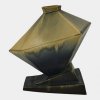
Bart Schultz, the Masking Tape Guy, constructs his version of the Statue of Liberty. The object would later be painted and decorated. |
Norcross, Georgia by Marty Steiner Sixteen is an awkward age. With all the apparent appearance of maturity, there are occasional spontaneous spurts of youthful experimentation. Some of these experiments become part of the persona; others are mere passing incidents and are lost forever. The phrase "sweet sixteen" probably is more the hopeful wishes of parents and older observers than the truth of surviving the turmoil of this age. Events may well share this split personality. Folk Fest, held August 14-16 in Norcross, Georgia, turned 16 this year and exhibited much continuity in galleries, artists, and types of material offered. It also offered new and different material. This new material has met with mixed reactions. The show, billed as "The World's Greatest Self-Taught Art Show & Sale," occupied the same footprint as last year. That was a return to the original layout after a one-year experiment with an expanded space. Six aisles with 95 galleries occupying booth space provide more than enough to satisfy even the overzealous collector. Where to start after entering the exhibit floor with a map of the hall in hand? Veteran collectors generally head for their favorite galleries. Most longtime exhibitors try to keep their same locations from year to year for exactly this reason. Trekking to the far aisle somehow seems to avoid the logjam near the entrance, especially during the preview evening. Anchoring that aisle is Hazel M. Giles Antiques of North Carolina, which has participated in a number of Folk Fests. Their booth personifies the earlier Folk Fests. Hazel Giles's husband is the artist in the family; she is the vintage ephemera dealer. You can count on tramp art, trench art, and other examples, all at moderate prices. Canada is always well represented by Scott Griffin and Minivan Gallery of Toronto. These artists have expanded their media and subjects over the last few years. Initial work saw graphics created with a welding torch on all manner of metal surfaces. Refrigerator doors sported scenes of bush planes in flight over landscapes. Today the artists paint on found wood, and the images include ships and humans with angel-like wings. Minivan has had outstanding success at Folk Fest over its years of attendance, and this year was no exception. There were a few galleries from prior years that did not attend this year. As happened at last year's Folk Fest, a number of first-time exhibitors filled in the space. Among these were Woody Gruber with miniature three-dimensional building façades, Thomas Moore with the work of a single artist, and others. Gruber's assemblages bridge the gap between gift shop "production" pieces and the longstanding traditional found-objects items. His creations are three-dimensional memory art. Each creation feels like some place you've been. Gruber is trained in architecture and graphic design and has experience restoring houses. He draws inspiration for his creations from coastal South Carolina and creates miniature building façades; he calls them "architectural folk art." Even as a child, Gruber was fascinated with houses. His professional career focused on restorations of houses and other buildings. His first façade, from leftover materials, was over 35 years ago. After retiring, he wanted to do something he loved and began constructing his façades in earnest. Each has some humorous or quirky element. Most are modestly priced from $45 to $100. Gruber found his first Folk Fest a "visually stimulating and exciting experience" and looks forward to 2010. Atlanta-based Linda Pirkle produces original paintings on metal ceiling tiles. She started this work in 2001 after some years producing painted birdhouses. Her subject material is usually flowers. Although the tiles appear old, she uses new material because of concern about old lead paint. Another assemblage artist, Camille Ronay, creates more complex works that feel like home used to be. Ronay, located in Union Point, Georgia, mixes old cabinetry, photos, and labels to create art that feels like part of the room itself. Operating totally independently, there were two artists who appear to be kindred souls. Kimberly Dean creates ethereal female forms from various mixed media, usually joined with found objects and wispy fabric. Likewise, Kirsten Stingle combines porcelain figures with found objects and creates a similar mood. Simply Southern offered serious pottery and a few select furniture items, among other things. Pottery from Georgia included examples from Crawford and White Counties. A Crawford County churn with no lid was marked $600, as was a White County storage jar. Many of the original or early Folk Fest exhibitors are the general line galleries that may also represent specific artists. One of these, Barbara Archer Gallery in Atlanta, holds a special place in the history of Slotin Folk Art Auction. She provided the space for its very first folk art sale in the late 1990's. Among Archer's offerings was what seemed to be the ultimate "junkyard dog," a dog fashioned from automobile engine parts appeared ready to pounce on the viewer. It is made up of pistons, exhaust components, a fan, gears, and other metal parts. Jimmy Hedges of Rising Fawn Gallery always provides a rich mixture of established artists' work. The gallery itself is a folk art environment located on Lookout Mountain near Chattanooga, Tennessee. Lindsay Gallery, Columbus, Ohio, always presents some high-end examples at Folk Fest. Individual panels display the work of each artist represented. Although the gallery brought fewer such pieces this time, a Clementine Hunter Zinnias, priced at $3800, did sell. This year's selection included Helen LaFrance, Janis Price, and a new artist, Mark Thomas. Thomas does neighborhood scenes, especially with sports involved. While there was much interest, there were no sales. "It can take a while to introduce a new artist," reflected gallery owner Duff Lindsay. Asked about his experience at this year's Folk Fest, Lindsay offered, "It wasn't as good as my best year or as bad as my worst. In this economy, I'd say that's pretty darned good!" Potteryman occupied several different booths. Each featured a current potter and his works. Michel Bayne produces historically inspired stoneware in Greenville, South Carolina. Shelby West is known as "alkaline man," working primarily with traditional alkaline glazes on utilitarian forms. He is located in Adairsville, Georgia. Wayne Hewell, a sixth-generation potter, produces wood-fired wares in Gillsville, Georgia. Also from Gillsville is Dwayne Crocker, who creates face jugs and other forms with detailed applied facial features such as beards and bushy eyebrows. Stan Clark of Potteryman reported the "best show I've ever had!" Folk Fest is held once a year. Where can you go to learn about and see more of this rapidly growing art market? Slotin will hold two auctions in 2010 at its auction hall in Buford, Georgia (just outside Atlanta). Its next sale is on November 7 with the preview on November 6. This sale will feature 800 lots of the lifetime collection of Lynne Ingram, a folk art collector and artist. New Jersey resident Lynne Ingram decided to explore her roots in the 1980's. She wound up traveling across much of the South meeting self-taught artists. This led to her doing photographs for a book by Tom Patterson in 1993, Not by Luck, which led her to become an art dealer representing many Southeast artists. For further information, call (770) 532-1115 or check the Web site (www.slotinfolkart.com). Originally published in the November 2009 issue of Maine Antique Digest. (c) 2009 Maine Antique Digest
Login or Register to post a Comment |