










Presentation Pieces from Old Ironsides

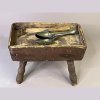
Block of wood, 9" x 5¼" x 4", with an imbedded medallion depicting the Constitution under sail and her significant naval victories listed in the margins. Its inscription indicates that the artifact is from the original hull of the Constitution. The stout 7¼" Paul Revere foundry copper spike is lodged in the wood. 
Snuffbox, 3¼" in diameter, with gold medallion inscribed Constitution or Old Ironsides Mr. Miller to Hon. Mr. Jarvis, probably from the 1833 restoration. William Jarvis was the United States Consul at Lisbon when the Constitution visited Portugal for repairs in 1803. While serving as consul to Portugal, Jarvis bought a large number of merino sheep, highly valued for the quality of their wool, and shipped them to America where the breed became a prized commodity. 
Examples of bookends: one of bronze (7" x 1½") and one of wood (7" x 6¾" x 4"), both made from material from the original hull of the Constitution. 
Twelve-pound cannon cast from the ships old brass mounted on a truck made from wood of the original hull of the Constitution, 15½" x 7" x 5". 
This small (3" x 2" x 2") block of live oak was from the 1927 restoration of the Constitution. 
Miniature (4" x 4") cast anchor marked as from material taken from the Constitution. 
Cribbage board, 10½" x 9½", with a small copper plate that identifies it as made from the Constitutions wood. The markings IX-21 indicate it was made between 1941 and 1975, when its official hull designation was IX-21. |
by Louis Arthur Norton The United States frigate Constitution, popularly called "Old Ironsides," is a floating icon that has earned a warm place in the hearts of all Americans. Many unusual artifacts made from discarded wood and metal from its restorations adorn places of honor in homes and a few select public buildings. This was started by one of its most illustrious captains, who took command 200 years ago. How these pieces came into the hands of famous and ordinary citizens is an intriguing yet seldom remembered maritime history saga. On September 16, 1830, a distraught 21-year-old Oliver Wendell Holmes (later the father of jurist Oliver Wendell Holmes Jr.) penned a poem titled "Old Ironsides" in response to the Advertiser's report about the proposed scrapping of the U.S.S. Constitution. A public outcry arose first in response to that article and later heavily reinforced by Holmes's moving poem. "Save Old Ironsides" quickly became a sentimental battle cry repeated throughout the country. Patriotic passions for the time-scarred symbol of American naval strength and success scuttled the plan for her dismantling. Instead, she was to be rebuilt and given an honored place among America's warships. Just after sunrise at 5 a.m. on June 24, 1833, the tide reached its early morning height. At that moment, in a light rain and mild wind, the venerable United States Navy frigate Constitution was nudged into the newly built Charlestown dry dock on a western edge of Boston harbor. She would be the first vessel to use the engineering marvel recently completed by Loammi Baldwin. Her pending restoration would be the culmination of the emotional plea expressed in the Holmes poem published three years earlier. The 60-year-old Isaac Hull, with his speaking trumpet in hand, was the honorary commander of the Constitution for this momentous docking event. He was first assigned the ship in 1798 as a lieutenant and in 1809 was its captain. Hull commanded the vessel during its brilliant 1812 capture of the H.M.S. Guerrière. After an absence of 21 years from her quarterdeck, Hull, in his impressive navy dress uniform, played host to Vice-President Martin Van Buren (President Andrew Jackson was too ill to attend), Secretary of War Lewis Cass, Secretary of the Navy Levi Woodbury, Massachusetts Governor Levi Lincoln, and Joel R. Poinsett, representing South Carolinathe source of the Constitution's live oakplus many other dignitaries. The ship was made fast in the dock in about 15 minutes. A traditional three huzzahs erupted from the crowd assembled on the wharf as escorting naval vessels fired muffled cannon salutes that echoed across the harbor. The entourage of notables disembarked and shortly reassembled at the house of Captain Jesse Duncan Elliott, the commander of the Boston Navy Yard, for formal presentations. Hull ceremoniously awarded canes fashioned from the Constitution's timbers to Van Buren (for the absent President Jackson), Woodbury, Lincoln, and Poinsett. In a brief speech that followed, Hull mentioned that all of the recipients had been strong supporters of the Constitution of the United States as well as the great ship that bore the same name. He said that it was his great hope that these strong canes made from the live oak of the Constitution would return "the support which the instrument [the document Constitution] has received at their hands, I trust that an equal support may be rendered to them when they arrived at the same age."¹ Hull returned to Washington after this event on July 1 but did not forget the Constitution or the significance of these unique gifts. For the next several years during the vessel's overhaul by Josiah Barker, Hull ordered souvenir canes, snuffboxes, and other artifacts made from her discarded wood as gifts for distinguished friends. In a September 1833 letter, Hull commissioned Mr. Jones, a jeweler from Cornhill in Boston, to carve an urn from the frigate's wood. In the letter he said, "I believe...[he] charges 25 dollars for making the urn." (Since wages were about a dollar a day, this was a month's salary.) Thus the evidence indicates that Hull launched the quasi-patriotic and sentimental American tradition of crafting presentation pieces from the wood, copper, and brass of historic ships. The creation of souvenirs from removed parts of famous vessels, however, was borrowed from the British. Their long and proud naval and maritime traditions gave birth to the custom of fabricating useful artifacts from ships of the Royal Navy, particularly Lord Nelson's Victory. The memory of famous American naval ships, such as the Lawrence, Kearsarge, and Hartford, is partly kept alive through their presentation pieces. Yet because of her many major restorations (1833-35, 1875-76, 1907-08, 1927-30, and 1992-96) and the fact that she is still a commissioned naval vessel, the number of objects made from the Constitution appears to far exceed those made from any other American ship. Among the earliest artifacts created from the vessel's various woods were practical and fashionable items. Besides the canes and snuffboxes favored by Captain Hull, there were picture frames, inkwell stands, ashtrays, cribbage boards, ship model stands, portable writing desks, chairs, tables, etc. The Smithsonian Institution has in its collection a cane presented to President James Madison inscribed with etched drawings of the Constitution and the vanquished Java, Guerrière, Cyane, and Levant. Mystic Seaport has a unique object technically not made from the ship, a whalebone cane whose shaft is a scribed log of the Constitution's travels during its 1839-41 voyages, scrimshawed by the ship's sailmaker, William S. Somerby. The Museum of Connecticut History in Hartford displays a 35" oak cane with a gold ferrule dated 1842 with an ivory knob carved in the head of a woman. Nearby is a judicial gavel of similar vintage made from the ship's wood. The Hermitage near Nashville, Tennessee, the home of President Andrew Jackson, owns a large desk chair made from the wood of the Constitution that was given to Jackson's secretary of the Navy, Levi Woodbury. The most elaborate object fabricated from the wood of the Constitution was a phaeton carriage presented to Jackson, the one that he rode in at the inauguration of President Van Buren, his successor. Unfortunately that unique vehicle was destroyed by fire in 1894. A few wheels and part of the frame survived the flames and are on display at The Hermitage.2 During the first restoration of the Constitution in 1833 a government resolution was passed stating that all public buildings then under construction were eligible to receive discarded timbers from the ship. The massive impressive doors to the Custom House in New London, ConnecticutHull's home stateare constructed from the wood of Old Ironsides. Because the Constitution is a large wooden boat, it has required constant maintenance, especially replacement of planks, beams, and spars over its lifetime. It has been said that if all the pieces of lumber taken from the Constitution were used to rebuild the ship, the U.S. Navy would own a sizable fleet of frigates. As with most antiques, the earliest dated artifacts with provenance are considered the most desirable. The most commonly found are those from its 1927 reconstruction, probably because their sale was used as a partial source of revenue for this work. Canes, gavels, and wooden cannons were turned on lathes. Cigar boxes, bookends of both wood and copper, anchors, oddly shaped chunks of paperweight wood, etc. were also marketed to the public. Each bore an authenticating plate or embossing. Most were inscribed "This material was removed from the U.S. frigate Constitution during its reconstruction, 1927." On some items it stated that they were taken from the ship's "original hull." A few were made from the Old Constitution, the vessel's designation from 1917 to 1925 when a cruiser of that name was to be built but was never finished. Still others are inscribed IX-21, the ship's official hull number from 1941 to 1975. Paul Revere's foundry received the contract to make the copper spikes and sheathing for the ship. Therefore copper spikes from or found in pieces of the original hull are highly prized as artifacts of both the vessel and the work of the legendary Revolutionary War-era figure. The finest collection of these relics is to be found at the U.S.S. Constitution Museum in Charlestown, Massachusetts. Many others have found their way into private collections, purchased from antiques dealers or through auctions. These souvenirs have the status of wood and/or metal icons. In reality they are mementos of naval history, tangible footnotes to the heroic story of America's greatest sailing warship. Cane, 34" long, with a silver ferrule inscribed presented to Martin Silver by J.W. Young This stick is from the Old Constitution. The Constitution was called the Old Constitution from December 1, 1917, to July 25, 1925, when a cruiser bearing her original name was under construction. The namesake vessel was never completed. |
Notes- Linda M. Maloney, The Captain from Connecticut: The Life and Times of Isaac Hull (Boston, MA: Northeastern University Press, 1986), p. 433.
- The fourth figurehead that adorned the bow of the Constitution was that of Andrew Jackson fashioned by Boston woodcarver Laban S. Beecher. Unfortunately there was a deep anti-Jackson political sentiment in some quarters in Boston at the time. On April 28, 1834, the figurehead was installed on the vessel, but on the following July 3, the wooden effigy's cranium was decapitated from the full figure. Woodcarvers Dodge & Son of New York City quickly restored the missing head. The figurehead remained on the Constitution until 1848, an amalgam of Boston and New York woodcarving restorationperhaps analogous to a man in a Red Sox uniform wearing a Yankees cap. Fortunately both the original wooden body and the missing cranium were preserved separately and were finally reunited in 1998 at the Marine Gallery of the Museum of the City of New York.
Originally published in the December 2009 issue of Maine Antique Digest. (c) 2009 Maine Antique Digest
Login or Register to post a Comment |