













The International Fine Art and Antique Dealers Show

Pair of Sèvres biscuit models of lions supporting gilt white reticulated baskets, modeled by Jean-Charles- Nicholas Brachard lainé, after a drawing by Fragonard, 1818-20, part of an elaborate dessert service, $400,000 from Brian Haughton Gallery. 
Three-panel room divider by Paul Evans (1931-1987) of patterned welded steel panels with gold-leaf edges and applied pigment, 96½" x 26" x 8", $95,000 from Bernd Goeckler Antiques. Evans created a dozen or so panels of various sizes during his career in his New Hope, Pennsylvania, studio. 
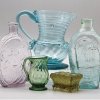
James Robinson, Inc., New York City, offered 20 Flight period (1783-92) Worcester plates for $23,000, two dishes for $1750, and a sauce tureen and ladle for $2850. An English glass jug was $1750, and an 1810 English glass decanter, $1950. On the bottom shelf, a George II silver teapot and stand ($12,000), a sugar basket ($5850), and a creamer ($3850) were all the right style and shape but made in the period before tea sets were matched en suite; the circa 1750 silver candlesticks by John Payne cost $16,000. |
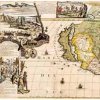
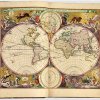
New York City by Lita Solis-Cohen "Change is good," said Brian Haughton just before the preview party of the 21st annual International Fine Art and Antique Dealers Show at the Park Avenue Armory in New York City on October 15, 2009. "We have four more dealers than last year," added his wife and partner, Anna, not mentioning the 18 dealers who had elected not to return to the show, or that the Haughtons had canceled their 20th-century International Art+Design Fair, which for a decade had been held early in the fall. "The fair looks younger and improved," commented Axel Vervoordt, the Belgian dealer and tastemaker who every year since the show's inception in 1989 has combined contemporary design, modern painting, and sculpture with 17th- and 18th-century furniture and ancient works of art. A large book illustrating his work for clients around the world was open on a slate-top coffee table of his own design incised with the Golden Mean. "Art is timeless. I find all art inspirational. I especially like the work of the contemporary Japanese action painter [Kazuo] Shiraga; he died in 2008," said Vervoordt. Shiraga's abstract work in thick impasto hung over a long white sofa with random-size pillows in Morandi colors affixed to the frame with dowels. Next to it was a "Kangourou" chair by Pierre Jeanneret, made for a hotel in India; only two or three survive. The French Empire throne-like chair across from it once stood in Jacques-Louis David's studio. Napoleon may have sat in it for his portrait. Classical sculpture, Bactrian stones, and an 1800 B.C. idol from Yemen were on shelves, tables, and pedestals, providing light forms against charcoal walls and dark brown bookcases. Vervoordt's stand sets the mood of this show. Because the Haughtons canceled their 20th-century design fair, half a dozen of those dealers moved over to the art and antique show, held October 16-22, giving 20th-century and contemporary works a greater presence, right alongside stands with the finest 18th-century English furniture available. This show has more 18th-century English furniture than any other in the U.S., but there was also a broad selection of early 20th-century furniture, most of it European. Dealers put a great deal of effort into designing their stands and tried hard to offer fresh material. To show off its Continental art pottery, Jason Jacques Gallery, New York City, offered a white-painted cabinet with satinwood interior by Swedish architect Ragnar Östman and an ebonized cabinet with bird's-eye maple interior by Patriz Huber, a central figure in the German Art Nouveau movement and a founding member with Peter Behrens of the Darmstadt Colony in 1899. Huber died young, committing suicide in 1902. Everything that the gallery does is edgy-its booth design and what it sells, pottery, furniture, and graphics that were rebellious at the time they were made. In contrast, New York City dealers Maison Gerard presented Art Deco with classic perfection-an entire room full of Art Deco furniture by Jules Leleu set against machine-made tapestries, their design taken from period images of Leleu interiors. They were woven in Lyons, France by Prelle, a company founded in 1752 and now using a new computer-driven loom with a 63" repeat. The show seemed more varied than in past years. There were the expected dealers with the finest silver and jewelry, but there were more dealers in rare books and maps. New York City dealer Donald Heald shared a stand with Clinton Howell, a dealer in Georgian and Regency furniture. Dr. Jörn Günther Rare Books, Moosboden, Switzerland, offered books illustrated by Dürer; an Arthurian romance illuminated by an Alsatian, 1420-30, an example of medieval folk art, for €1.5 million ($2.25 million); and a paper astrolabe by Leonhard Thurneisser with revolving discs that show constellations and other astrological features that help determine the course of the planets and their influences for €275,000 ($412,500). These were shown along with cases full of illuminated Bibles, books of hours, and books on geometry and geography. The big news of the day after the preview party was the sale of the massive "Ricci Map" by Bernard J. Shapero Rare Books, London, for more than $1 million. The buyer was an American collector and philanthropist who will give it to an institution. This massive map of the world, printed on Oriental paper in six sections, was made by the Italian Jesuit priest Matteo Ricci in 1602, and it shows the world with China in the center. It was touted as the first map in Chinese to show the Americas and the first to incorporate eastern and western cartography. It is the second most expensive printed map ever sold. (The most expensive was the 1507 Waldseemüller map, the first to name America, which is now in the Library of Congress. That map was bought by a group of philanthropists from Prince Johannes zu Waldburg-Wolfegg of Württemberg, Germany for $10 million in 2001, and since 2007 it has been displayed permanently in a special case at the Library of Congress.) The day before the show opened, the Philadelphia Museum of Art announced the acquisition of a monumental early Renaissance horse and man armor set. Peter Finer, the London dealer who had a stand front and center, said he had engineered the sale. "I had been after that armor for years," he said. "It was one of the last complete European horse armors to have remained in private hands and is accompanied by an imposing man armor. I made one call to a client, Nicholas Karabots in Fort Washington [Pennsylvania], and asked him who might buy it for the Philadelphia Museum of Art, where it fits so well into the Carl Otto Kretzchmar von Kienbusch collection, and he said he would do that," said Finer. "It is the most important piece I have ever handled. It has been a privilege to buy it and sell it." The armor was created about 1507 by Wilhelm von Worms the Elder, the most famous Nuremberg armorer of his day. It is made entirely of steel plates enriched with etched and gilded figures of a dragon and noblewomen. The horse armor is the first available in 45 years. At the fair, Pierre Terjanian, the young curator of arms and armor at the museum, said it is "without equal among surviving man and horse armors." Although it was not a sale consummated at the show, this is a good example of how museum curators attend year after year and forge relationships with dealers. Magda Grigorian, the show's spokesperson, said more than 100 curators visited the show during its eight-day run. What makes this international show special is that in one afternoon a visitor can see and learn about arms and armor and then delve into English or French porcelain. Ask Paul Crane at Brian Haughton Gallery anything you want to know; he is a walking encyclopedia. For English pottery, talk to Jonathan Horne at Sampson & Horne. The dealers in ancient art are an impressive lot, and they sold well. Phoenix Ancient Art, New York City and Geneva, published a detailed scholarly catalog and sent it to clients before the fair opened; on opening night the gallery had made three sales. As the week wore on, Charles Ede of London sold a kalyx krater with a man stomping on grapes in the center (asking price $200,000), a 5th-century B.C. Etruscan bronze stamnos priced at $24,000, and a Roman statue of Ceres holding a cornucopia. At the booth of Ariadne Galleries, New York City, a large anthropomorphic ancient Arabian stele was a show-stopper. Douglas Dawson Gallery, Chicago, exhibited plenty of prehistoric abstract ancient objectsthe sort of things mentioned in an op-ed piece in the New York Times on October 15. Professor Denis Dutton of the University of Canterbury in New Zealand wrote about how practical tools are "transformed into captivating aesthetic objects, contemplated both for their elegant shape and virtuoso craftsmanship." The pictures and captions show some of the highlights of this very well-attended show, where some business was done and other deals will take months to finalize. The Haughton organization announced a major new art fair in London to fill the gap left by the demise of the Grosvenor House Art & Antiques Fair in 2009. Art Antiques London will take place June 9-16 in Kensington Gardens, opposite Royal Albert Hall, with about 60 dealers. It will open with a gala evening preceded by a private preview, and there will be lectures and workshops. For more information, contact the Haughtons at (212) 642-8572; Web site (www.haughton.com). Originally published in the January 2010 issue of Maine Antique Digest. (c) 2009 Maine Antique Digest
Login or Register to post a Comment |