













Letter from London
by Ian McKay, e-mail: <ianmckay1@btinternet.com> 
A Celtic copper-alloy comb with "armadillo" motif, A.D. 40-70. Found by a metal detectorist in a field in England, it sold for $43,825 at Bonhams. 
Two Roman cameos from the Bonhams antiquities sale of October 28. That of the Empress Livia sold for $159,360, and the little dog for $51,790. 
Restored and so catalogued, like all the Roman mosaic panels from Rossie Priory, as "partly classical," the 15¼" x 16 1/8" example showing a panther or other big cat and a large flower was sold for $65,820, while for the 29" x 29½" panel of a Triton with a mushroom growing out of his hair, which came with a very similar companion piece, the bidding reached $141,515 in a Sotheby's sculpture sale of December 8. 
Over 5000 years old, this 6½" long Egyptian Predynastic sandstone carving of a Nile fish made $6375 at Bonhams. |
Celtic Armadillos, Nilotic Fish, and a Bright Blue Shabti: The Arcane World of AntiquitiesThe market in antiquities is one that continues to hold up strongly in the face of what remain difficult economic times for some markets, not to mention stricter export laws and regulations on what can and cannot be sold. Sotheby's no longer holds antiquities sale in London, but Bonhams and Christies are doubtless happy to take full advantage of that, and as was the case last April, their October 2009 auctions saw healthy sales by lot as well as some strong prices. Sound, or at least old Western provenance was again a key selling point. Found a couple of years ago by a metal detectorist working away at a newly ploughed field near Tanworth-in-Arden (Warwickshire), the Celtic copper-alloy comb illustrated here is the only one of its type ever found in Britain, but its "armadillo" motif decoration links it with late Iron Age mirrors which can be dated A.D. 40-70, and it is likely that this 2½" wide comb is of similar date. The only other recorded copper-alloy comb was excavated in France at the late Iron Age Gaulish town of Bibracte in the Saone-et-Loire district. Russell Peach took this and other items discovered in the field to the appropriate archaeological authorities to get them properly recorded, his recent finds packed into old ice-cream tubs. This comb was lying in one of them, on top of what proved to be some old tractor parts. The arched flat plate of the comb is decorated to both sides with curvilinear swirls, the terminals forming comma shapes that contain crescentic "armadillo motifs." One of the curved outer tines is missing, but this may have happened when it was still in everyday use, as the next one in seems to have been long ago bent inwards to serve the same purpose. Whether the comb was used on someone's hair, or on the mane of a horse (or both?) is another matter, but it is a beautiful thing, and it sold at Bonhams on October 28 for $43,825. Formerly in the Ralph Esmerian collections, a Roman onyx cameo depicting the Empress Livia, the third wife of the Emperor Augustus and the mother of Tiberius, seen in the Bonhams sale is more or less contemporary with the Celtic comb, A.D. 10-40. A little under 2" high and executed in a style known as the Fayum type, after a portrait found in that Egyptian city, it depicts Livia as the embodiment of the virtuous and modest Roman matron, wearing a veil. It sold for $159,360. Until 1899, when some of the Marlborough collection were dispersed at auction in London, a Roman agate cameo of a dog, under ½" wide and now mounted in a modern gold brooch, was housed at one of England's great stately houses, Blenheim Palace. Estimated by Bonhams at anything up to $10,000, it moved on to sell for $51,790. The real surprise in the Bonhams sale, however, was to be found among the Egyptian piecesa bright blue-glazed composition royal shabti of the 19th Dynasty, circa 1279 B.C. It was one of a number of shabtis, or funerary figures, in a property sent to auction by an American couple who began buying antiquities in the 1970's from British and U.S. salesrooms and dealers. They clearly had a particular passion for Egyptian pieces and this 5½" high figure, its back inscribed with six bands of hieroglyphs for King Menmaatre, or Seti I, an Egyptian pharaoh whose tomb in the Valley of the Kings was found in 1817 by the great Giovanni Battista Belzoni, a circus strongman and showman turned engineer, explorer, and amateur archaeologist. Like the canine cameo, this was valued at $10,000 or thereabouts, but that possible Belzoni provenance and its association with one of the better-known pharaohs seems to have worked a potent spell. Shabtis have been found in very large numbers over the centuries and are frequently seen at auction, but this one was special and sold at a whopping $339,640. Another lot from this American propertyone that was not in the same price league but took my fancy-was a Predynastic period (pre-3100 B.C.) greywracke or sandstone carving of a fish. Just over 6" long and carved to each side to resemble a Tilapia nilotica, a fresh-water fish that was an important food source for those who lived on or near the Nile, it sold for $6375. Something else with a U.S. provenance in the Bonhams sale was a life-size marble bust of a child's head, a Roman piece but made in Egypt in the 2nd century A.D. The details of the child's hair indicate that it is intended to represent a worshipper of the god Isis, whose magically born son, Harpokrates, is traditionally depicted with his head completely shaven except for a "side-lock of youth." Such locks were worn by devotees until they reached puberty. Once again, it made far more than had been anticipateda seven times estimate $87,650. Exceptional in being both beautifully preserved and in retaining both back attachment studs, a pair of Greek gold rosette ornaments seen at Christie's South Kensington on October 27 must surely have been the work of a master goldsmith working in the 4th century B.C. Gold ornaments of this type are known principally from sites in Asia Minor and Cyprus but do occur in other Mediterranean regions influenced by Greek fashions and culture. Each disc, just over 1 5/8" across, is rosette shaped and has at its centre a large flower resembling a starburst. The ornaments, one of a group of early pieces which ticked all the appeal and time laundered provenance boxes, in having been acquired by the Alexandrian-born collector of antiquities and coins, Victor Adda (1885-1965), sold for $276,724 at Christie's South Kensington. An English provenance that stretched back nearly two centuries was attached to a group of Roman mosaic panels offered as part of a December 8 sale of sculpture and works of art at Sotheby's, but this group were a reminder of how export laws, which were in any event notional rather than concrete, could be circumvented in past timeswith a bit of help from the local museum curator! Whilst on a Grand Tour to Italy in 1823, Lord Kinnaird of Rossie Priory in Perthshire (Scotland) and Lord William Russell, the future Duke of Bedford, visited a vineyard on Monte Rosario near the Porta Portuensis in Rome, where a Roman mosaic pavement of the Hadrianic period (A.D. 117-158) had been unearthed. The central rectangle of the pavement had been destroyed by the roots of a tree, but their lordships bought the mosaics and, under Kinnaird's supervision, had them restored in Rome by Giuseppe Baseggio. Lord Kinnaird's son, in his Notes and Reminiscences, later recalled that his father "
had great difficulty in getting it [the pavement] out of Rome and had to gain permission from the Curator of the Vatican Museum and on the express stipulation that it was to be shipped off direct from Civita Vecchia without anyone seeing it." Elements from the pavement acquired by Lord William Russell, together with modern replacements, were incorporated into the mosaic floor under the central dome of the sculpture gallery at the family seat, Woburn Abbey, but the restored mosaics from the Kinnaird home, on loan for the last 20 years to the National Gallery of Scotland, were sold at Sotheby's last December. Two of the seven lots are illustrated here. Inscribed with hieroglyphs linking it to Seti I, an Egyptian pharaoh whose tomb was uncovered in the Valley of the Kings in 1817 by Giovanni Battista Belzoni, this 5½" high shabti from an American collection brought a huge bid of $339,640 at Bonhams on October 28. | Sporting a shaved head and "side-lock of youth," indicating a young worshipper of Isis, this is a Roman marble head of a child but one sculpted in Egypt in the 2nd century A.D. It sold for $87,650 at Bonhams. | Front and back views of a pair of tiny Greek gold ornaments, dating to the 4th century B.C., that sold for $276,724 at Christie's South Kensington on October 27. |

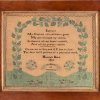
Pages from Mary Yelloly's manuscript "A Picture History of the Grenville Family" of 1825-29 in which we see, at left, the "Pleasant Farm residence
" of a Mr. Melville, with whom the Grenvilles are staying, and in the two illustrations on the right-hand page, Mrs. Grenville's sitting room at Rosedale, where Eleanor and her mother are sorting out clothes for their poor neighbours, and the Rosedale nursery, where Eleanor and her sister Augusta are packing up the fruit they had been given at dessert, but which instead of eating they have decided to give to poor old Mrs. Sandby. |
Life with the Grenvilles"A Picture History of the Grenville Family," a profusely illustrated manuscript that brought $45,430 at Christie's on November 24, 2009, was described by the salesroom as "an extraordinary pictorial record of Regency England, a visual counterpart to the world of Jane Austen's novels," but this charming work, compiled in the years 1825-29, was largely the work of a little girl named Mary. Her mother and her siblings helped out, and some of the captions, introductory pages, indexes, and later annotations regarding the artist responsible for each drawing are in a more mature, cursive hand, but the young lady to whom this delightful invention must really be credited is Mary Yelloly, the daughter of a Norfolk doctor. In a little over 200 pages that contain no fewer than 257 drawings in watercolour, Mary documents the life of the imaginary Grenvilles, their children (who increase in number as the narrative progresses), and their governess. Mary's story takes them from the fashionable and modern Rosedale House in Gloucestershire, and Woodlands Hall, to the inheritance of the even grander residence, Bellemere Park in Cumberland. Many of the watercolours show daily routinethe children are seen playing shuttlecock, practicing their dancing, writing to their cousins, visiting in the neighbourhood, running local errands, and of course tending to the sick and the poor. Eleanor Grenville even buys meat for the poor and cloth for a new dress from her own pocket money. The close attention paid to interior domestic detail, said the Christie's cataloguer, offers a valuable insight into the tastes of the period in matters such as the use of colour, furniture arrangement, picture hanging, window treatments, etc. In young Mary's pictorial history, the Grenvilles take two extended tours. The first sees them travelling from Cornwall to Cumberland, by way of Stonehenge, Arundel Castle, and Carrow Abbey in Norwich (Mary's real-life home), while the second takes in northern England and the Scottish Highlands and Islands, including Holy Island (Lindisfarne), Iona, and Skye. Mary points out that most of these topographical scenes are real, but identifies the few for which she has substituted views closer to home in Norfolk, or in West Sussex, where she perhaps had spent her own holidays. The ninth of ten children, Mary Yelloly was just eight years old when she began the story of the Grenvilles-the same age as the eldest Grenville daughter-but her own life was cut cruelly short. Mary died of consumption at 21.
The Cameo Sale of the Century?What promises to be the antiquity sale of the decade, perhaps of the century, was tentatively announced by Bonhams in London in October 2009, and Richard Falkiner, a Bonhams consultant and old friend of mine whose expertise on such things is, I know, valued by museums and auction houses alike, has described it as "the greatest classical find since the Portland Vase." In fact, it is, like that famous treasure of the British Museum, another brilliantly executed cameo glass vase and one that could even be the work of the same craftsman. Made at some time between the late 1st century B.C. and the 1st century A.D., it is one of a small and precious surviving group of luxury items that were produced by the Roman empire's finest craftsmen for only the most distinguished Roman families. Carved from two layers of glasscobalt blue and, above that, whitethe cameo decoration on this newly identified vase includes some 30 figures and a battle scene in the lower register. The Portland Vase, the most famous example of Roman cameo work in the world, has only seven figures and at 9 7/16" high is over 28% shorter than the 13 3/16" high example unveiled by Bonhams. Academically and artistically it is priceless, and what it could make at auction is the stuff that dreams are made on, but for the moment Bonhams, in conjunction with leading experts in the field and the owner, are carrying out detailed research into the historical background and more recent provenance of this wonderful vase. First publicly shown at a conference of the world's leading glass experts held in Thessaloniki, Greece last September, it was greeted then with great excitement. We must now wait to see how excited the commercial art market gets if the vase does indeed come to sale this year or next.

An exhibition standard Steinway upright piano, first owned by H.R. Halsey, sheriff of Suffolk County, Long Island, New York, sold for $63,745. |
Don't Shoot the PianistIt's the Sheriff's Piano!According to the Steinway archives, this extraordinarily ornate piano, an instrument the makers designated a "style three" upright, was completed and sold on the very same day. That day was October 8, 1875, and the eager buyer was Henry Halsey of 22 West 53rd Street, New York City, the sheriff of Suffolk County, Long Island, New York. Henry Steinway had set up his first small workshop in New York City in the early 1850's, in Varick Street, but by the time this very grand upright was made, the company was producing exhibition standard instruments and in 1876 won top honours at the Philadelphia Centennial Exhibition. The ormolu-mounted and parcel-gilt rosewood, tulipwood, sycamore, ebony, ebonised, and marquetry cabinetwork for this exhibition standard piano is the work of the prominent New York City cabinetmaker Edward W. Hutchings of lower Broadway, while the painted porcelain plaques were produced by A. Deligny. In a Bonhams New Bond Street sale of November 25, 2009, Sheriff Halsey's exhibition standard piano was sold for $63,745.
Eagle-eyed ArmchairsThis striking pair of gilt-gesso armchairs, the arms terminating in eagles' heads, were most likely part of a celebrated suite of furniture commissioned from James Moore by James Brydges, 1st Duke of Chandos-for either Cannons, his Edgeware (Middlesex) home, or his central London residence in St. James's Square. The suite, which included chairs for the chapel at Cannons and the "best bedchamber" and the dressing room at St. James's Square, was ordered at the time of his elevation to the dukedom in 1719. In 1747, however, a ten-day sale of furnishings and works of art from the duke's estate witnessed the dispersal of the suite, and though this pair of chairs, bearing a "C" for Chandos cypher, cannot be positively identified from a 1725 inventory of Cannons (now in the Huntington Library in San Marino, California), they bear a striking resemblance to those chairs whose whereabouts are known-those at Houghton Hall in Norfolk, for example. At Sotheby's on November 18, 2009, this pair sold for $181,355.
Nightcaps, Posh Togs, and Driving Gloves
The 17th-century gentleman's nightcap at left sold for $35,424 at Christie's South Kensington, and at right is a close-up detail of the stitched and sequinned decoration of the lady's cap sold by Bonhams Knowle for $30,875. 
Ice blue is this season's hue. A French robe volante, or flying gown, of the 1730's that sold for $70,097 at Christie's South Kensington. 
Not really this correspondent's style-I suit shambling better than sharp-but in a Christie's South Kensington fashion sale of December 3, this gentleman's French banyan of 1818-20 brought a bid of $66,097. 
Designed circa 1925 by Coco Chanel, the lady's leather motoring gauntlets and matching scarf sold for $14,586 at Christie's South Kensington. |
His and her nightcaps kick off this little fashion supplement; one of them is from a Christie's South Kensington sale of December 3, 2009, the other, part of another specialist costume and textiles sale held November 30 by Bonhams in one of their provincial salesrooms. To find two very fine examples of 17th-century embroidered nightcaps coming up for sale within days of each other is in itself quite something, but the fact both have the county of Leicestershire as their source and long-standing provenance is an even more unlikely coincidence. The example offered as part of the sale held by Bonhams in their Knowle (West Midlands) salesrooms was part of a small group of 17th-century and later embroideries that can be traced back through the female line of the same Leicestershire family to at least 1755, when it was owned by a Maude Morris. A fine lady's needlework cap worked in floral and fruit designs in vivid shades of silk thread to a cream linen ground, the Knowle cap is decorated with metal scrolling, chain-interlocking stitches, and sequins. It also features some intriguing purple stitching to a flower head at the neckthe colour purple being reserved for members of the royal family or high ranking courtiers under sumptuary laws of the timelaws that placed restrictions on official expenditure. It sold for $30,875. I am not sure on what basis the distinction is made, or how one knows whether it was a fashionable wig or lady's hairpiece that was removed before its owner pulled on the comforting, heat retaining nightcap and slipped under the covers, but the nightcap sold by Christie's was designated a man's garment. Finely embroidered to the linen ground with gold thread curling stems and embroidered with carnations, bunches of grapes, thistles, roses, pansies, irises, and strawberries, this nightcap features a type of embroidery well known in paintings and portraits of the late 16th and early 17th century. It was one of a small group of lots that came to auction from Stanford Hall in Leicestershire, one of whose former owners, Sir Thomas Cave, was a staunch supporter of Charles I during the English Civil War period and helped defend the manor house and church against the Parliamentarian army at the time of the battle of Naseby. This cap sold for $35,424. The poshest frock seen in the London sale was a stunning French robe volante of ice blue silk damask, dating from the 1730's. The lace pattern damask fabric is woven with flowers and foliage among lace ribbons, and the garment has three-tiered cuffs, is closed from the waist, lined with blue silk, and has deep pleats that fall from the shoulders and the nape of the neck. The robe volante was loved not just by the ladies, but by painters as well, for it allowed both to show off large areas of patterned silkand allowed artists a chance to show off their technique. This robe volante brought the sale's top bid of $70,097. And now something for the dedicated followers of fashion among the chaps. Dating from 1818-20, a gentleman's French banyan of toile de Nantes could have been yours for a mere $66,097. Double-breasted with a stand-up collar and deep flap pockets at the hip, it is printed with a design, "Le Départ de la Garnison: Les Français Garnison" (garnison being garrison, as you probably guessed), and was the creation of a Monsieur Jamet. The banyan, I understood to be a loose fitting, informal garment of Asiatic inspiration, usually worn at home, but this one looks exceptionally well tailored and fit to grace almost any occasion. But then, as my children and my more forthright friends would enthusiastically agree, sartorial elegance and your correspondent are perfect strangers. The Christie's South Kensington sale was called "Fashion through the Ages," so I should in all fairness include something of more recent vintage in this selection. My choice is a colourful pair of motoring gauntlets with matching leather scarf, designed circa 1925 by the legendary Coco Chanel. The cuffs of the gauntletssize 7, as you askare trimmed with bands of blue, navy, and cream suede, and the scarf is similarly worked with chevrons of blue and cream kid. Both are stamped with the name of the designer, and these chic driving accessories sold for $14,586.
Grotesqueries and DrolleriesA move to the medieval world now and a selection of pieces from the Richard Wiseman collection of medieval carvings, sold in 33 lots at Sotheby's on December 8, 2009. Depicting demons, men, women, and fantastic beasts, these carvings, grotesques, and gargoyles were made to adorn churches, castles, and civic buildings in the medieval period. The masons who produced such carvings took their inspiration from medieval bestiaries, from stories in the Bible, and from pagan folklore. While some were intended to terrify, to frighten the onlooker into adopting better ways, others are comic and were meant to amuse and entertain. 
A 12th-century English sandstone corbel carved with a Sheela-na-Gig, a female figure displaying an exaggerated vulva, sold for $22,825. They are found all over Britain, but the greatest number of such carvings is to be found in Ireland, hence the name, but things are seldom so simple. It appears that "gig" was also a northern English word for female genitals. | 
One of a group of four sandstone grotesques of English origin and dating from the 13th or early 14th century that sold for $26,975. Together with this figure pulling wide its gaping mouth are others (not pictured) showing a toothy demon, a stylised dog, and a stylised cat. Those mysterious figures shrouded in foliage, the ever-present Green Man carvings have been linked to the cycle of growth or rebirth and are essentially pagan but are frequently found on ecclesiastical architecture. This corbel carved with a Green Man figure is a 14th-century English example which, lotted with a 12th-century English Green Man and a French example in 15th-century style, sold for $20,750. | Straight from the Hunchback of Notre Dame, this winged goat is indeed a French limestone carving of the 14th or early 15th century. It sold for $29,050. |

This 13½" silver basket by Paul de Lamerie was a gift on the occasion of the marriage in London in 1734 of William IV, Prince of Orange, and Anne, the Princess Royal (eldest daughter of George II). At Sotheby's on December 8 it sold for $350,675. 
A "Jolly Boat" wine trolley, sold at Bonhams on November 25 for $20,915. 
Each just over 8" diameter and bearing London hallmarks for the years 1600-02, this pair of silver plates or dishes with distinctive raised central bosses are part of the famous "Armada Service," most of which is now in the British Museum. They sold for $267,800 in a Lawrences of Crewkerne (Somerset) sale of October 15. 
A Victorian novelty silver tea service on the kettledrum theme, sold for $41,830 at Bonhams on November 25. |
Silver: Historic, Royal, and CuriousTwo dishes from a famous Elizabethan silver dinner service, familiarly known as the "Armada Service," appeared in an October 15, 2009, sale held by West Country auctioneers Lawrences of Crewkerne. The service was commissioned by and bears the engraved arms of Sir Christopher Harris (1553-1625), a West Country landowner, local member of parliament, and Admiralty official, who was a close friend of that most famous of seagoing Devonians, Sir Francis Drake, and was appointed Commissioner of the Booty under Sir Walter Raleigh. Sir Christopher's duties included overseeing the division of plunder taken from Spanish treasure ships, including, in 1592, the vast fortune that filled the holds of the Madre de Dios. The years following the devastating failure of the Spanish Armada probably proved very lucrative. However, Harris family fortunes declined during the English Civil War, and in 1645 royalist forces in Plymouth under the command of Major General John Harris suffered defeat at the hands of Parliamentarian troopers. It may have been at this time that the Harris family silver was hidden in a potato store on a nearby farm, and there it remained, its exact whereabouts apparently forgotten for almost 200 years. Then in 1827, two labourers found the hoard buried beneath an outhouse attached to the property of a Mr. Splat of Brixton, just a few miles down the coast from Plymouth. After some legal discussion and argument, the silver, including 31 large silver dishes, was eventually handed over to Harris family descendants, but when hard times came around once more, 23 of the original 31 dishes were sold at auction in London in 1885. They were bought by a distant family member who was obviously in a better financial situation at the time and who acquired three more of the dishes before, in 1911, he put all 26 dishes up for sale at Christie's. On that occasion the set sold for what would then have been about $45,000a world record for an English silver lotand was bought by the well-known London dealers Crichton Brothers of Old Bond Street. The dishes remained in private hands until 1992, when the British Museum, attracted by the fact that this is the earliest extant hallmarked dinner service, acquired them via private treaty sale from Sir John Crichton-Stuart, 6th Marquess of Bute. It is suggested that the two dishes that came up for sale in Crewkerne, bearing the 1600-02 marks of the London maker who is known only by his monogrammed initials "TE," were among those few dishes retained by the Harris family in the late 19th century, but the vendor told Lawrences that they were purchased by a now deceased member of his family at an estate sale somewhere in the southern states of America. Are there any silver sleuths out there whose memory could be jogged by the accompanying pictures and this tale? Much Elizabethan silver, especially unadorned, functional pieces such as this, would have been melted down during the English Civil War period, making it very rare, but what function did these dishes with their pronounced central bosses serve? One suggestion is that they were used for the display of spiced fruits or some other Tudor delicacy. Both the Victoria and Albert Museum and the British Museum looked at the plates, and the latter, which of course has 23 of them already, suggested that the Exeter Museum would make a good home. On the day, no institutional interest was converted into cash offers, and the dishes were sold to London silver dealer Alastair Dickenson, acting for a client, at $267,800. There is some question also as to the precise purpose of the silver basket pictured above, which could have been used to hold bread or fruit, or might just as well have found employment as a receptacle for a lady's sewing accessories. There is also, in the Netherlands (and perhaps in England as well), a connection between such baskets and the marriage ceremony, and of the group of eight recorded silver basket-weave pattern examples made by the celebrated silversmith Paul de Lamerie, all of which date from the years 1731-33, two are very definitely connected with grand marriages. One of them is now in the Ashmolean Museum in Oxford. The other is the example seen at Sotheby's on December 8 and featured here, which bears the arms of William IV, Prince of Orange and Nassau-Dietz, and Anne, Princess Royal, eldest daughter of King George II of England, who were married in the German chapel at St. James's Palace in London in March 1734. If such baskets were indeed seen as being talismanic or bringers of good fortune as marriage gifts, then Prince William may have picked up on the tradition. At the time of his wedding, a report in The Penny London Post told readers that "
the princess royal found on her toilet [i.e. dressing table], the morning after her nuptials, a fine gold filigree basket, with several flowers in it, under which were a watch and equipage set with diamonds and rubies, to the value of £2000, the same being a present from the prince of Orange." But who might have given the Princess Royal this silver basket? Sir Robert Walpole, Britain's Prime Minister at the time and a man who has been described as Paul de Lamerie's most influential client, is one possibility. Another is the Earl of Chesterfield, who knew the Prince well, had been his ambassador at The Hague, and was another good de Lamerie customer. Sold for $20,915 at Bonhams on November 25 was a two-bottle wine trolley bearing the 1799 maker's mark of London silversmith John Emes. Taking the form of a clinker-built ship's boat on ivory wheels, engraved "The Jolly Boat" to the stern, it may have been inspired by an old Royal Navy tradition. It seems it was the custom at smarter (and landlocked?) naval dining tables in the 18th century to pour one's port from the decanter provided, then return it to its stand and push it along to the next officer. Those more familiar, broad based "ship's decanters" that would not tip over are another thing altogether. It is also said that the saying "to push the boat out," meaning to spend more than one would usually do, or in some circles, simply to buy a round of drinks, has its origins in this old naval custom-as the officer paying for, or supplying the wine had the privilege of starting the jolly boat on its voyage around the table. In the same November sale at Bonhams, a Victorian novelty silver and parcel-gilt tea service, marked for E.C. Brown of London and the year 1867, was sold for $41,830. This time, the kettle, teapot, sugar bowl, and milk jug are all modelled as drums, or to be more precise, kettledrums, and all bar the sugar bowl fitted with grotesque mask-head spouts that have square, bat-like snouts. The smaller pieces are all supported on lion's mask and paw feet, while the kettle stand has an apron formed as a lion's pelt and haunched paw legs. The arms on all the pieces are those of Sir Archibald Kennedy, 2nd Marquess of Alba, who never had much time to enjoy his novelty tea service. Less than three years after taking delivery, he died at his Scottish country home, Culzean Castle, from injuries that he had received whilst out hunting. One of Scotland's older families, tracing their ancestry back to Robert the Bruce, the Kennedy family placed Culzean Castle into the caring hand of the National Trust for Scotland in 1945.
Crayfish and HareTo end this "Letter," a couple of fun ceramic pieces from a Bonhams sale of December 2, 2009. 
When Chelsea porcelain crayfish salts were first made, in the Triangle mark period (1745-49), they were usually left in the white. The model was reissued a few years later, during the Red Anchor period, and though some examples of coloured crayfish salts would appear to be coloured up versions of the earlier white models, this one has the thinner glaze associated with the Red Anchor period and was dated by the salesroom to 1755-56. Just under 5" wide and realistically modelled and coloured, with a large open clamshell forming the salt compartment itself, this was not a perfect example-three back legs and a few feelers having now gone missing, and a few other breaks having been enamelled over during manufacture-but it sold well at $43,825.

Minton maiolica game tureens can be great fun, as witness this "Mad Hatter" example of 1878, attributed to Paul Comola. With the heads of two hares forming the lid handle and the heads of two ducks added as a bonus, this example has been broken and restuck in the past, but again it sold well at $24,900. |
Originally published in the February 2010 issue of Maine Antique Digest. (c) 2009 Maine Antique Digest
Login or Register to post a Comment |