








Daffodils, Lilies, and Pansies Bloom

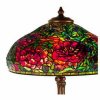
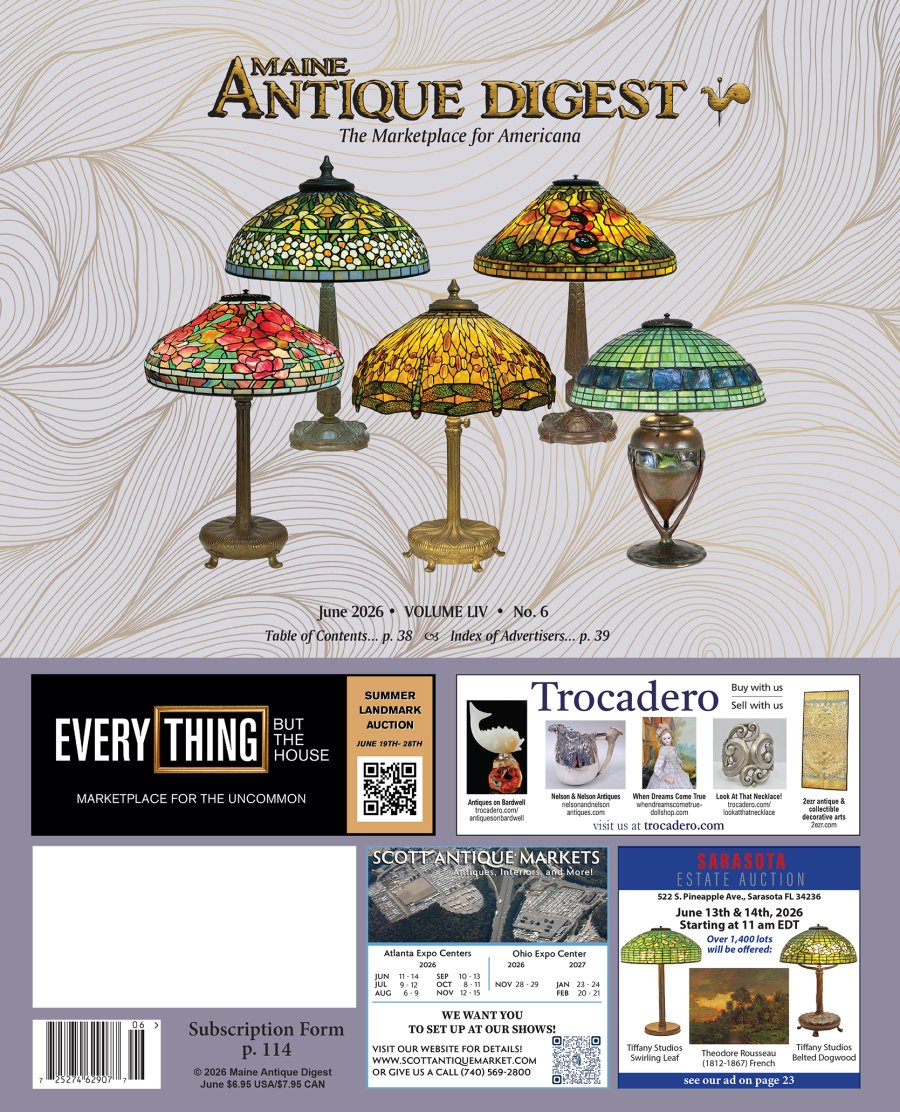
Tiffany Studios Daffodil lamp, $63,250. 
Tiffany Dragonfly lamp in dichroic glass, $40,250. 
Leaded glass window, possibly by LaFarge, the Rudy Brothers, or perhaps another maker, $16,100. |
James D. Julia, Inc., Fairfield, Maine by Mark Sisco Leaded glass lamps led the way at James D. Julia's lamp and glass auction on November 19 and 20, 2009, in Fairfield, Maine. Despite a $1.5 million gross, the results pointed to some weaknesses in the market. All told, about 340 of the roughly 645 lots failed to sell. Of the approximately 45 lamps estimated around $10,000 or higher, with names such as Duffner & Kimberly, Tiffany, and Handel, only about 20 sold. The sale's leader by a wide margin was a Tiffany Studios Daffodil lamp, the shade with downward-hanging daffodils in yellow, bluish purple, and green hued glass with rectangular panels at the edges, on a mock turtleback bronze finish base. Matching hues in the gold finish suggested all parts were original. It was marked "Tiffany Studios New York 1497" on the shade and "Tiffany Studios New York 687" on the base. It was the day's biggest score at $63,250 (includes buyer's premium), just over estimate. Not too close behind it was a Tiffany Dragonfly lamp with a curious and delightful feature. It changed color dramatically when lit. The shade was made of dichroic glass, which has the ability to transmit light of one color and reflect an entirely different color. It had a tucked-under style shade that appeared to be a deep purple or lavender when unlit, but when the chain was pulled, the shade turned amber. The seven big bugs had piercing emerald green eyes, multicolored bodies, and highly detailed veined wings. The shade was signed "Tiffany Studios New York 1562," and the base was marked the same and numbered "333." Despite cracks and hairlines, it drew an impressive $40,250, within estimate and the second-highest price of the day. The only item in the two-day sale to carry a six-figure estimate was another Tiffany Studios Dragonfly table lamp. The shade appeared to be stylistically identical to that of the other Dragonfly lamp, with some subtle differences in the colors of the insects themselves. The base was vertically ribbed, sitting on five ball feet, and the top head cap was replaced. The better condition of the shade, with virtually no evident problems, accounted for the juiced-up $80,000/100,000 estimate. But as is often the case, the high-profile items come with hefty reserves, and the bidding wasn't high enough to reach it. "The one with the lower estimate had two areas with a considerable amount of cracking
and the other one had a library base on five ball feet," Dudley Brown, the head of Julia's lamp and glass division, said later. Another of the best sellers was a table lamp by J. Morgan & Sons of New York. The multicolored pansy flowers that filled the shade were hand painted from the interior, yielding a realistic three-dimensional effect. It stood on a spindly, vine-wrapped trunk ending on a striated base with several leaves lying upon it. Minor hairlines in the shade didn't dampen it too much, and it sold well over the $16,000/ 20,000 estimate for $26,450. An extraordinary leaded glass window with two parrots fluttering around an aquarium bowl with swimming fish and a small crab produced a strong multiple of the estimate. A photocopy of an invoice from 1928 stated that it was purchased from J. Horace Rudy of York, Pennsylvania, and sold to Howard Z. Fisher, a grandfather of the consignor. The letter noted that the window was produced about 30 years earlier with glass made by Louis Heidt and John Dannenhaffer. Heidt and Dannenhaffer (sometimes spelled Dannenhoffer) were contemporaries of Louis Comfort Tiffany. Tiffany had patents on opalescent glass, but Heidt was also one of its primary developers. Through a syndicated newspaper column we located, Frank Maraschiello of Bonhams & Butterfields offered speculation that the window was actually made by Tiffany himself, but that remains unproven. Julia further suggested that the window may have been done by John LaFarge (1835-1910). In addition to being a muralist, decorator, and author, LaFarge also created numerous monumental stained-glass windows and is credited with being yet another innovator with opalescent glass. The large (26" x 45") opus shattered the $3000/5000 estimate and settled in at $16,100. Dudley Brown discredited the Tiffany notion, adding, "To my knowledge, Heidt and Dannenhoffer didn't make windows, but Tiffany bought glass from them." He further suggested another possible maker, the Rudy Brothers of the Pittsburgh area. For more information, call (207) 453-7125 or visit (www.juliaauctions.com). Originally published in the March 2010 issue of Maine Antique Digest. (c) 2009 Maine Antique Digest
Login or Register to post a Comment |