











The Winter Antiques Show, 2010

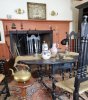
Patrick Bell and Edwin Hild of Olde Hope Antiques, Solebury, Pennsylvania, asked $95,000 for the white, black, and gold painted fireboard (on the wall at left) from a house in Long Island, New York. The painted chest below is from Kentucky, 1820-40, 30¼" x 57½" x 20", and $110,000; it sold. The Federal clock from Maine, painted blue, was $65,000. The pair of portraits (far left) of the Sherman children by Jane Anthony Davis was $85,000. The Mahantongo chest of drawers (right) in bright orange-red, once owned by H.F. du Pont and from the Dittmar collection, was $175,000. The portrait of a girl over it by William Matthew Prior, signed and dated 1848, was $65,000. It sold. The orange of her blouse picked up the color of the orange-red chest. On the far back wall the pediment carved with owls and acorns was $65,000 and sold. The portrait of a Massachusetts doctor by John Brewster was $128,000. The 12-sided drop-leaf table with 19th-century red paint over earlier red paint and forged iron butterfly hinges, 1740-60, was $65,000. It came from the Topping Tavern in Vermont, a private museum, and there is not another like it. The Rhode Island Windsor chair was $35,000. It is green over a gray primer. Olde Hope Antiques photo. 
Morning Star Gallery, Santa Fe, New Mexico, asked $295,000 for the womans embroidered manta, Acoma, New Mexico, mid-19th century, that was a real show-stopper. The dovetailed chest, New Mexico, was $40,000; the pair of New Mexico side chairs, $3000. 
Lori Zabar and Carrie Rebora Barratt signed their new book, American Portrait Miniatures in The Metropolitan Museum of Art, at a champagne reception in Elle Shushans tiny stand that was designed to resemble the Harrison Gray Otis house in Boston. |
New York City by Lita Solis-Cohen The New York Winter Antiques Show, a benefit for East Side House Settlement in the Bronx, is the big fish. Over time it has spawned a school of smaller shows, some striking and elegant, but it has always been in the lead in terms of attendance and sales even when rough waters made it tough swimming. For dealers, a booth at the Winter Show is a goal; when it is achieved, they work hard to live up to the high standards. "We don't take our part in the show lightly," said Fred Giampietro of New Haven, Connecticut. "For the thirty-five years I have been in business, dealers have put aside their best finds for this show; they bring them here in order to jump-start the year. I don't even like to advertise what I will bring. I want everything I show to be one hundred percent fresh, have real punch to it." Giampietro said his business plan worked this year. "After last year when it took me all year to spoon feed the best I could find to my regular customers, this time I brought twenty-five objects and sold fifteen of themtwelve to new customers, people who had never bought from me before. I was happy about that." Stories like this make every major dealer in Americana aspire to a stand at the Winter Antiques Show. But not all Winter Show dealers are that successful, and the cost of doing the show is enormous. Most dealers expect to make back their costs, but that is not always the case, and they say it is the prestige of being at the show that supports their business for the year. In the course of its 56 years the show has become more diverse. This year's show, held January 21-31, offered an encyclopedic range of European, Asian, and tribal art, antiquities, books, autographs, medieval manuscripts, medieval armor, silver, and jewelry, and for the first time it went well beyond Tiffany lamps to include modern design up to 1980. Of the 75 dealers, there were only a dozen dealers in American furniture and folk art, seven with American paintings, two with American prints, and one with American portraits on ivory. That fact makes one forgot that this is the show that inspired Americana Week in New York City, which began with American heritage auctions and was followed by a number of American antiques shows. Now there are so many events that they dilute the impact of the Winter Antiques Show and eat into the time people have to spend there. When people don't have time to look carefully at what is offered they complain that the amount of first-rate Americana at the show has dwindled, and they have to be reminded that there is no other Americana show as vigorously vetted as the Winter Show. Even though Americana has a smaller presence at the Winter Show, the loan show has always featured an American museum. This year, a spectacular exhibition of works of art that reflect the cultural history of New England was put together by Historic New England. It covered every category with masterpieces of furniture, ceramics, glass, textiles, silver, folk art, paintings, and metal, all commemorated in an essay in the show catalog. This year's show will be remembered for New York City photography dealer Hans P. Kraus Jr.'s re-creation of William Henry Fox Talbot's Lacock Abbey, where he exhibited the earliest photographs on paper by the inventor of the medium. It was an exhibit worthy of any museum. People left the show talking about the monumental (6' tall) Tennessee marble vase carved by Paul Manship in 1914 with a Neoclassical frieze of Indians hunting buffalo. Gerald Peters Gallery, New York City and Santa Fe, asked $6 million for it, delivered. A very large Egyptian sarcophagus for a woman, 1090-945 B.C., with the face, black hair, and hands carved in the round, was sold by New York City dealer Alan Safani on opening night. No one will forget Cohen & Cohen's stand. The London dealers in Chinese export porcelain evoked the ambiance of a Chinese palace with a backdrop of orange pagodas in a spacious courtyard populated with porcelain figures and large vessels on pedestals. Not every dealer went to the time and trouble to re-create a Federal house to show off their wares. Elle Shushan of Philadelphia had designer Ralph Harvard of New York City construct a brick house with a classical lunette, all made of scrim, based on the Harrison Gray Otis house in Boston. Inside, a fireplace and faux-painted walls set off a rash of tiny portraits on ivory. Dealer Michele Bieny of New York City set a table with her finest Continental porcelains of the 18th century and installed a mirror to make it look like a very large dinner party illuminated by a Meissen chandelier. Very few stands were jammed with furniture. Olde Hope Antiques, Solebury, Pennsylvania, had a designer choose the right shades of gray and install chair rails and cornices to make their furniture and folk art look as though it was in a comfortable house. Others put decorative art on pedestals in a gallery setting. Donald Ellis's display of American Indian art was striking as usual. Dealers pulled out all the stops, and the word got out. Attendance was up 17% by Thursday, and by Sunday the numbers for 2010 were 20% higher than in 2009, a low year in the show's history. Dealers said there was real interest and excitement about buying again. "I came with no expectations and was pleasantly surprised," said Ellis, who has galleries in Ontario and New York City. Elle Shushan said she sold to new people, old clients, and to several museums. She held a champagne reception and book signing for Carrie Rebora Barratt and Lori Zabar's new book American Portrait Miniatures in The Metropolitan Museum of Art, published around the time of the show. Barratt and Zabar gave a talk before the book signing that was the best attended lecture at the Winter Showever! Although some regular buyers were missed, good weather brought New Yorkers out on both weekends and during the week. The last Sunday of the show traditionally has been a time when deals are made, although dealers will tell you that the business generated at the show goes on all year, and it often takes months for a sale to gel. More furniture than art objects and paintings was left behind this year. Some of the treasures pictured here are still available. For more information, go to (www.winterantiquesshow.com). Originally published in the April 2010 issue of Maine Antique Digest. (c) 2009 Maine Antique Digest
Login or Register to post a Comment |