|
Miami presentation pipe, the curly maple stem with German silver mismatched to a catlinite pipe decorated with bands of concentric circles and inscribed "Nov. 20 1819" and "Hery Dubois," late 18th to early 19th century, 26" long overall, pipe stem broken and reglued and missing a few pieces of silver inlay, $23,500.
San Ildefonso blackware bowl with gunmetal finish by Maria Martinez (1887-1980) and Popovi Da (1922-1971), decorated with repeating feathers, signed and dated 1966, 2¾" high x 12" diameter, $6463.
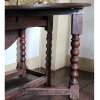
Painted wood drop-leaf table with sand-painting motif to the top and two ladder-back chairs with woven rope seats, from the Shiprock Trading Post, 1930's, $1800 the set.
Santa Clara redware jar by Margaret Tafoya (1904-2001), decorated with a single bear-paw impression, signed, mid-20th century, 9½" high x 9½" diameter, excellent condition, $7050. |
Cowan's Auctions, Cincinnati, Ohio
by Don Johnson
Photos courtesy Cowan's
It's proof that there's more to this stuff than numbers. For the October 5, 2012, auction of American Indian art conducted by Cowan's Auctions in Cincinnati, Ohio, the figures came down to this. Approximately 370 lots grossed more than $450,000, but that wasn't the whole story.
There was no runaway bidding during the day. "Overall, I thought the sale was OK," said Danica Farnand, director of Cowan's American Indian and Western art department. "It wasn't one of our best auctions."
Yet there was something special. Offered 19 lots from the end of the sale was a Miami pipe said to have a connection to the 1795 Treaty of Greenville. The top lot of the day, the pipe realized $23,500 (including buyer's premium), selling to the Eiteljorg Museum of American Indians and Western Art in Indianapolis, Indiana.
The pipe consisted of a mismatched bowl and stem. The catlinite bowl was decorated with bands of concentric circles, and inscribed around the opening where the bowl joins the stem was "Nov. 20 1819" and "Hery Dubois." The undersized stem was curly maple with engraved bands of German silver and diamond-shaped inlay, a brass mouthpiece, and a German silver tip.
James Nottage, the Eiteljorg Museum's chief curatorial officer, was pleased that the institution acquired the pipe, even though the provenance attached to it was questionable. "You can't pin it to the Treaty of Greenville," he said, "but it does represent ideas of Native diplomacy."
As the catalog noted, "The Treaty of Greenville was concluded after several failed attempts by the United States Government to wrest control of the Ohio Country from the Native populations of Miami, Shawnee, and smaller groups. For a sum of $20,000 and other gifts, the Indians ceded a vast tract to the control of the Federal government that included much of Indiana, Ohio, and Illinois. The treaty largely put an end to the war in the Northwest Territory, added Ohio to the Union, and created a clear boundary which separated Indian lands from lands available to white settlers."
Although there are doubts about whether the pipe was actually part of that treaty process, some things are certain. "What we don't question is the style and time period of the pipe. We're really confident it is a Miami pipe," said Nottage.
As such, the pipe fits the museum's objective of educating people about the culture from which it came. "It really relates to a long-term strategy at the museum," Nottage explained. "We realized a number of years ago that we looked pretty deeply at Native American cultures of North America without giving attention to the peoples of Indiana."
The museum has concentrated energy and floor space to the story of the Miami and other regional tribes. "We look for opportunities to preserve objects from those cultures," Nottage said.
The pipe fits that mission in a unique way. It was collected by Dr. Perry G. Moore of Wabash, Indiana. At one time, Moore also possessed a flag given to the Miami tribe by General Anthony Wayne at the Treaty of Greenville. Now owned by the state of Indiana, that flag is on display at the Eiteljorg Museum.
As for the pipe, the museum is working to make sense out of the inscription and other markings. "It's difficult to decipher," Nottage said. "And, even when you know what it says, so far it hasn't helped us to follow any tracks. That's our first task, really, is to conduct that."
At the very least, the pipe is part of a puzzle. "The important thing that all these objects do is help the public to understand how important the Miami were to the history of this whole region," Nottage explained. "Without the Treaty of Greenville, all that land that became Ohio—at least that process would have taken a lot longer. All these objects are symbols of those events from 1795 and the next couple of generations."
For more information about the auction, contact Cowan's at (513) 871-1670; Web site (www.cowans.com).
Sioux beaded hide shirt with an image of an elk, sinew-sewn, with red cotton trim, integrated triangular bib, and hair drops, early 20th century, $5288. |
Navajo Moki-style weaving, thin bands of bluish purple and black with large diamonds and crosses decorating the field, late 19th century, 83" x 57½", bleeding, broken edge cord, and small hole, $4113. |
|
|
Fetish necklace and earrings by Leekya Deyuse (Zuni, 1889-1966), mid-20th century, one tail chipped, $4500. |
Originally published in the January 2013 issue of Maine Antique Digest. © 2012 Maine Antique Digest