









|
Three phone bidders wanted this Federal carved mahogany high-post bed with feather-carved reeded posts, made in Charleston, South Carolina, circa 1815. It sold for $26,250 (est. $8000/12,000).
Five phone bidders competed for this Tiffany Favrile aquamarine paperweight vase with yellow narcissi with orange and black centers and green stems and leaves. Inscribed “L.C. Tiffany Favrile 5253G,” the 7" high vase sold for $26,250 (est. $10,000/15,000).
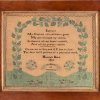
Two phone bidders pushed the price of this 10¼" x 10¼" Perkins family coat of arms to $5000, well past its $1000/1500 estimate.
This upholstered wing chair was cataloged without a date, but apparently someone thought it was 18th century. It sold to a phone bidder for $5313 (est. $1000/2000).
Wig stands or washstands have been hard to sell, but two phone bidders and bidders in the salesroom liked this mahogany one with two drawers and a triangular shelf. It sold for $1500 (est. $300/500).
The highest price paid for any of the 18 portrait miniatures in the sale was $3375 (est. $400/600) for this English portrait of a young child with a dog and a cat. It sold to a phone bidder, underbid by Lynda Cain acting for a client.
A 40" x 49" x 18 3/8" marble-top double washstand, mid 19th century, with an arched backboard and scrolled sides, serpentine front, reeded legs, and tall peg feet, sold for $4063 (est. $500/700) with competition in the room, on the phones, and from an absentee bidder.
This sterling silver Cassini centerpiece, designed by Charles O. Perry (1929-2011) and made by silversmith Ubaldo Vitali (b. 1944) for Tiffany & Co, is 9½" x 9½" and 80 troy ounces. It sold for $22,500 (est. $3000/5000) to an absentee bidder. The sculpture is named after the astronomer Giovanni Domenico Cassini (1625-1712), who believed that a planetary orbit could occur along the intersection of a cylinder with a sphere. Charles Perry, an architect, created a sculpture that comprises six Cassini orbits. There are large-scale Cassini sculptures in Australia, in Moline, Illinois, and in some private collections, and there are just six silver ones.
Staffordshire yellow and blue rainbow spatter teapot, circa 1840, decorated with a thistle on both sides, sold for $4375 (est. $300/500) to a phone bidder with competition in the room, on the phones, and from absentee bidders. |
Freeman’s, Philadelphia, Pennsylvania
Photos courtesy Freeman’s
Freeman’s in Philadelphia offered more than 900 lots in two long days of sales on November 13 and 14, 2012, with mixed results. The marathon ended with a 6 p.m. sale of 27 lots of historic Muhlenberg property that featured the Grand Division colors of the Eighth Virginia Regiment. It was billed as the sale of the last military battle flag carried during the Revolutionary War still in private hands. The now faded and fragile, nearly colorless flag, conserved and framed as a relic, had been passed down in the family of General John Peter Gabriel Muhlenberg, known as the “Fighting Parson” of the American Revolution. A Lutheran minister who became a celebrated general, Peter Muhlenberg was the eldest son of Henry Melchior Muhlenberg, the patriarch of the Lutheran Church in America. The family was celebrated by Lisa Minardi in her book Pastors and Patriots (see M.A.D., March 2012, p. 4-B), and Minardi wrote an introduction to the Freeman’s auction catalog.
The divisional color of the Eighth Virginia Regiment, first organized and commanded by General Peter Muhlenberg, is the oldest-known example of a color for the Virginia line. It was consigned to Freeman’s by Muhlenberg descendants, along with manuscripts and documents. Freeman’s devoted a separate catalog to the consignment and publicized the flag, suggesting a $400,000/600,000 estimate. The buzz was it might go for between $600,000 and $800,000.
In the days before the sale, it was evident that some collectors with deep pockets who had been expected to bid were not interested. The new Museum of the Revolution, planned for Independence Park in Philadelphia, is still on the drawing boards, unfunded. Many people wonder if Philadelphia needs another museum that charges admission when others that do charge are failing. The chatter at the sale was that Colonial Williamsburg would have liked to have had the flag but thought it would go for a lot more and could not think in such big numbers. Some old-time flag collectors came to the sale, some from the Midwest and the West, but they had come to watch. There were fewer than a dozen people in the room who were not Freeman’s staff or Muhlenberg family members. Freeman’s had a large phone bank, but only one bidder bid for the flag. From his center aisle seat on the last row, he used his cell phone to bid.
Beau Freeman opened the bidding at $300,000. Flag historian J. Craig Nannos, consultant for the sale, said he had told Freeman that he would pay that much for it. Kerry-Lee Jeffery, the assistant in the documents department, held a phone to her ear and raised her other hand at $350,000. After a long wait, auctioneer Freeman dropped his gavel, and the flag was sold for $422,500 with the buyer’s premium.
The sale continued with the Muhlenberg family documents, all of which went to the young man in a striped shirt on the center aisle seat on the last row. No longer bidding by phone, he used his paddle, number 499. He battled two phone bidders, one on a phone with David Bloom, who heads Freeman’s book department, and another on the phone with Sam Freeman, who heads Freeman’s trusts and estates department. A Philadelphia bookseller, standing at the back of the room, bid for some of the later lots, but bidder number 499 persevered. He bought every lot, paying over estimates for most of them. His final bill came to $646,063.
Asking for anonymity, the young collector said he collects materials about the Revolutionary War. “I bought the portrait of General Peter Muhlenberg by John Trumbull at Pook and Pook a few years ago. It’s the one that is pictured in the catalog. And I own a Muhlenberg pistol engraved ‘P Muhlenberg.’ I did not think I would have a shot at his flag.”
He said he knew that one of the three battle flags that sold at Sotheby’s on June 14, 2006, was similar to the Muhlenberg flag, and the three, sold as one lot, had brought $5,056,000. (At the same sale an American battle flag with 12 red and white stripes sold for a record $12,336,000. See M.A.D., September 2006, page 46-B.)
The collector said he wanted the first few lots of manuscripts, the general’s orders and letters, and the land grant document signed by Franklin for 400 acres of land in Washington County. “I really did not care about the later material, but then I decided I should keep the archive together so I went for all of it,” he said. “I have no idea what is in all the letters—one lot has six hundred letters, another five hundred letters, and another four hundred eighty. I just feel lucky enough to have acquired all of it.” He said that he lends parts of his collection to institutions and hopes to lend the Muhlenberg material.
“I’m grateful that he kept the collection together, and I look forward to working with him on analyzing the contents and then finding the appropriate institutions that want them on loan,” said Lisa Minardi, who is the president of the board of trustees of The Speaker’s House in Trappe, Pennsylvania. Peter Muhlenberg’s brother Frederick was elected the first speaker of the U.S. House of Representatives in 1789, and he lived in that house.
Freeman’s sale of historic Muhlenberg property, which was 100% sold, came after its annual Pennsylvania sale, a six-hour marathon that began at 10 a.m. and ended with a section on books, maps, and manuscripts that began at 3 p.m. Of the 543 lots offered, 437 sold for $547,899; that’s 81% sold by lot. The previous day 356 lots of American furniture folk and decorative arts not made in Pennsylvania crossed the block, and 273 of them sold for $591,232, a 77% sell-through rate by lot. The Muhlenberg property sale brought the total for the 926 lots offered by Freeman’s in three days to $1,785,194.
There were some strong prices, but only a few lots topped estimates. A Tiffany paperweight vase, estimated to sell for $15,000 at most, sold on the phone for $26,250. A Modernist sterling silver Cassini centerpiece, designed by Charles O. Perry and made by Ubaldo Vitali for Tiffany, estimated to sell for $5000 at most, sold for $22,500. According to Freeman’s, it had been purchased at a flea market for $200.
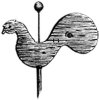
A Massachusetts Federal clock by Calvin Bailey of Hanover, Massachusetts, that brought $20,000 from a woman in the salesroom had been estimated at $30,000/50,000. A cigar-store Indian that sold for $25,600 had been estimated at $30,000/45,000. Except for a Tiffany lamp with an Acorn pattern shade that sold for $8125 (est. $6000/8000) and a full-bodied fox weathervane that made $9375, the remainder of the lots sold for less than $5000 each (most of them less than $3000). If clear pictures of the lots had been projected on a screen during the sale, as they are at most auctions these days, perhaps higher prices would have been paid. The pictures projected were so poor that at times no one could see what was being sold without a catalog. Catalogs were distributed free of charge to anyone attending the sale, however.
Collectors look forward to the yearly sale of Pennsylvania items because there are often historical treasures from local estates. The sale on Wednesday began at 10 a.m. with the collection of Mr. and Mrs. Jay Moyer of Lederach, Montgomery County, who collected household gear from the region where they live. Jay Moyer came to the sale and said he was selling to downsize. “It is time to do estate planning and move to a smaller house, and the children are not interested,” he said.
The Moyers’ rare yellow and blue rainbow spatterware teapot with a thistle painted on each side, estimated to sell for $500 at most, sold on the phone for $4375. Their Schwenkfelder dower chest, inscribed “Lydia Hubnerin” and dated 1832, was hammered down to dealer Steven Still, who paid $9375 (est. $8000/12,000). The fraktur, redware, canes, and quilts brought disappointing prices from on-line and phone bidders and the few bidders in the salesroom.
The Pennsylvania sale produced a few treasures. A terra-cotta medallion by Jean-Baptiste Nini with a profile of Benjamin Franklin without his hat, estimated at $3000/5000, sold for $8125. There were some Colonial portraits of Robert Patterson and his wife. Mrs. Patterson by Charles Willson Peale sold for $8750, well under the $10,000/15,000 estimate, and Robert Patterson by Rembrandt Peale sold 42 lots later for $12,500 (est. $3000/5000). Why weren’t they successive lots?
The portrait of their son, Dr. Robert Maskell Patterson (1787-1854), by Samuel F. DuBois (1808-1889) brought only $1875. A pair of Thomas Sully portraits of Mr. and Mrs. Christian Dannenberg, dated 1815, sold for $9375 (est. $10,000/20,000).
A Gothic Revival side chair, its crest rail pierced with quatrefoils, attributed to Michael Bouvier, estimated at $1500/2500, sold in the salesroom for $10,000 to Peter Tucci, a local collector who has an extensive collection of Joseph Bonaparte’s letters and furnishings from Point Breeze, Bonaparte’s house in Bordentown, New Jersey. A note on the chair’s seat rail reads “Joseph Bonaparte’s 1847 Sale, Point Breeze, Bordentown, NJ Michael Bouvier (1827-1836) 2 chairs Classical, 2 chairs Gothic.” Joseph Bonaparte was Napoleon’s brother.
There were no bids for a Philip Syng Jr. coffeepot (est. $50,000/80,000) and no bids for a William Huston clock (est. $20,000/30,000). A Rhode Island high- post bed, attributed to John Goddard (est. $10,000/15,000), passed for the second time. Freeman’s had originally offered it in April.
One phone bidder, number 1031, bought some choice Philadelphia items. His for $1875 was a satirical print showing a free black woman in her flamboyant dress and bonnet shopping for flesh-colored stockings, according to the inscription, but being offered black ones by the clerk. For $6875, he also purchased the Ode to La Fayette, a framed broadside that had been printed on the printers’ float during the parade for Lafayette in Philadelphia in 1824. For $200, he got a children’s game called History of Philadelphia, 1872, with 60 printed cards in its original box. Two 19th-century watercolors illustrating the yellow fever epidemic in Philadelphia in 1793 cost him $21,250 (est. $300/500).
For more information, contact Freeman’s at (215) 563-9275 or check the Web site (www.freemansauction.com).
|
|
|
|
|
|
|
A 53¼" x 29" x 20" Arts and Crafts oak chest of drawers by Gustav Stickley (1858-1942), Eastwood, New York, sold for $6875 (est. $1500/2500). |
|
|
|
|
|
This manuscript document, signed by Benjamin Franklin (detail shown) as president of the Supreme Executive Council of Pennsylvania, and dated March 6, 1788, is a land patent granting 400 acres in Washington County to Peter Muhlenberg. It sold for $15,000 (est. $5000/8000) to the young Revolutionary War collector, underbid by an absentee bidder. |
After spending several years in Germany for his education, John Peter Gabriel Muhlenberg, known as Peter, returned to America in 1767 and trained for the ministry. In 1771 he accepted a call to lead a ministry in Woodstock, Virginia. Active in Revolutionary War committees, on January 12, 1776, Peter Muhlenberg accepted a commission as a colonel in the Eighth Virginia Regiment and began recruiting troops in the Shenandoah Valley. According to legend (and witnesses), he delivered a rousing sermon in Woodstock. After telling his congregation there is a time for all things—a time to preach and a time to fight—he threw off his clerical robe to reveal his military uniform underneath and began mustering volunteers.
Peter Muhlenberg served with distinction. After defending a British attack on Charleston, South Carolina, he was promoted to brigadier general in 1777. He fought at the battle of the Brandywine, suffered at Valley Forge during the winter of 1777-78, and supported Anthony Wayne’s assault at Stony Point. He was then deployed to Virginia where he commanded a brigade at Yorktown. He was promoted to major general before he retired from the army of 1783.
Following his military service, he became involved in politics. He was elected to the Supreme Executive Council of Pennsylvania and served as its vice president under Benjamin Franklin until 1788 when he was elected to the U.S. House of Representatives. He served as a member of the First, Third, and Sixth Congresses. He was elected to the Senate in 1801 but resigned before serving because Jefferson named him collector of revenues and then customs in Philadelphia. He served in that capacity until his death on October 1, 1807, his 61st birthday. He is buried at Augustus Lutheran Church in Trappe, Pennsylvania, in the town where he was born.
|
|
|
|
|
|
Originally published in the February 2013 issue of Maine Antique Digest. © 2013 Maine Antique Digest