









Fused bars of gold and a gold chain from the Nuestra Señora de Atocha lost in 1622 that was recovered by treasure hunter Mel Fisher sold for $172,500. Sisco photo.
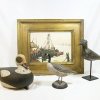
The best-known paintings by William Bradford (1823-1892) are of the Arctic regions of Labrador and Greenland, often painted with dramatic lighting, such as this scene of Henley Harbour, Labrador. The uncharacteristically small (9" x 14") oil on artist board was housed in a deep gilded period frame and sold close to the high estimate at $57,500.
An enormous (32" high) Ottman Bros. & Co. advertising jug, designed as an award for sales agents Warren & Wood, sold with the jug on the left for $103,500.
A large vignette painting on board, romanticizing the life of California Gold Rush-era bandito Joaquin Murrieta, sold for $11,500. Sisco photo.
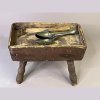
A classic New England double-sided game board, circa 1900, with a richly painted Parcheesi game on one side and a black-and-white checkerboard with a mustard yellow border on the other, crept by minuscule increments well past the $2500/4500 estimate up to $8682.50. |
James D. Julia, Inc., Fairfield, Maine
by Mark Sisco
Photos courtesy James D. Julia
It took four days and two heavy phone-book-size catalogs for James D. Julia to present its end-of-summer sale August 21-24 in Fairfield, Maine. By my count, about 940 out of the roughly 3100 lots didn't find new owners, but what did sell tallied up to just under $4.5 million, making it Julia's biggest summer-closing sale ever.
For the first time since I've been covering the Julia sales, the auction house had a Chinese interpreter on hand to accommodate the non-English-speaking segment among the attending bidders. The Orientalia sections provided some of the best bidding fireworks, as it was liberally peppered with items that blew away their estimates. A Ming Dynasty (1368-1644) ivory seal flashed by its $1500/2000 estimate and sold for a remarkable $47,150 (includes buyer's premium). An ivory carving of a Taoist Immortal figure from the same period brought $24,150 (est. $1000/1500).
The market for antique carved rhinoceros horn libation cups has been noticeably curtailed as recent reinforcement of Chinese laws regarding their sale and ownership has radically inhibited the Chinese buying market. A few did sell successfully here, albeit not for the six figures they might have drawn in the past. A Kangxi period (1662-1722) carved horn cup with prunus branches and carved representations of rocks did well at $34,500. Another, with a carved mountain landscape and pine, prunus, and bamboo branches, fetched $20,125.
Jim Julia elaborated, "The Chinese, back in the eighties, put a law on the books that you weren't supposed to import ivory and this [rhinoceros horn material]. But then they never enforced it In January of this year, there was this huge outcry which means that the Chinese can't buy it, and that's where the market was."
With no shortage of hyperbole, a gargantuan stoneware jug was listed as a "Monumental Presentation American Stoneware Advertising Masterpiece." Fully inscribed in cobalt blue "The Best Stoneware/ In/ The Market/ Warren & Wood/ Agts. For Manufacturers/ Ottman Bros./ & Co./ Fort Edward/ New York," the huge advertising jug stood a full 32" high. Accompanying it was a more normal size jug with an impressed mark for "Haxstun & Co." and cobalt lettering reading "R.B. Haxstun The Just."
The larger jug was presented to Ottman's top dealer, Warren & Wood, and the smaller one, according to family members, was a gift from the Ottmans to their original partner, Andrew Haxstun, when Haxstun sold his share of the business to Ottman Bros. in 1872. The oddly matched pair met expectations (est. $85,000/125,000) and sold for $103,500. A well-known stoneware dealer recalled that it was sold at a Vermont auction about 19 years ago when it was merely an addendum and brought just a small fraction of the amount it sold for here.
A treasure of gold came from the wreck of the Nuestra Señora de Atocha that sank off the Florida Keys in 1622. Over the next few years, the Spaniards salvaged about half of the treasure from the Santa Margarita, which was lost in the same hurricane, but it wasn't until 1969 that treasure hunter Mel Fisher restarted the search for the Atocha. He worked for the next 16 years to recover the treasure.
The artifact offered here consisted of a fused encrustation of three gold bars and a long gold chain, all joined together in an amalgam of coral. The catalog stated that as far as the auctioneers knew this was the only gold cluster from the Atocha to come to market in "as found" condition, just as it was taken from the ocean floor. It came with a Treasure Salvors Inc. certificate of authenticity, "TSI #85A-GB117," indicating that it was listed on the recovery manifest. Consigned by one of the original Mel Fisher investors and weighing in at over 115 troy ounces, it sold for $172,500 (est. $150,000/200,000).
Leading the estimated 750 artworks in the sale was a small oil on canvas by William Bradford showing a dramatic sunset scene in Henley Harbour, Labrador, that finished at $57,500. An Adirondack scene by Jasper Cropsey topped out at $29,900.
Among the more interesting historical items was a large painting on board that displayed a romanticized image of Joaquin Murrieta (c. 1829-1853) that hailed him as the famous "Robin Hood/ [of] El Dorado County." Little is known about the life of Murrieta. Even his place of birth is uncertain. He may have been Chilean or Mexican, or he may have been born in the United States. But as Yogi Berra might have said (but didn't), "and what is known about him isn't true."
Because of a largely inaccurate dime-store novel written about his escapades, Murrieta became known as the Robin Hood of El Dorado during the California Gold Rush. While he was mining in California, supposedly his wife was raped and murdered, and Murrieta was whipped and beaten senseless. But what is more likely, according to a 20th-century biography, is that Murrieta was the leader of a gang of horse thieves and traders who may have murdered as many as 28 Chinese and 13 Americans. He was eventually killed by a company of 20 California rangers, who beheaded him and preserved the severed head in a jar of alcohol as a means of collecting their $1000 bounty, or maybe not.
Even the facts of his death are in dispute. Seventeen people, including a Catholic priest, signed affidavits attesting to the head as Murrieta's. Others claimed that the rangers had bribed the witnesses for their signatures, and years later, even Murrieta's sister, after viewing the pickled head, claimed that it wasn't her brother's. The head was eventually lost in the San Francisco earthquake of 1906.
Murrieta may have been the inspiration for Johnston McCulley's fictional character of Zorro, first appearing in his 1919 story "The Curse of Capistrano." The large (32½" x 65½") painting of Murrieta, with a provenance through the W. Parker Lyon Pony Express Museum, galloped off into the sunset at $11,500.
For more information, call (207) 453-7125 or visit the Web site (www.jamesdjulia.com).
A six-page holograph letter in German signed by composer Richard Wagner (1813-1883) and dated February 5, 1855, in which Wagner discusses several of his works, including Tannhauser, Lohengrin, and The Flying Dutchman. It came with an English translation and several other letters regarding the possible sale of the letter in the 1970's. It brought $12,650 (est. $5000/10,000). |
|
|
|
|
|
|
|
|
|
|