This large E.A. Lanceray (1848-1886) bronze showing the capture of a wild horse was part of a group of decorative arts that attracted international buyers. Sold at $39,440 (est. $10,000/15,000) to a Russian bidder, the composition was the top lot of the June sale. A smaller Lanceray bronze (not shown) of a soldier on horseback brought $8352.
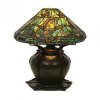
This six-light brass chandelier was trademarked by the Angle Lamp Company of New York. The bidding far exceeded a modest $500/900 estimate to reach a final price of $4872.
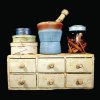
Arie Waldrop Meaders (1897-1989) helped rejuvenate the Georgia pottery industry in the mid-20th century by introducing new designs with decorative appeal. This set of four lidded canisters with grapes in relief sold for $6496.
The most important lot of regional pottery in the June sale more than doubled its $4000/4500 estimate to bring $9512. The stoneware rundlet bore an inscription stating that it had been made by Charles Frederick Decker (1832-1914) at the Keystone Pottery in Washington County in 1897. German-born, Decker had worked in Pennsylvania and Virginia before moving to Tennessee.
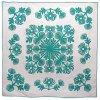
Case had uncovered a cache of coverlets in very good condition that were made at the Maryville Woolen Mill in Blount County, Tennessee. All four surpassed their $500/700 estimates, and this bright red example sold for $2204. |
Case Antiques, Knoxville, Tennessee
by Karla Klein Albertson
Photos courtesy Case Antiques
The June 30 Case Antiques sale in Knoxville, Tennessee, is an excellent example of the regional/national/international balancing act that must be current practice at regional auction houses. For smaller firms that do not offer specialty sales in multiple fields, the rule is, play to your traditional strengths while reaching out to the world.
This reality has even changed the way auctioneers talk about their offerings. They begin by pointing out choice lots featuring regional treasures they obviously love. Then they briskly move on to a discussion of big-ticket items that are attracting interest from abroad.
John Case, a well-known expert in southern pottery, is no exception. Before the sale, he spoke fondly of his favorite things and in most cases was able to predict the regional material that would succeed. For example, there was no doubt in his mind that the top pottery lot would be the stoneware rundlet made by Charles Decker (1832-1914). It was estimated at $4000/4500 and sold for $9512 (includes buyer's premium).
Case noted, "There's another example in the state museum, but it doesn't have as much decoration as this. This particular example has an inscription that reads, 'Aug. 15th, 1897. Made by C.F. Decker Sr. at the Keystone Pottery of Chucky Valley Tenn.' Rundlets are quite a bit rarer than jugs because so many did not survive."
Case also revealed an important textile discovery: a cache of colorful late 19th-century coverlets from a mill in Blount County, south of Knoxville. They featured an identical pattern woven in teal blue, black, red, green, and white, and all were marked "M.W.M. Tenn." Estimated at $500/700 each, the four coverlets brought between $1392 and $2204.
"They were just stacked on the bed, one after another, and had been there for seventy years or more," Case explained. "The quilt on top had been eaten up, but you went down through the layers, and there were these Maryville Woolen Mill coverlets in pretty incredible condition with minimal wear." The moral of the tale is to always look beyond the surface.
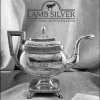
Another regional star was a coin silver julep cup that sold for $2436. It was made by William Henry Calhoun, who worked in Nashville from 1835 until his death in 1865. Vice-president Sarah Campbell Drury, who handles the Nashville end of the Case operation, said after the sale, "Tennessee coin silver flatware is hard to find; hollowware is even scarcer. This piece has the added benefit of the Frazer and Murfree names on the inscription. Murfreesboro, Tennessee, is named for the family."
Drury continued, "Calhoun retailed quite a lot of silver in his later years; he even did business with Andrew Jackson's family. But an early piece of hollowware actually made by him is quite a find. We were thrilled to get it." Drury and Tennessee silver specialist Dr. Benjamin Caldwell are conducting research for a future publication on the silver of President Jackson.
As it turned out, the top-ten list for this sale was almost equally divided between regional offerings and lots that appealed to bidders elsewhere. The top lot-a large Lanceray bronze group-went to a Russian bidder at $39,440. Close behind were two French clocks. A Restoration period gilt and patinated bronze mantel clock depicting Jason capturing the Golden Fleece brought $19,140, and a porcelain mid-19th-century Sèvres-style clock, marked "Cie LeRoy Paris," reached $12,180.
Case is able to maintain a broad range of sales because it has access to a steady stream of consignments with appeal for national and international
buyers. Tennessee collectors of the last two centuries were not cartoon rustics, sitting in rockers drinking homebrew from a jugalthough the rocker and the jug might bring a pretty price. Families traveled widely abroad and brought back fine and decorative arts from Europe, the Middle East, and the Orient. Back home, the 1897 Tennessee Centennial and International Exposition in Nashville featured displays from around the world as well as massive reconstructions of famous monuments, including an accurate copy of the Parthenon, which has survived to the present day.
Drury emphasized the intense interest in the catalog that developed on the LiveAuctioneers site before the sale. Out of the 1850 bidders active in the sale, 1539 were on line. She noted that Case Antiques has become very selective about who is allowed to bid this way. Over 150 people came in out of a terrible Tennessee heat wave to bid on the floor.
"We had eight phone bidders and multiple Internet bids on the top lotthe Lanceray bronzeand the winner was a person bidding by phone from Russia," said Drury. "There were also multiple phone line bids and foreign bidders on other lots, notably the French Jason and the Golden Fleece clock and the smaller Lanceray bronze.

"We also had more bidders signed up from China than from any other country besides the U.S. Chinese silver was super hot, and there was good interest in porcelain. But jade and ivory as categories seem to have cooled off."
The top Asian lot, a pair of Chinese Republic period vases decorated with fishermen, sold near the beginning of the sale for $6960 (est. $700/900).
Drury said in conclusion, "This was not really a sale in which Americana was center stage, but it was our best selection in some time of international decorative arts, and the results showed that our small auction house in Tennessee can successfully compete with anybody else out there because of our emphasis on technology and marketing.
"I'm convinced no one works harder than we do to research, promote, and ultimately sell quality art and antiques under a hundred thousand dollars. John, Wray Williams, and I all had extensive marketing and/or strategic planning experience in our previous careers, so now it is a very intentional part of what we do.
"In advance of every auction, we sit down and map out a marketing campaign that includes print, on-line, and television advertising, social media, and direct contact with core collector groups and individual collectors, dealers, designers, and institutions. We reinvent the recipe every time. It's different for every auction, and at the end of every auction we evaluate how it worked and what we'll do differently next time."


Case Antiques will continue to pursue this successful formula for capturing bidders' attention, while it accepts consignments for the next auction on October 6. For more information, phone Case Antiques in Knoxville at (856) 558-3033 or in Nashville at (615) 812-6096; Web site (www.caseantiques.com). A complete list of auction highlights for past sales may be accessed on the Web site.
|
 |
|
|
|