This Chinese carved jade ruyi scepter sold with its matching hardwood base for the day's top money, $25,300.
A broadside proclaiming President George Washington's 1789 visit to the city of Boston and organizing a parade of artisans and merchants in his honor sold for $2875.
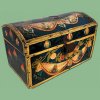
Competition was intense for this compartmented box in curly or tiger maple with alternating bone and dark tropical hardwood inlays. Determined bidders chased it up to $8050. |
J.J. Keating Auctioneers, Kennebunk, Maine
by Mark Sisco
The parade of strong selling Orientalia continued at J.J. Keating Auctioneers in Kennebunk, Maine, on May 19. Before the auction, co-owner Dale Keating commented, "It's really diversified. The scrimshaw is going to do really well. The silver is going to do well...but the antique jade, the Chinese jade, is the hottest thing." He was right on all counts.
Top seller for the day was a rare Chinese carved jade ruyi scepter, a talisman that symbolizes power and good fortune in traditional Chinese culture, sometimes used in Buddhist ceremonies and used in their folk traditions.
This one certainly produced good fortune for the consignor. It started at a mere $1000 and at first seemed destined for oblivion as bidding sluggishly crept along in $200 increments. But two phone bidders chased it all the way to $25,300 (includes buyer's premium). Of dark green jade, it featured a long, curved handle with carving along the full length and had a matching wooden stand. Later in the auction, a two-part carved and reticulated jade urn with an old Sotheby's label attached hit $12,650.
As for the maritime antiques, the scrimshaw sold well. A large whale's tooth embellished with a stylishly dressed young woman, an eagle, and an "E Pluribus Unum" banner brought $8050. That price was matched when a terrific compartmented box inlaid with bone and tropical hardwood hit the same $8050. A double-sided sewing box in wood and whalebone rang in at $6325.
Some items relating to the earliest days of America caught my attention as well. In 1925 Marion Boyd Allen (1862-1941) of Boston, Massachusetts, traveled west at the age of 63 to paint landscapes and Native Americans. So it seems likely that she painted the portrait of Founding Father Robert Morris (1734-1806) some time prior to that.
British-born Morris was a signer of the Declaration of Independence, the United States Constitution, and the Articles of Confederation. He served with the formal title of superintendent of finance during and after the Revolutionary War and as one of Pennsylvania's original senators. He was a brilliant financier but is largely unremembered as a large player in the politics of his time. Some of his land speculation eventually led to bankruptcy, and he spent several years in debtor's prison, where his health deteriorated despite the support of his wife. The large portrait sold for a modest $747.50.
In 1789 the city of Boston was to be favored with a visit from the recently elected President George Washington. A broadside dated October 19, 1789, announced the event. At the time of its publication, Washington had been the president for less than six months, and the city planned to honor him with a parade. "I don't know how many of you were there," Jim Keating joked, "but it was one of the greatest things I've ever been to!"
According to the terms on the broadside, each of the more than 40 trades listed was to have a specific place in the procession. There were blacksmiths, tanners, lawyers, hairdressers, and about 35 others, among which was my personal favorite, "Duck manufacturers." (Honest, folks, that trade is included in the list!) In 18th-century parlance, "duck" was the term that described a type of cotton fabric of various weights and often used in sail making and for bedding material, among other things. The historic broadside sold for $2875.
For more information, call (207) 985-2097 or visit (www.jjkeating.com).
|
|
|
|
|