











|
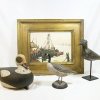
This “humpback” model goldeneye hen with “paddle tail” and turned head by the Ward brothers, in original scratch paint, sold just over low estimate for $80,500 (est. $75,000/95,000) to a private collector from New Jersey. “It had everything you look for in an early Ward brothers working decoy,” remarked one collector.
This early working “dust jacket” style black-bellied plover by Elmer Crowell (1862-1952) sold for $103,500 (est. $110,000/140,000) to a collector in Texas. The 11" long shorebird had excellent original dry paint. As described in the catalog, it had a natural flaw in the wood running from one side of the neck down to the mid primary region and an early thin crack that showed some early filler. There was a small amount of touch-up to the flaw and a small paint flake next to it. The term “dust jacket” originated from the dust jacket of William Mackey’s book American Bird Decoys, which featured three plovers of this style. Crowell’s working shorebirds, roughly from 1900-15, exhibit artistry in their carving and paint that is remarkable and highly prized within the top-end field of decoy collecting. |
Guyette, Schmidt & Deeter, Easton, Maryland
Photos courtesy Guyette, Schmidt & Deeter
Guyette, Schmidt & Deeter’s sale held November 7 and 8, 2012, at the Talbot County Community Center in Easton, Maryland, in conjunction with the Waterfowl Festival, grossed $1,521,008 (including buyers’ premiums). It was a 699-lot sale, capping a year in which the auction company grossed a total of $6,045,778 through four auctions, not including private sales or retail gallery sales.
Thirty-seven of the lots in Easton sold for over $10,000. The highest-selling lot was an Elmer Crowell rare “dust jacket” style black-bellied plover that sold for $103,500 to a private collector in Texas.
According to the auction company, roughly 18 of the “dust jacket” style plovers exist. The term was coined by collectors because three of these Crowell plovers are featured on the dust jacket of William Mackey’s book American Bird Decoys. These early working decoys exhibit exceptional blended paint along with stylized raised wing carvings and dropped tails. This particular example was once owned by James McCleery, who mounted the bird on the rounded base. “They are early gunning birds with a very classic look,” remarked one collector after the sale.
Some extremely rare decoys were sold at this large sale. A “humpback” model goldeneye hen with its head turned 85 degrees and exhibiting a “paddle tail,” also in original scratch paint, sold for $80,500. Made by the Ward brothers of Crisfield, Maryland, the working bird had some shot marks on one side of the head and a thin chip missing from one side of the tail but remained in good overall condition with moderate wear to the scratch-painted surface. One reliable source stated it was last purchased privately for over $100,000. A hollow-carved pintail drake in original paint by early Michigan carver Nate Quillen (1839-1908) sold for $35,650, more than double its high estimate. It came from a well-respected collection.
This was a well-diversified auction with good overall results, even though some areas indicated it is still a buyer’s market.
Upcoming sales include one on February 15 in Charleston, South Carolina, in conjunction with the Southeastern Wildlife Expo; an uncataloged and unreserved sale on March 15 in Westlake, Ohio, in conjunction with the Great Lakes Decoy Association Show; and the annual spring sale in St. Charles, Illinois, scheduled for April 25 and 26 in conjunction with the National Antique Decoy and Sporting Collectibles Show.
For additional information, contact the St. Michaels, Maryland, office at (410) 745-0485 or Web site, (www.guyetteandschmidt.com).
|
|
|
|
|
|
|
|
|
|
|
|
|
|
|
|
|
|
|
|
Originally published in the February 2013 issue of Maine Antique Digest. © 2013 Maine Antique Digest