












|
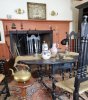
David Petrovsky. Petrovsky uses two-thirds of the depot in Claverack, New York, as his showroom and the rest for storage. Petrovsky attributed this armchair to architect Leopold Eidlitz, who worked on the New York State Capitol in Albany. He says he has seen a line drawing by Eidlitz depicting this chair in the building. It is one of a pair, but he is selling them individually for $7500 each. Petrovsky likes photography and has a lot of it for sale. The large print of the man is of Marcel Breuer and was used in a Museum of Modern Art show of his furniture and interiors. It is $125. Other photos run in the $125 to $250 range. The fan with brass blades is $50. Reverse on glass advertising sign for the Meriden Britannia Co., in its original oak and gilt frame, $1600. Collection of naturally formed canes in old crackled finishes, along with the brass Arts and Crafts holder, $1500. Something you’re not likely to come across every day: a pair of sconces made of old computer panels. They were used at the Limelight night club in New York City. They are $750 for the pair. Ebonized English Regency cabinet with freehand and stenciled tin panels, $1400. Petrovsky said, “It’s in relic condition. I don’t want to restore things anymore. |
In the Trade
by Frank Donegan
David Petrovsky deals in all sorts of stuff. He has a showroom in a quaint train depot in the equally quaint hamlet of Claverack, just east of Hudson, New York, and in it you might find anything from a George I writing table to a piece of contemporary Outsider art.
But Petrovsky is probably best known for his deep knowledge of the various exotic art-furniture styles made in America during the second half of the 19th century. Over the years, he has placed important pieces by makers such as Herter Brothers, Pottier and Stymus, and Associated Artists with museums, top-of-the-line dealers, and the few, but deep-pocketed, collectors who operate in this field.
You don’t see him at a lot of auctions, but when you do, it probably means there’s some serious, obscure object in the sale, and there’s a good chance he is the only guy in the room who knows what it is. “It’s always been an esoteric field,” he said.
People follow many routes to becoming antiques dealers, but in Petrovsky’s case, his career path seems to have been preordained from earliest childhood. He started collecting when he was five years old and was selling by the time he was ten. His earliest purchases were lamps. He said, “I bought electric lamps. I’d nag my mother to take me to white elephant sales and thrift shops. I was a price buyer. My budget was twenty-five to fifty cents.” His father taught him to rewire the lamps. “I brought in a rewired lamp for show-and-tell in kindergarten.”
Why lamps? “I suppose color and form had something to do with it. They had to have some years on them,” Petrovsky explained.
He said his parents weren’t collectors, but “they were responsive to antiques. My father had been an artist at one point in his life.”
Petrovsky began learning the basics of connoisseurship at a tender age. He recalled, “I bought a lampshade. It was green. I said to my mother, ‘I really like that color.’ She said, ‘It’s chartreuse.’”
He also began buying art glass and old phonographs. “I liked mechanical things. I liked to take things apart,” he said, adding, “I would sell so I could buy more.”
Petrovsky was born in Manhattan but grew up in the Westchester town of Yorktown Heights, New York. By the time he started selling, he also had begun working Saturday afternoons for local dealer Bill Hunt. “He was a country dealer who bought mostly out of houses,” Petrovsky said. “He was an old-fashioned dealer of a type that doesn’t exist anymore.”
By his mid-teens, Petrovsky was working for another local dealer, Sy Whittner, who owned Pony Express Antiques in Yorktown Heights, New York. “He had an enormous temper and way more energy than one person should have,” Petrovsky said. “Working for him was the only time I ever worked twenty-four hours straight.”
Along with the antiques shop, Whitt-ner also ran an auction house catering to haulers looking for round oak tables and spindle-back chairs. Petrovsky recalled, “It was a three-ring circus. Everybody was smoking, and the more Sy got people lathered up, the more he liked it.”
Petrovsky, who later would import substantial amounts of Anglo-Indian antiques, learned from Whittner that there is money to be made in the American market by looking overseas for merchandise. He said, “Sy imported schoolhouse clocks from Japan. They had been made by Ansonia and other American makers. He imported them by the hundreds if not thousands.”
His stint at Whittner’s led to working for Mark and Marjorie Allen, who now live in New Hampshire but who then lived in the lower Hudson Valley. Petrov-sky said, “Mark and Marjorie Allen came into Sy’s and asked if he knew anyone to work shows with them.”
Whittner recommended Petrovsky, but he had to pass a test first. Petrovsky said Mark Allen “had this English tea table, and he said to me ‘Which one of these legs has been replaced?’” Petrovsky, not surprisingly, picked the correct leg. Of Mark Allen, he said, “He was the one who taught me to step out and buy better things.” As a result of this experience, “I bought a van and was in business.”
Petrovsky’s first major purchase was an Empire armoire. He said, “I was looking through the local Pennysaver, and there was an ad that said ‘Mahogany armoire with gold decoration. $895.’” It was a classic Meeks-type New York City piece with ebonized columns and gilt-stenciled decoration, located in the Heritage Hills condo community in nearby Somers, New York. He sold the piece to Richard Kelly, the well-known collector of Classical furniture. “That sale carried me through the summer,” he said.
That armoire reminds Petrovsky of another early purchase. He recalled, “Not long after, I went to a benefit auction in Armonk, New York. There was another Meeks armoire.” Unfortunately, it had been nailed together so that it couldn’t be broken down as armoires normally can. Petrovsky bought it anyway, even though he had no tools in his truck. “I took the doors off and kicked the rest of it apart,” he said.
Petrovsky’s first major foray into the exotic styles of the second half of the 19th century involved a pair of Aesthetic Movement inlaid armchairs. “I bought them from Dale Hunt, a Main Line Philadelphia dealer, and sold them to Mimi Findlay,” he said. Findlay was one of the first dealers to bring this material to the attention of major collectors. He said that shortly after this sale, “I got a call from Margot Johnson. She said, ‘I hear you’ve got a pair of chairs.’” Johnson is the other major pioneer dealer in this field. Petrovsky told her the chairs were sold but that he’d be happy to keep her in mind for the future. “That’s how I met both Mimi and Margot,” he said.
It was now time for Petrovsky to become a major player in this esoteric market himself. He did the From Pilgrim to Pop show in New York City and Sanford Smith’s Modernism show. He credits Mark Allen with putting in the good word that got him onto the major show circuit. “That sort of launched me. I had been doing high-end wholesaling.” Until then, the only large show he had done was Brimfield.
The Modernism show played a major part in his business development. Petrovsky said, “I did really well and met a lot of clients. It was an exciting show…and then it wasn’t.” He said he took part in his last Modernism show in 1993. He said Smith “gave me a great booth up front. I had great stuff, and I didn’t sell anything.”
Yet 1993 turned out to be not such a bad year after all. Petrovsky recalled that in that year he sold an extremely important sideboard with glass and jade mosaic panels and carved accent panels by Lockwood de Forest, one of the founders of the brilliant Associated Artists firm that included Louis Comfort Tiffany, Candace Wallace, and Samuel Colman. The sideboard went to the Wolfsonian museum in Miami Beach, Florida.
Petrovsky has had a deep and longstanding interest in de Forest. It began, he said, when he bought a pair of carved wood benches at the Cal Smith auction house in Pleasant Valley, New York, just outside Poughkeepsie.
“I was intrigued by them,” he said. He visited Olana, the elaborately exotic home of artist Frederic Church. “I looked at the mantels and furniture that de Forest did for Church. I said, ‘Those are my benches!’”
He didn’t stop there. He went to extraordinary lengths to learn more about de Forest, a study that eventually led him to India, where de Forest lived and oversaw carvers who produced some of the work that ended up in great American art furniture and in Tiffany’s decorating schemes.
Petrovsky has been single-minded in his pursuit of de Forest material. For example, he tracked down the catalog to a de Forest exhibit mounted in 1970 at the Heckscher Museum of Art in Huntington, New York, on Long Island. The catalog had no pictures, but it did include a list of lenders to the exhibition. He began contacting them and studying their furniture. Over time, he said, “I was able to distinguish between lower-end Anglo-Indian commercial stuff,” and the fine work produced by de Forest.
He went to India in the early 1990’s. “I had some friends in India that I wanted to visit,” he said. While there, he said, “I met somebody who said, ‘I know Umang Hutheesing.’” The Hutheesings are an ancient and distinguished Indian family; Umang is the great-great-grandson of Maganbhai Hutheesing, who co-founded the Ahmedabad Wood Carving Company with de Forest.
Petrovsky fell in love with India and with Anglo-Indian furniture, which often resembles English Regency and William IV furniture, and which employs the best tropical hardwoods such as rosewood, teak, and ebony.
He thought there would be a market for this furniture in the U.S. He said, “I took a few years to source the type of antiques I wanted,” and he was seduced by the subcontinent. Petrovsky said, “I love India. Calcutta is amazing. It’s a crumbling Indian version of Paris. That was fun, fun, fun.”
Petrovsky returned home and opened a shop in Hudson in the mid-1990’s. He began importing Anglo-Indian material. “I’d bring in a couple of containers a year.” That worked out well for a while. He pretty much had a monopoly, until, he said, “A couple of my customers—who shall go nameless—started buying in India.”
He continued to widen his interest in de Forest. He mounted a de Forest exhibition at the Merchant and Ivory Foundation. (The foundation is located nearby in Claverack at the Red Mills, a complex of restored mill buildings on the property of the famous film makers James Ivory and Ismail Merchant [1936-2005]).
Petrovsky noted that the Cooper-Hewitt museum in New York City has scheduled a show on exoticism that will examine the relationship between de Forest and Frederic Church.
Petrovsky said the market for the exotic furnishings of the latter part of the 19th century seems to be holding its own, at least when compared with the Classical and Victorian wares from earlier in the century. The industry, he said, is “still gaining momentum. The market is healthy because it’s so rare, while the market for other nineteenth-century furniture has waned.” He pointed out, however, that there are no new collectors, and the strong market is principally for masterpieces.
Petrovsky remarked, “I’ve been exceedingly careful in my buying.” These days, he doesn’t usually buy unless he has a customer in mind. “I have to know where I’m going to go with it.” The trimming of his inventory, however, has not been as drastic as it may sound. Besides the substantial stock at the depot, he keeps inventory at his home in nearby Churchtown and in three storage units, including one that is temperature controlled for his most serious pieces.
Museum sales have always been part of his business. He said, “Museums are buying very cautiously, but they are buying.” He recently sold a rare 20th-century piece that had been exhibited in Tokyo shortly before World War II to the Brooklyn Museum.
Petrovsky said he sells about half to the trade and half to “a few very loyal and dedicated collectors.”
He closed his Hudson shop in 2001 when business in town virtually collapsed. (As one who had a shop in Hudson at the time, the writer of this piece can testify to how drastic the decline was. When the business was at its most frantic in the late 1990’s, we might have seen 200 people in our shop on a Saturday or Sunday. Post-collapse, we were lucky to see 20, and sometimes the number was two or three.)
Petrosky said, “I had a thirty-five- hundred-square-foot warehouse. I had stuff stacked. Rows and rows. And people would come in and buy a teapot.”
But Petrovsky keeps a close eye on the Hudson market and said it has made quite a comeback. “Hudson’s foot traffic has come back. It’s almost as if people are rediscovering the tactile experience of going into a store.” He sells to Hudson dealers on a regular basis. He said, “I know a few of them are doing exceedingly well. All the viable stores are rented.”
As for himself, Petrovsky said he has no plans to open a retail shop, nor does he have a presence on the Internet. He laughed and said, “I’ve been planning to have a Web site for fifteen years. When I buy something, I light a fire and send out smoke signals. People think I’m retired.”
He’s not retired, of course, but he is thinking about a project that’s tangential to the antiques business. He’s contemplating a film documentary on dealers. “I feel like a dinosaur,” Petrov-sky said, and he thinks he might like to focus on similar dealers before they depart the scene. “I want to make a documentary on dealers, about the obsession with objects that puts people out on the edge.”
He said the project is “unformulated,” but he has lined up a filmmaker and editor with whom he’d like to work. In a sense, the project brings him back to his student days when he spent time at New York University and Purchase College, State University of New York. He majored in filmmaking, animation, and psychology. He said, “I was interested in the subliminal messages in filmmaking.”
As for his current business, he thinks it’s doing OK. “When people come by, they usually buy something,” he said.
Contact David Petrovsky at (518) 851-2854; e-mail <pet601@valstar.net>. By appointment.
Originally published in the February 2013 issue of Maine Antique Digest. © 2013 Maine Antique Digest