


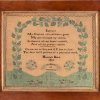










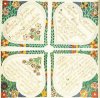




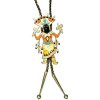
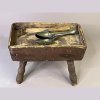
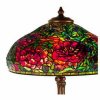
Top lot of the sale was the Shenandoah Valley bookcase on bureau. It sold for $93,600 to a private collector, edging out a southern museum, which had pursued the lot for its permanent collection. Sporting an old untouched surface, the case piece was attributed to the Frye-Martin cabinetmaking school of Winchester, Virginia. Taylor Thistlewaite of Case demonstrated the lot’s neat diminutive proportions. Albertson photo. A brightly colored folk art textile, stitched with hand-dyed and spun wool by Kate Clayton “Granny” Donaldson (1864-1960) of Brasstown, Jackson County, North Carolina, brought $1404 (est. $200/400). The artist is known for her pictorial “cow blankets.” Among the many important document lots in the sale was this 19th-century printed handbill with the text of the “Mecklenburg [N.C.] Declaration of Independence,” purportedly written in 1775, a year before the Declaration of Independence was signed. The item went far beyond its $1000 high estimate to bring $6084. The catalog entry laid out the intriguing history of the legendary declaration.
The harvest jug, which sold for $8190, was made in East Tennessee around 1880. It was decorated with incised slogans promoting local and national candidates. This side reads “For President Gen. James A. Garfield of Ohio.” The reverse reads “For Congress Hon. A. H. Pettibone of Green.” Similar jugs were made by potter Lewis Manning Haun of Greene County, but this is the only example that has retained its handle. Albertson photo. |
Case Antiques, Inc., Knoxville, Tennessee
by Karla Klein Albertson
Photos courtesy Case Antiques
While auctions at Case Antiques, Inc., in Knoxville, Tennessee, offer a diverse mix of antique furniture and decorative arts, serious regional history is always at the heart of these sales. Top lot of the October 6, 2012, auction was a well-documented 18th-century walnut bookcase on bureau with pull-out writing surface, which sold for $93,600 (includes buyer’s premium).
The comprehensive catalog entry attributed the case piece to the Frye-Martin cabinetmaking workshop in Winchester, Virginia, and chronicled its descent in the family, which owned Spangler Hall, also known as Matin Hill, in Strasburg, Shenandoah County. After the auction, John Case, owner and president of the company, said, “I was pleased with the secretary bookcase; I think that’s quite a lot of money for that piece of furniture. It had the potential to do even better, but I think that where it ended up—when I speak to other folks in the trade—was excellent.”
Sarah Campbell Drury, who is vice president of decorative arts for Case Antiques, explained what they hope to achieve with their carefully researched catalog entries. “One of the most gratifying things we do—and one of the things I think we do best in cases like this—is telling the story of the objects people entrust to us and placing them within a larger material history context.
“My favorite item was the group that included the Mecklenburg Declaration. It was like a time capsule, because they had all descended in two families, important not just to North Carolina but to the settlement of Middle Tennessee...from Ephraim Brevard of North Carolina to Richard Alexander, who served in the War of 1812 with Jackson, to the Anderson family, who was important in the medical/Masonic communities of the Sumner/Wilson County area.”
As the long catalog entry explained, printed copies of the Mecklenburg [North Carolina] Declaration of Independence began to appear around 1819, purportedly containing the text of a statement of freedom from British rule made on May 20, 1775, before the formal U.S. Declaration of Independence. The text may be a re-creation of the Mecklenburg Resolves (original now lost) using language borrowed from the 1776 declaration. Historians are divided on the issue, but the 19th-century handbill with the text is a rarity and sold for $6084.
Drury continued, “As little as seven years ago, if you sold something at auction in Tennessee, it crossed a block; at most there was a photo or one line mention in an auction ad; and then it essentially ‘disappeared.’ Now, when an object is sold through us, there is a written and digital record, multiple high resolution photographs (and for documents, often scans), text, historical research, and even measurements. For this consignor, it was important, even though the objects were leaving her family, that they be recorded and hopefully sold to people who understood their significance. And that’s exactly what happened.”
Although collections of documents do not photograph well, this particular Case auction offered several other notable ephemera lots, which were snapped up by collectors and institutions. A Civil War group contained a signed document discussing the treatment of Confederate General P.G.T. Beauregard by Union General Benjamin Butler and a two-volume set of Military Operations of General Beauregardby Alfred Roman, all for $1404.
Another lot was a March 3, 1857, letter of appreciation signed by all seven members of President Franklin Pierce’s cabinet, including future President of the Confederacy Jefferson Davis. It brought $960. Purchased for $2520, a group of early 19th-century military documents, relating specifically to Tennessee, brought together a series of supply requisitions and receipts from the War of 1812.
The most interesting decorative arts offerings in the auction came with a heavy dose of American history. John Case’s first love is regional pottery from the nearby counties of East Tennessee and North Carolina. The top lot in this specialty was listed as a “Presidential Presentation Harvest Jug” and sold for $8190. The campaign vote-getter and souvenir promoted James Garfield for president on one side and A.H. Pettibone for Congress on the other. Both candidates won in 1880, although Garfield would die the following year.
On October 25-27, the Museum of Early Southern Decorative Arts (MESDA) held its 2012 conference in Knoxville at the East Tennessee Historical Society. Most appropriately, Case was called upon to lead one of the “rambles” over the weekend, guiding MESDA members around Knoxville’s important decorative arts collections.
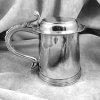
Most curious of the decorative arts in the sale was a two-handled 18th-century English silver cup that had been reworked and repurposed in the 19th century as a presentation piece. Thomas D. Rice (1808-1860) is called the father of the American minstrel show tradition, because of his blackface song-and-dance act featuring himself as a fictitious slave named Jim Crow. The character name became a derogatory term used in the South during decades of segregation, although Rice performed for both white and black audiences in his day. The cup, which brought $3000 in the sale, had been given to the actor during his 1837 tour of England by a group of admirers.
The showrooms of Case Antiques, Inc. are located at 2240 Sutherland Avenue in Knoxville. For more about past and future sales, call (865) 558-3033 or visit (www.caseantiques.com).
|
|
|
|
|
|
|
|
Originally published in the February 2013 issue of Maine Antique Digest. © 2013 Maine Antique Digest