Skinner, Inc., Boston, Massachusetts
by David Hewett
Photos courtesy Skinner
|
The two-sided gold medal presented to President John Quincy Adams at the completion of the Erie Canal in 1826 was the highlight of a 16-lot consignment from descendants of America’s sixth president. Interest in the historic objects was high, and a collector seated in the gallery took the medal for a cool $156,000. He also took a gold and carved hardstone watch fob with a carved profile image of Adams (not shown) for $6600.
One of the two best American Federal dressing chests in existence. That’s what Seymour authority Robert Mussey Jr. said, and the evidence backs up his claim. Made by John and Thomas Seymour in Boston between 1805 and 1810, it was bought by a phone bidder for $312,000.
A memorable 1820-dated needlework picture of George and Martha Washington strolling the grounds of Mount Vernon brought $102,000 from a phone bidder. It is 27¾" x 35½" (sight size) and appeared to be in its original frame. For more details, read the text.
A 24" x 38¼" oil on canvas depiction of The Battle of Trafalgar (not shown) by Thomas Buttersworth did not meet its reserve, but this 12" x 16" oil on canvas Yachting Scene off Sandy Hookby his son, James Edward Buttersworth (1817-1894), brought a strong $90,000 from a phone bidder.\
The 13" x 22½" pro-Union sentiment of cardboard and cut paper with painted shields in the corners, all in a molded wood frame, spells it out on the bottom border: “Death to Traitors Union For All.” The date in the top border is December 25, 1861, so perhaps this was a Christmas present for someone, as nothing of great importance happened on the war front that day. It brought $5100. Gould collection.
These two pieces of cherry furniture came from the Skinners’ collection. The Federal candlestand with drawer, probably of Connecticut River valley origin, brought $4800. The four-drawer chest with overhanging serpentine top, inlaid fan segments in drawer corners, and ogee bracket feet is either from the same area as the candlestand or central Massachusetts. Dealer Bill Samaha took it at $14,400 for a collector who was in the room.
The 2" diameter miniature watercolor under glass portrait of an unidentified man, attributed to New London, Connecticut, and New York City artist Mary Way (1769-1833), brought $6000.
The 6½" high Liverpool creamware jug has a few chips, but historical Staffordshire pottery is very popular and, with that motto, very desirable; it went to a phone bidder at $5700. Although the English creamware mug with the hand-painted village street scene and legend was in worse condition than the jug—its handle was missing—it brought more money, $8400.
This walnut side chair with leather-covered slip seat originated in Boston around 1730-50. Tons of other desirable attributes helped it to bring $31,200 (est. $10,000/15,000), but two other Massachusetts Queen Anne walnut side chairs that followed within minutes of this one failed to break the $1000 mark and were bought in. The key words in a tight furniture market are quality, quality, quality.
Choice mahogany furniture from the New York City shop of Duncan Phyfe did well here. The sofa (above) brought $24,000, and a pair of rare klismos-form side chairs (below) with hairy paw feet brought $27,600.
|
Skinner held its fall Americana sale in Boston, Massachusetts, on October 28, 2012, one day before Hurricane Sandy made its devastating landfall on the East Coast. The firm dodged a bullet with this sale, avoiding by a scant 24 to 30 hours the mess created by the monster weather event that flooded and darkened cities up and down the northeastern coast.
This 2012 event fell eerily on the one-year anniversary of Skinner’s American furniture and decorative arts sale of 2011, which had to be postponed for a week because of a communications blackout that followed Tropical Storm Irene, a massive windstorm that dropped trees and telephone lines throughout Massachusetts and Connecticut.
The only obvious effect of Sandy on the gallery at Boston’s 63 Park Place was a somewhat weakened attendance in the second-floor salesroom, with absentee bids and computer and phone bidding substituting for live bidders’ bottoms on seats.
The prices, however, didn’t suffer any. The full 780-lot sale grossed $1.87 million; “The Patriotic Americana Collection of Marilyn and Michael Gould,” offered in a separate catalog but included in the above total, brought $183,376.
Skinner had some very attractive consignments for its October 28 auction, including a larger than usual group of fine Federal furniture, much of it made by the talented firm of John and Thomas Seymour. (Anyone not familiar with those cabinetmakers and their products should beg, borrow, or buy Robert D. Mussey Jr.’s 2003 book, The Furniture Masterworks of John & Thomas Seymour.) The lead item, also the sale’s highest priced, was a Seymour dressing chest with mirror, a near duplicate of the chest shown on the front cover of the dust jacket on Mussey’s book.
In the catalog essay accompanying Skinner’s dressing chest, Mussey wrote, “Thomas Seymour constantly experimented with both basic form and with all the variations of surface ornament so that rarely are two pieces identical unless made originally as a set.”
The one shown on the cover of Mussey’s book, and pictured again inside on pages 254 and 255 as catalog entry #60, was in 2003 said to be in a private collection. It is not the one that was offered at Skinner.
The question posed by Mussey’s observations about the two chests is left unanswered. Were the two chests ever a pair?
The Boston-made Seymour example offered by Skinner came from the estate of Virginia Couper Johnson, a prominent socialite who died in Delray Beach, Florida, on January 8, 2008. She grew up in Virginia, lived in New York City, had ties to Massachusetts, and was a member of the Daughters of the Cincinnati, The Colonial Dames of America, and The Pilgrim Society of America.
Robert Mussey summed up the Seymour dressing chests with these words: “In the opinion of the author, they are two of the great masterpieces made in Federal era America. Their perfection of proportion is unsurpassed.”
The dressing chest, offered as lot 169, carried a $150,000/200,000 estimate. When it came up for bid at around the noon hour, a bidder in the room chased it for a while, but the phone bidders seemed determined, and one of them finally took the masterpiece for $312,000 (including buyer’s premium).
There was another Seymour-attributed dressing chest with mirror in the Sunday sale, in mahogany and mottled bird’s-eye maple with Sheraton form details, such as segmented groups of large vertical reeds on the turned legs at the sides of the case, then tapered, turned reeded legs descending to turned cuffs above small brass casters. With the exception of having a large oval mirror instead of a rectangular one, this dressing chest followed closely the general form of the chest shown in Mussey’s book as catalog entry #66, including a frame for a bag (as seen in sewing or work stands) hidden in the skirt.
The Skinner example had its mirror supports embellished with paint, tentatively attributed to decorative artist John Penniman, but it also had some obviously rejoined breaks on those mirror supports. It carried a $100,000/150,000 estimate but drew no interest from bidders above the $80,000 reserve bid by auctioneer Stephen Fletcher, and it was bought in.
The 110 lots opening the auction comprised material that had been collected by the firm’s founders, Robert and Nancy Skinner. Robert Skinner died in 1984, and Nancy Skinner is moving to smaller quarters and needed to downsize. (“She will be very happy with the results,” said Skinner president and CEO Karen Keane.) There were some wonderful smalls in those 110 lots, with the result that nearly every one went over its estimate.
Two of the lots consisted of miniature wooden items made by Samuel Hersey and William Tower of Hingham, Massachusetts. Hingham woodenwares have soared in price in the last couple of years, so no one should be terribly surprised to learn that a miniature card table with the paper label of Samuel Hersey (est. $400/600) sold for $8400, or that a miniature center table with the impressed mark of Wm. S. Tower & Co. (est. $400/600) brought $1440.
A make-do mirror—a piece of pine in red paint with a cut-to-shape opening for a mirror fragment—shot to $3360 (est. $400/600). Its price caused Steve Fletcher to offer the wry aside, “If we could only recycle today with such enthusiasm.”
A choice 7" x 9" framed watercolor on velvet depicting a village hillside scene, with cows, a white church with steeple, and a figure seated under a tree by a white house on a hill, was the center of attention for the folk art crowd. Skinner gave it a $400/600 estimate, but Boston collector/dealer Stephen Score, seated front row and center, battled phone and in-house bidders until it was his for $8400. “I just love that little gem,” Score said later. “I wasn’t about to leave without it.”
The 16 lots consigned by descendants of our sixth president, John Quincy Adams (1767-1848), caused several bidding battles, highlighted by a gold Erie Canal completion medal. Examples of the medal were struck in 1826 in a variety of metals, with those in gold restricted to only the most honored recipients, such as living former presidents, the surviving signers of the Declaration of Independence, and family members of Washington and Lafayette. John Quincy Adams, president from 1825 to 1829, attended the ceremony in New York City and received a gold example.
Skinner gave the medal a $30,000/50,000 estimate, but that was nowhere near what was needed to take it home. When all the bid raising was over, the medal sold for $156,000 in the room to a publicity-shy collector, who also paid $6600 for a gold and intaglio-carved hardstone watch fob that reportedly had belonged to Adams.
Gardner, Massachusetts, collector and dealer Rex Stark unsuccessfully battled the collector on those lots, but he did win some Adams items, including a gold and cameo-mounted brooch bearing a bust-length profile portrait of Adams ($12,000), a gold and carved carnelian seal with the Adams crest ($780), plus other jewelry lots associated with Adams.
The estimates were totally blown away with the silk needlework picture depicting George and Martha Washington strolling the grounds of Mount Vernon, with Washington’s African-American valet, Billy Lee, holding the reigns of his horse in the background.
It’s a large work, 27¾" x 35½", set in a black-painted liner within what appeared to be the original gilded frame. Mary W. Innes of Philadelphia made the picture in 1820, and in a Reward of Merit accompanying the fabric picture, she was identified as a student at the writing academy of William Bedlock in 1813.
Like many of this type of needlework pictures, it has a print source, tentatively identified as Mount Vernon, the Seat of the Late General G. Washington by Samuel Seymour after William Russell Birch.
It is an impressive piece of work in wonderful condition, and Skinner estimated it at $20,000/30,000. Absentee bids had been left with the auctioneer, and several phone bidders wanted it, so when it was finally hammered down to one of the latter, the price was $102,000.
There was no lack of bidders for the better furniture lots either, but the trend of middle and lower-end examples bringing bargain prices continues.
The first lot sold after the Bob and Nancy Skinner collection was a fine Boston-made Queen Anne walnut side chair in an older finish, with fully molded edge brackets and C-scrolls on the cabriole legs and a nicely shaped flat stretcher. The choice walnut chair easily surpassed its $10,000/15,000 estimate and brought $31,200.
Two mahogany lots attributed to Duncan Phyfe brought near what Skinner had guessed they would. A Federal sofa with its crest rail carved with cornucopia and swags and with carved and turned open arm supports sold for $24,000; a pair of Classical klismos-form side chairs with reeded stiles and seat sides and legs with carved hairy animal shanks and paw feet sold for $27,600.
A very good pair of Federal card tables with four carved and turned columns supporting the top, above four saber legs with reeded tops and with cast brass paw-topped casters, went to Massachusetts dealer, author, and furniture advisor Clark Pearce for $31,200.
So many objects brought decent prices at this sale, it’s tough to pick out some and ignore others. There were the two silver beakers made by Paul Revere Jr. that had belonged to Massachusetts publisher, printer, Minuteman, and patriot Isaiah Thomas. Portsmouth, New Hampshire, dealer Jonathan Trace picked up those for $8400.
There were the two Liverpool pottery pieces in creamware, each bearing a variation on the popular legend, “Success to the Crooked but interesting Town of Boston.” One, a small (6½" high) handled jug, brought $5700. The other, an almost similarly sized mug, missing its handle but painted with a village scene and the legend “Liberty for Ever,” in addition to the “Success to ye City of Boston” legend, brought $8400.
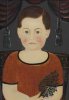
An unsigned 21" x 15¾" portrait of Mary Anne Elizabeth Thum of Philadelphia, age two, facing forward and full length from about her knees to over her bonnet, holding her pet bird, went to a phone bidder at $16,800.
There was a Federal wall mirror from New York, in mahogany and with an églomisé upper tablet and an inlaid oval shell below the gilded swan’s neck pediment. It sold at Sotheby’s in January 2006 for $24,000. It brought $31,200 at Skinner.
One phone bidder took the top-priced weathervane. He (or she) paid $18,000 for the 29½" long molded, flattened full-body copper steer vane by Cushing & White.
|
This circa 1825 tombstone-shaped tin militia hat plate, 9¼" high, was once owned by the specialist dealer Bill Guthman (1924-2005). It sold for $5100, way above the $600/800 estimate. Gould collection. |
Skinner had an abundance of choice material to sell at this Sunday sale, so they halted the regular catalog sale after lot 507 and went to the separate catalog for the Marilyn and Michael Gould collection of patriotic Americana.
Marilyn Gould is no stranger to the antiques dealer world. As director of the Wilton (Connecticut) Historical Society, she organized and ran antiques shows in Wilton for the past several decades.
Her husband, Michael, who died this past July, aided and abetted Marilyn’s very successful shows. Each had their collecting focus. Michael shared an interest in Marilyn’s Americana objects but also focused on post-World War II modern art. She, however, was definitely the Americana fan.
Marilyn Gould has left the historical society, exited the antiques show business, and moved to Florida. We wish her well.
As she wrote in a foreword to the catalog, “I was not able to collect rare and important folk art that would appear in coffee-table books. But I was able to assemble things that as a group told a story about America.”
That material amounted to 211 lots. Nine of those lots sold for over $3000, and the total for all 211 lots was $183,376.
The top-priced lot, a sheet metal Union shield in red, white, and blue paint, surmounted by a molded sheet copper eagle, was 41" high and dated from 1860. It sold for $9600.
For more information, contact Skinner in Boston at (617) 350-5400 or in Marlborough at (508) 970-3000; Web site (www.skinnerinc.com).
Originally published in the January 2013 issue of Maine Antique Digest. © 2013 Maine Antique Digest