Inlaid serpentine-front Hepplewhite sideboard, probably New York, circa 1795, mahogany and pine, with inlay of sawtooth trim, small flowers, and 14 ovals, 41½" high x 75¾" wide, with two short splits on top, several small veneer repairs, and brasses replaced in new holes, $5287.50.
Pie safe in poplar, with diamond-pattern tins, possibly the workshop of George Moyers and David Sears of Grainger County, Tennessee, mid-19th century, cleaned to its original brown paint, 42" high x 54" wide, repairs to hinges and feet, stabilized door, some rodent chew, replaced pulls, $1144.75. This pie safe sold in January 2004 at Brunk Auctions in Asheville, North Carolina, for $2750.
The Prodigal Son Revelling with Harlots, reverse painting on glass, American, circa 1815, after the 1814 print by Amos Doolittle, 15¼" x 11", with some flaking, $587.50.
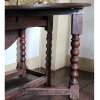
Queen Anne slant-front desk, probably Philadelphia, circa 1760, figured walnut, stepped interior with shell-carved drawers, 43½" high x 39½" wide, older refinish, replaced feet, other imperfections, $9640. |
Garth's Auctions, Delaware, Ohio
by Don Johnson
Photos courtesy Garth's
In the end, it came down to three words: Furniture was strong. That typically means one of two things. Either bidding for everything else was rotten, or something might be stirring in the marketplace.
During the March 31 Americana sale held by Garth's Auctions in Delaware, Ohio, a packed house of enthusiastic bidders suggested a revival within the furniture market.
The full house didn't hurt. "I can't say how pleased I was to walk out to the barn and see it standing room only," said Amelia Jeffers, president of Garth's.
As expected, the March sale was smaller than the January auction, but it still drew a crowd of 300, plus Internet and phone bidders, competing for approximately 525 cataloged lots.
Furniture led the day, claiming six of the sale's eight highest prices, including the top four spots. At the head of the list was a Queen Anne slant-front desk, probably of Philadelphia origin, circa 1760, in figured walnut, that sold for $9640 (includes buyer's premium). The 43½" high x 39½" wide desk had a stepped interior with shell-carved drawers.
"It was a just a good-looking piece," said Jeffers.
Speaking of goodgood forms and good proportions brought good money.
Tiger maple and paint-decorated furniture both do well at Garth's. When something is painted to resemble tiger maple, as was the case with a two-part corner cupboard, it seems a given that buyers will bully each other to take the piece home. That happened with the cupboard, which brought $8225. Another paint-decorated corner cupboard, this one in a faux mahogany surface, probably of Pennsylvania origin, 1800-20, realized $7931.25. Both cupboards sold above estimates, as did a Queen Anne high chest of drawers in maple, New England, 1750-80, at $6932.50.
There were other bright spots in the sale, including clocks. A 52" high Federal-style dwarf clock in mahogany, 1900-30, in the manner of John Bailey of Hanover, Massachusetts, with a rocking-ship dial sold for $6462.50 (est. $2000/4000). The catalog noted, "The dwarf clock was a form popularized in southeastern Massachusetts by the Bailey family of makers in the opening years of the 19th century. This particular clock is an early reproduction and was collected by the current owner's father prior to 1939."
A carved mahogany Empire mantel clock by Asa Munger of Auburn, New York, second quarter of the 19th century, with its original dial and paper retail label, made $1762.50, well above its $300/600 estimate, while a Sheraton tall-case clock in curly maple, 1815-30, with brass works and a phases-of-the-moon dial, realized $4465.
The sale included more than just case pieces and clocks. "It was a pretty wide-variety auction," said Jeffers. "With the American Indian, both contemporary and old stuff, Currier and Ives, furniture, and folk art, if you could get any more diversity in five hundred lots, I don't know what it would have been."
Results for the Indian material were mixed. The best of the prehistoric relics from the collection of Stephen Kelley (1949-2011), author of Adams County, Ohio, Home of Serpent Mound (1978), was a 10½" high pottery effigy bottle with painted designs, Mississippian culture, 1400-1600, found in Center Ridge, Conway County, that sold for $2232.50. More typically, these lots brought three-figure prices, but the vast majority of the pieces were within or above estimates.
"The prehistoric pottery from Stephen Kelley was really all over the board," said Jeffers. "The older pieces with provenance took off. It's a struggle because the reproductions are so good."
Contemporary Indian items consisted largely of artwork. "The modern Indian art came from a Fortune 500 company, and they were more or less just skimming the collection," said Jeffers. "They were moderate examples of those artists. They did OK for what they were."
Among the other smalls, a selection of mocha looked promising, but condition problems kept prices down. One item, however, was notable. An 8" high pitcher with a tobacco-leaf design on a brown ground, English, first quarter of the 19th century, sold for $5287.50.
The volatility of the marketplace could be seen in a pair of American reverse-painting-on-glass images, circa 1815, depicting the Biblical story of the prodigal son. The framed works, each 15¼" x 11", were after prints by Amos Doolittle and estimated at $1000/2000 each. The Prodigal Son Revelling with Harlots sold for $587.50, while The Prodigal Son Reclaimed was passed. In August 2002, the pair sold together for $4600 at Northeast Auctions in Manchester, New Hampshire.
The market continues to adjust elsewhere, with seating making a bit of a rebound but other areas offering reasonable buys. "Chairs seem to be doing OK today," said Jeffers. "If I were to buy something right now it would be rugs and beds."
She noted an increase in buying from both collectors and dealers. "They were all there, all the way to the end," she added.
For more information, phone Garth's at (740) 362-4771 or visit (www.garths.com).
 |
|
|
|
|
|
|