James B. Grievo of Stockton, New Jersey, sold the 18th-century New Hampshire chest-on-frame to a collector. The unsigned tall clock sold to a dealer visiting the show. Grievo said he also sold "many, many smalls. It was one of the best shows I've ever had. I don't think [the distance away from Manchester] stopped anybody."
Matthew Ehresman of Wadsworth, Ohio, had no signage up when we visited his booth before opening, but when we came back some hours later, one sign we saw was a "sold" one on the cupboard.
John H. Rogers of New London, New Hampshire, wanted $3800 for the Ming-era style dining table made of northern elm (yumu) with saber legs and a picture frame molded, wood-grain patterned top. Positioned at the table, the pair of Chinese officials' hat chairs, province unknown, made of southern elm (jumu), was $2995. The cypress side table against the wall was made in Fujian province, said Rogers, who had it marked $4500. The architectural carved cornices were variously priced. A pair in the form of a crane and lotus, made in Zhejiang province of unspecified wood, was priced at $4495.
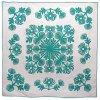
Stephen Score of Boston with his wife, Eleanor. The textile behind them is a 7'2" x 6'7" crocheted tablecloth from the 1920's.
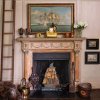
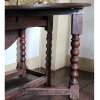
Jacques Lilly of The Red Horse Antiques (on right) is shown with a customer. Lilly and his wife, Sue, asked $2450 for the circa 1820 tavern table in pine with a single-plank top, breadboard ends, one drawer, and early red paint on the base. The 1920-30 mirror above it has an unusual frame wrapped with iron arrows. Its tag read $2300. The circa 1800 English cherrywood dining table with two drawers was $6000.
Michael Rouillard of Quiet Corner Antiques, Sterling, Connecticut, brought a variety of superb bowls, including a late 18th- or early 19th-century trencher chopping bowl in a rare oval form and its original blue paint, $1995; a circa 1780 deep oval ash burl bowl with thin walls and traces of original red paint, $4900; and a 1760-1800 Atlantic white cedar burl bowl attributed to an Abenaki master, $5950.
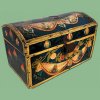
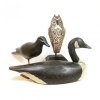
"I sold mostly smalls," said Jane F. Wargo, including "lots of tin," a miniature painted wooden bucket, a mohair bunny, a "Fresh Eggs" trade sign, a large market basket, a hand-carved mallard duck, a nautical diorama, and an early 20th-century dollhouse, pictured in the corner, priced at $425. With metal porch and chamfered door additions, it was handmade for "Bernice," according to a faint inscription. Still available at $2275 was an 18th-century New England child-size pine settle with original painted surface; a mid-19th-century blue-gray painted storage box with original interior dividers, $1675; and a late 19th-century penny rug, $1550. A Connecticut slat-back armchair from the mid- to late 18th century that appeared to have been converted from a rocker was $475. The early 19th-century seven-spindle Windsor fan-back was $1075. |
Concord, New Hampshire
by Jeanne Schinto
How far away is too far from Manchester, New Hampshire? Concord, capital of the "Live Free or Die" state, is apparently close enough. Making the easy 20-minute jaunt north from the old mill city, an unexpectedly huge number of collectors, curators, and dealers from other venues found their way to Frank Gaglio's newly situated Mid-Week Antiques Show on August 8 and 9 at the Douglas N. Everett Arena.
We arrived before the 9 a.m. opening and saw the line circling the building, with the collector-king of cast-iron cookware, Joel Schiff of New York City, near the front. "God's in His heaven/ all's right with the world," Schiff's presence alone seemed to say.
Pat Garthoeffner of Lititz, Pennsylvania, could see the door from her booth. "They just kept coming in and coming in. It was amazing," said the dealer, who, with her husband, Rich, had a "terrific" show. "We didn't know what to expectnew show, new location. We've done [Mid-Week] for so many years, I figured we'd do OK because our customers would find us. But we had no idea we'd see that many people, and the line so long. Robert Snyder and Judy Wilson were set up across from us, and we were all so busy, we didn't talk to each other until the end of the day. It was just constant business, and it was a continuing good show right to the end."
We heard variations on this theme in post-show conversations with a dozen other dealers. E-mails from a half-dozen more echoed them.
Lorraine German of Mad River Antiques, North Granby, Connecticut, wrote that she and her husband, Steven, had "one of the best shows we've ever had. The gate was very strong at opening, and we wrote tickets almost until closing. We sold some very good pieces of stoneware, a child's chair, a collection of important Abraham Lincoln items, a pretty coverlet, and many smalls. We also heard a lot of positive feedback from our customers about how beautiful the show looked and how much they liked the venue because it allowed for wide aisles that didn't make them feel cramped or jostled."
John H. Rogers of Chinese Antique Furniture Shop, New London, New Hampshire, told us he had three points to make. "First, anytime Frank Gaglio operates a show, you're going to know it's a beautifully well-run, extremely well-organized show. Unless you've done operations work yourself, which I have, you have no idea what goes into doing one of those shows, to make it go like clockwork, with no glitches or hitches, no miscalculations or 'Oops!'
"Second, a lot of dealers questioned whether the show, having moved from Manchester, would still attract the people. Any doubters should have been there at opening, when more people flooded into that show than practically all the shows I've done this year, combined.
"Third, there was quality and diversity. And did the diversity work? Absolutely. There were buyers for anything and everything, at the right price."
Jane Langol of Medina, Ohio, declared that for her the show was "excellent." "I was very gratified," she said. "It was very well done. Personally, I loved [former Mid-Week venue] Furniture World because it had indirect lighting and carpeting, and my booth had a curved wall, so it was scrumptious. I could set up a unique booth with that curve."
The new setting is an ice rink that accommodates a traditional grid floor plan. "That worked very well too," said Langol. "Load-in was very convenient. My fear that no one would come was a false fear. We had an outstanding gate."
Jane F. Wargo of Wallingford, Connecticut, was another satisfied dealer. "I thought the gate was unbelievable," she said. "I was surprised because I was worried about people coming to Concord, but they did! It wasn't far at all. The second day's crowd was sparser, naturally, but still I had two sales. Another great thing was that each day there was a farmer's market behind the building, where we'd buy fresh fruit. It was a very pleasant experience, I must say."
We saw for ourselves the masses of people and the buying that took place in the first few hours-and some of that buying included pieces of furniture. David H. Horst of Lebanon, Pennsylvania, sold a paint-decorated stepback cupboard. James B. Grievo of Stockton, New Jersey, sold an 18th-century New Hampshire chest-on-frame to a collector from his home state. He also sold an unsigned tall clock to a dealer visiting the show.
Los Angeles dealer Michael J. Ogle of American Garage, known for unique items of folk, industrial, and rustic art, as well as Americana, sold furniture too. "There were some design teams in there. I know that for a fact because they bought from me," Ogle said.


Stephen Score of Boston, appropriating a quote from the film Field of Dreams, wrote in an e-mail: "'If you build it, they will come.' And they didlots of collectors and dealers we knew and many new faces as well. We sold paintings, folk art, decorative accessories, even a piece of furniture."
Score's analysis continued with praise for Gaglio and his fellow dealers. "Frank did a terrific job of finding a location easy to get to, a cinch to set up in, and with lots of room for booths in a spacious setting. Dealers brought interesting, diverse objects in many collecting fields at price points that were not all geared to the top levelsand that seemed to be a happy range for buyers who came to the show. There was a lot of energyboth during setup and during show hours. The cluster of shows all opening during that week made it quite a spectacular rompa movable feast. If stamina was key, there were many rewards along the way."
Pricing was an issue that many dealers discussed. Some comments seemed prompted by the sundering that took place when more than two dozen former Mid-Week exhibitors left Gaglio and signed on with promoter Karen DiSaia, who this year inaugurated Antiques in Manchester: The Collector's Fair at the JFK Coliseum.
Robert Snyder, who had an "excellent" show in Concord, told M.A.D., "A lot of the public told us that they thought our show was 'buyable.' They thought the new [DiSaia] show looked great too, but that prices there were staggering. I thought prices [in Concord] were great. Some people just don't have forty or fifty or seventy thousand dollars to spend, but they still want to buy something. And I think our show had nice merchandise, and I think people responded by spending some money."
The strain generated by the split was something few people discussed directly. Langol praised Gaglio's "very professional job of handling the transition and of the addition of the new show. At no time did he lose spirit," she said. "I liked his attitude. He forged on. He worked very hard to find a new location, and it paid off." On a personal note, she added, "I do shows by myself. I have no help. And he has been nothing but gracious about helping me with my unique situation. I really appreciate it."
Michael Ogle was more outspoken about the effects of the schism. "I thought it was very difficult that the shows splintered," he said. "It was tough for me as a dealer. I think it shocked everybody. It was difficult for buyers too. I personally know some big, very serious shoppers, who fly in for the shows, who didn't come because they wanted to wait until next year, to see what happened."
On the theme of the new show's prices, Ogle said, "I think they're trying to build a higher-end show, but my personal belief is New Hampshire is not a place to entice a New York crowd. It's not what New Hampshire is all about. It's not what it has been, and I don't think it ever will be.
"A lot of people go up there hoping to get a good deal, find a real treasure. It's not New York, where people know they're going to pay nosebleed prices. All in all, I think New Hampshire Week is an entity unto itself, much like Brimfield and Americana Week in New York. To make one into the other does not work. New Hampshire Week has its own cachet. It's just itself, and that's enough."
Gaglio shared his own ample thoughts on many subjects, but first he wanted to say thanks to "all the collectors and customers and true fans of our Mid-Week and Pickers Market shows. I'm so grateful for their support of our move to Concord. People travel to get to Nan Gurley's fine show [in Deerfield, New Hampshire, which is, like Concord, about 20 miles from Manchester]. They found that coming to ours in Concord was a piece of cake. Next year, being our twentieth anniversary of Mid-Week, I'm going to have something even more special. It remains to be announced, but be assured, it's going to be a celebration."
Five years ago, Mid-Week had 112 exhibitors. The Concord venue holds fewer than half that number. Gaglio was asked if he would keep the show that size. "I love the smaller size," he said. "Of course, it's all relative. Furniture World was so expensive, we had to add additional dealers to make up the financial shortfall. Now we're in a city-owned facility. The price of the building is far less than Furniture World was, so we can meet our budget with fewer dealers."
In fact, the deal he struck was so good, he was able to give every dealer at Mid-Week and Pickers a $125 reduction in booth rent this year. The price of something went down? Truly, a miracle.
The show also was more diverse than in past years, we noted. Previously, the exhibitors were largely folk art dealers, as Gaglio himself once was. "We tried to mix it up," he said. "The days of one folk art dealer after another are done. It's gotten boring. Now it's about design. It's about decorating. Yes, it's also about antiques, but you know what? The focus has changed. We're constantly trying to bring a younger audience into our shows. It's a challenge because most of the people in the line [at opening] are in their fifties or above, but we try to do a little something a little different every year."
To conclude, Gaglio returned to his "gratefulness to the collectors and dealers and friends who came to Concord and supported our shows and really enjoyed themselves. People who didn't even know methey saw my name on my shirtcame up to me with full shopping bags and said, 'Frank, we love it. Don't move. You've got to stay here in Concord.' Who knows? Maybe we can get Concord to be the new center for Antiques Week."
Gaglio is convinced that the crowds were so big because Concord itself came out. "The Concord community is really antiques oriented," he said. "There are a lot of shops, many group shops, and those owners embraced our being there. They put out our show cards and posters. They talked it up. Concord may be twenty minutes from Manchester, but it's a world away from anything negative, that's for sure."
For more information, contact Barn Star Productions at (845) 876-0616 or see the Web site (www.barnstar.com).
|
|
|