




















Greater Boston Antiques Festival: "Surprisingly Not Terrible"
Wilmington, Massachusetts by Jeanne Schinto 
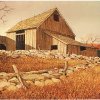
Christopher Scala of Salem, New Hampshire, asked $8500 for the largest painting pictured here, a scene of Maines Monhegan Island in oil on canvas by Stanley Woodward (1890-1970). On the left wall, an oil on canvas of Rockport, Massachusetts, by California artist Nell Walker Warner (1891-1920) was offered at $9000. Seen below the Woodward, the 19th-century lacquer sewing box with ivory fittings inside was $1200. 
The pair of 1930s Arts and Crafts oak chairs (one rocker, one armchair), re-covered in red leatherette, was $500 from Miller-Robinson Antiques, Ashby, Massachusetts. The top of the round oak Arts and Crafts table, marked $395, was fitted with a glass square covering a pattern of leaves and seeds. The painting on the wall, offered at $9995, is a watercolor of a lighthouse at Vinalhaven, Maine, by W. Lester Stevens (1888-1969). 
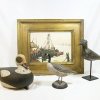
Anne B. Russell of Newburyport, Massachusetts, presented her wares stunningly with dramatic lighting effects. At center, the turn-of-the-20th-century penny rug, backed with a 19th-century ingrain carpet fragment, was $595. At right, the 19th-century spice box in blue paint with hand-labeled compartments, including cinnamon, allspice, ginger, and cloves, was $550. The stone fruits ranged from $30 for the small oranges to $105 for the grapes. 
Michelle Genereux of MG Art & Antiques, East Kingston, New Hampshire, asked $750 for the three-panel hand-painted leather screen; $195 for the lamp with wooden urn-form base; $525 for the santo figure with wolf-like dog; $175 for the 19th-century Sheraton armchair; and $135 for the iron plant stand. The santo, which we took to be Saint Francis of Assisi, sold; so did the lamp. |
Given the unprecedented state of the economy, dealers were unusually anxious as they performed their setup chores and rituals preceding the most recent Greater Boston Antiques Festival, held at the Shriners' Auditorium in Wilmington, Massachusetts, on the weekend of October 18 and 19, 2008. Just before the doors opened, some tallied their preshow dealer-to-dealer sales and noted ominously that numbers were down. Uncharacteristically, one of those worried exhibitors wore a suit, as if dressed for his own funeral, but like premature reports of Mark Twain's death, the fears were exaggerated. Late Sunday afternoon, Susan Mesick of Quirky Antiques, West Brookfield, Massachusetts, neatly summed it up for many of her colleagues when she said, "It was surprisingly not terrible." Mesick was buoyant, even upbeat as she chose this phrase, a mood in sharp contrast to what it had been during Friday's setup. "September Brimfield was a disaster," she had muttered at that point. "I'm looking at the hourly wage at Dunkin' Donuts with renewed interest." Greater Boston. Wilmington. The Shriners' show. This twice-yearly event goes by any or all of those names as well as its official one. Since its founding by promoter Marvin Getman in 2003, it has attracted a following among dealers in the middle- to lower-price range. The vast space, including the lobby, can host approximately 160 exhibitors. Some of them rent walled booths, others merely tables, but all have come to depend on Getman's advertising campaign, waged in print and on upscale radio stations, to draw a significant crowd. This time, Saturday's attendance was 10% lighter than it usually is in October, Getman said, and dealers noticed the change. Admissions on Sunday, however, made up the difference. The result, by Getman's calculations, was nearly the exact same number of attendees as at the 2007 October show. (For various reasons, January's attendance is customarily higher than October's, Getman said.) The promoter, who preferred not to divulge the gate figure this time, believes the second day's increase was the result of a new promotional coupon. It featured a discounted $5 entry redeemable on Sunday only, against Saturday's $8 tariff. (On both days children 16 and under were admitted free; traditionally that age limit at Getman's shows has been 12.) Getman also reported that "eighty or ninety" people used their Saturday tickets to return the following day. "And those people came back because they wanted to buy something. A number of dealers did report to me that Sunday was their better day." Our own survey revealed that while a number of fresh, excellent, and rare pieces sold, others matching the same description did not. The price points of shoppers at every level were far more resolute than in the past, dealers said. Everyone, it seemed, was watching their pennies, and most dealers sounded grateful for any pennies that came their way. "I got the impression that the dealers who had tempered their expectations to the current market conditions were satisfied," said Getman. Paul Greene of Webster-Greene Antiques, Methuen, Massachusetts, said his and partner Denis Webster's results were actually "good." "We were totally surprised," Greene said. "We sold a number of what for us were high-ticket items: a four-thousand-dollar Chippendale-style desk, a Federal mirror, some high-end art glass, some good jewelry. Furniture has been soft; we were especially happy about the furniture sales." Resser-Thorner Antiques, Manchester, New Hampshire, sold 36 items, including a lithograph of Burdett Park in Dover, New Hampshire, and a key to Sarah Bernhardt's coffin. "She used to travel around with it, sleep in it, before her death," said Richard Thorner. The key was accompanied by two letters of provenance and two photographs. The husband-and-wife dealers also sold a Grant Wood print and a double portrait ferrotype of Ulysses S. Grant and his 1868 presidential election opponent Horatio Seymour. Harry W. Hepburn III of Harrison, Maine, sold a fresh diminutive Empire bureau that was gone so fast no photograph was taken of it by this reporter, along with a piece of fine art glass. He also sold children's items, including toys and books. Brett Downer of Downer Art & Antiques, Wayland, Massachusetts, sold a pair of Egyptian Revival stands, a piece of Rookwood pottery, and a Chinese porcelain bowl. He and the third generation of Downer antiques dealers, his adult son, were doing Getman's show for the first time. Christopher Scala's Antiques, Salem, New Hampshire, sold a late 19th-century Asian carved rosewood scroll frame, taller than a door frame, and an Asian ivory figurine. Lillian and Edward Miller of Pioneer Folk Antiques, Ellsworth, Maine, sold an early 20th-century whirligig, a shoeshine box, a painted tole full-form bottle trade sign, and a horse decoration with a double heart made of celluloid and leather. Leslie and Marvin Wies of Baltimore, Maryland, sold "lots of primitives," including a painting, a carnival target, and a "very nice" set of children's blocks, along with other children's toys. "We had a decent show," said Marvin. "I did half of what I did last time, but I'm grateful for that," said Bert Rosengarten of Medfield, Massachusetts. "Things that are well made and well designed sold." Rosengarten added that he knew someone who had bought a sleeper from another dealer that would result in a $2000 profit. "So I know that it still happens. The hunt is still on. The search, the knowledge gathering, will continue." Rosengarten is recognized for his philosophical bent. The downturn is making philosophers of other dealers too. "Business is a process," said Christopher Scala. "You make your own way. It's not like you do one show and then you retire." Uncertain times also foster superstitions. Marvin Wies said he told a Saturday customer in a Boston Red Sox jersey that by buying the pair of $40 antique calipers he was looking at, he would ensure the team's win that evening. He did buy them, and the Sox did win. "He needs to return today and buy something else," Wies said on Sunday morning. The customer didn't return, and the Sox lost. On Monday, Getman was wondering aloud if he had attracted any new people to the show. "I won't know until all my mailing-list slips are put into the computer." Ads on drive-time spots on Boston radio station WBZ are particularly expensive. "I'm a believer in reaching that affluent audience. Is it worth it? At the same time, that's what I promise the dealers who do my shows: that I'm going to push as hard as I can." For more information, contact New England Antique Shows at (781) 862-4039 or see (www.neantiqueshows.com). Originally published in the January 2009 issue of Maine Antique Digest. (c) 2009 Maine Antique Digest
Login or Register to post a Comment |