















The Winter Antiques Show: The Show Must Go On
New York City by Lita Solis-Cohen 
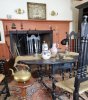
New York City dealer Carswell Rush Berlin said this is the only set of 12 dining chairs he has ever owned. They are closely related to a chair in the Brooklyn Museum and another set in maple, and he believes they were made in Philadelphia. They were $59,000. The dining table, attributed to Phyfe, New York, 1815-20, is the largest single-pedestal table and seats eight or ten comfortably. Measuring 54" x 72", it was $48,000. The china is a dessert and dinner service marked Puchet and D for De Roche, Paris, 1830-34; it was $34,000. The corner cabinet by Emmons & Archibald, Boston, 1820, was $55,000. 
Barbara Israel Garden Antiques, Katonah, New York, sold the recumbent greyhounds, a type not made often in America. The Adonis figure sold on opening night. The terra-cotta frieze was $35,000. Although it was bought in Pennsylvania, it is English. The columns were $25,000 and on hold. The finials were $16,500. The circa 1910 driveway gate, bought in England, was $19,500. Israel created a night scene for her display this year. |
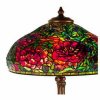
During a week when the economy was shrinking at a faster pace than predicted (layoffs rose, housing starts slowed, and a stimulus bill was stalled in Congress), the annual Winter Antiques Show, the big benefit for the East Side House Settlement in the South Bronx, celebrated its 55th year at the Park Avenue Armory in New York City, January 23-February 1. It started with a festive party where champagne flowed, and loyal supporters were tempted to buy art and antiques offered by 75 dedicated dealers. Those dealers demonstrated that paintings, photography, sculpture, and the whole spectrum of decorative arts, tribal arts, and folk arts are indeed works of art when the quality is high. This year the show extended the cutoff date to 1970. "It expanded the breadth of the show," said dealer Geoffrey Diner of Washington, D.C., who combined Tiffany lamps with tables, a Danish chair from 1934, and a large painting by early 20th-century muralist William de Leftwich Dodge (1867-1935), all tied together by a very long George Nakashima bench from the 1950's. "People who never come to modern shows were exposed to it," said Diner. He sold much of his stand. New York City dealer Leigh Keno changed the name of his business to Leigh Keno Traditional + Modern. He sold an Italian walnut and bronze cabinet made by Fabio de Sanctis and Ugo Sterpini in 1966. Jewelry had always had a 1945 cutoff at the Winter Antiques Show, and with the new 1970 date jewelers expanded their inventory. Those who sold jewelry said sales were OK, not great, but good for these times. They all had to negotiate prices. Sure, the crowds were thinner at the preview, but attendance was good on the first weekend, and people kept coming to shop for the next ten days. Business was done every day. Dealers were willing to deal, but few had lowered prices, saying they expected offers to be made. A few said they were selling on tight margins. Clinton Howell of New York City said prices for English furniture were down 30% from five years ago. British dealers were quick to point out that prices were down 30% this year because of the strong dollar. Peter Finer, arms and armor dealer of London, said exchange rates enabled him to close a deal that began at the Palm Beach show a year ago. He said he sold mostly pistols and rifles and had a good show. Unquestionably, the market is adjusting to a new price structure. There were only a few multimillion-dollar paintings for sale, and not many pieces of furniture or decorations had price tags over $500,000. "I knew it would be a difficult year, so I took a smaller booth and made it look like a living room, not a gallery, and it worked," said Enrique Goytizolo of Georgian Manor Antiques, Fairhaven, Massachusetts. "I made twenty-two sales, furniture and accessories, including a glass berry dish with the Great Seal of the United States to the Corning Museum [of Glass], whose staff was there for the loan exhibition. I believe the dish was from the Roosevelt administration." Goytizolo said the fact that there was a steady stream of people every day who engaged him in conversation shows that there is still serious interest in antiques. "I am dealing with the second and third generation of people who grew up with antiques. This is my thirty-sixth year in business. My clients want to buy genuine antiques, ready to use, that will keep their value, and my prices are affordable. My sales ranged from two thousand to twenty-five thousand dollars." Some dealers in Americana also made multiple sales. Patrick Bell said he and his partner, Edwin Hild, of Olde Hope Antiques, Solebury, Pennsylvania, delivered ten items that were sold the first weekend and sent their truck back to Pennsylvania for more furniture and folk art to offer during the week. Pat Bell said he saw the downturn in the market beginning last April. He sold only one piece in six figures. Jeffrey Tillou of Litchfield, Connecticut, brought a collection of 26 examples of stamp art, pictures made of postage stamps, found by a picker this summer. He illustrated them in a catalog for the show and sold 12 of them for prices ranging from $4500 to $6500. Selling continued until the show was breaking down. Folk art dealer Robert Young of London, England had a very good show even before a client arrived at closing time and made multiple purchases as the show was coming down around her. Thank goodness collecting is a passion, an addiction that is hard to beat. The Winter Antiques Show is more than a high-priced bazaar for luxury goods, and it is more than a grand annual reunion for the antiques crowd. It is a place where knowledge is exchanged. Not only do curators, dealers, and connoisseurs come from around the world, but the vetting process brings out new information. For example, who would think the Shaker tie-dyed silk neckerchief, hemmed in Alfred, Maine, 1840-60, had been woven and dyed in India? Americana dealer David Schorsch, who was asking $18,000 for it, said that according to the books on Shaker textiles, it was probably woven in South Union or Pleasant Hill, Kentucky. He learned, however, that the books are wrong on that point. Textile specialist and show vettor Titi Halle said the cloth had been imported from India. Halle brought to Schorsch a book about tie-dyed Indian fabrics in the collection of the Victoria and Albert Museum, published in 1991. There is a photograph of similar tie-dyed silk on the back cover of the book, and the text points out it is an old technique. Moreover, a kerchief worn by one of the sailors in John Singleton Copley's Watson and the Shark is of the same pattern, pointing to a long tradition. 
Barbara Pollack of Highland Park, Illinois, asked $140,000 for the painted fireboard once owned by Nina Fletcher Little. It came from the John Mosley house in Southbury, Connecticut. Painted in oil on wood, the 24" x 45" fireboard has slots to accommodate andirons. It is illustrated in Little by Little (p. 97) and called by Little a particularly delicate example of painted decoration. The diminutive (67" long) Windsor birdcage settee under it, from Worcester County, Massachusetts, is signed Spooner and Pitts, active in Athol, Massachusetts, 1805-15. The price was $45,000, and it sold. The painted tilt-top candlestand with a shaped top and carved pedestal from New Hampshire or central Massachusetts was $79,500. The candlestand to the right, probably made in Massachusetts, was $32,000. The German glass tulips on it were $3750. |
This sharing of information exemplifies what urban philosopher Jane Jacobs wrote about in her books on social action in cities. She pointed out that the city is not only the trading center for commodities, it is also the place where information is exchanged and where goods and ideas are hybridized. Fresh material at any show is arresting: at Leigh Keno's stand the Dunlap high chest with good proportions, fully developed carving, and a rich old surface; the diminutive birdcage Windsor settee from Worcester County, Massachusetts, signed by its makers, at Barbara Pollack's; the masterpiece Windsor fan-back brace-back chair from David Schorsch and Eileen Smiles; the Pennsylvania dower chest, deemed one of the ten best known, at Fred Giampietro's; the Shaker counter from the Andrews collection, one of the icons of Shaker furniture, at the booth of Courcier and Wilkins; the scrimshaw swift on top of a steeple at Grace and Elliott Snyder's; a group of four China trade paintings that included a record of the landing in Japan of Matthew Perry in 1854, along with three scenes of the south China coast, at Martyn Gregory's. These are just a few examples that stopped the Americana crowd in its tracks. Then there were the Gustav Stickley chandelier and the Frank Lloyd Wright table from the Imperial Hotel in Tokyo at Bernard Goldberg's stand; and the gold chair with orange plush upholstery designed by Louis Comfort Tiffany at the booth of Associated Artists. A pair of Charles Willson Peale portraits-of Christopher Hughes, a Baltimore banker, with a view of Baltimore harbor in the background, and of his wife with one of their five daughters holding her doll-was under a million dollars at Schwarz Gallery, Philadelphia. Those were just two of an impressive group of Colonial and Federal portraits at the show. Another was Charles Peale Polk's portrait of Thomas Jefferson, priced by Sumpter Priddy III of Alexandria, Virginia, at $685,000. There was John Trumbull's portrait of George Washington, painted in 1795, at $3.5 million from Adelson Galleries, New York City. A Gilbert Stuart portrait of Washington at Hirschl & Adler Galleries, New York City, was price upon request. Of course, business was off. Consumer confidence is down. Some who came to the preview walked through the show with blinders, not wanting to be tempted. Not a lot of furniture sold. Only a few paintings found buyers. Alexander Acevedo of Alexander Gallery, New York City, sold an Asher B. Durand Summer Landscape, painted in 1849. Elliott and Grace Snyder of South Egremont, Massachusetts, sold three folk art paintings. Arthur Liverant of Colchester, Connecticut, sold two. Olde Hope Antiques sold two. Peter Tillou, who works with Jeffrey Tillou, sold at least two. Most of them were portraits. Textiles sold well. Carol and Stephen Huber of Old Saybrook, Connecticut, said they had a good show, and so did Titi Halle of Cora Ginsburg, New York City. Halle sold a 19th-century mummer's costume from Yorkshire to a museum, among many other textiles illustrated and described in her annual and educational catalog. James and Nancy Glazer of Bailey Island, Maine, sold miniature redware plates, a collection 20 years in the making, for prices ranging from $7500 to $40,000, and redware figures priced up to $95,000. Elle Shushan of Philadelphia sold a portrait of a baby rajah, painted in Bombay by English artist Edward Nash in 1805. She said she sold 11 miniatures on ivory. Her prices ranged from $1000 to just over $20,000. There was as good a selection of English furniture as in years past, and dealers were willing to deal. "People will kick themselves in five years' time that they did not buy when prices were reasonable," said New York City dealer Clinton Howell, contending that "there were spectacular opportunities to buy furniture in move-in condition for a third less than five years ago." Howell sold a hunt table and a serving table and some smalls, but English furniture has not sold briskly for the past several years. The high-priced decorators who advise their clients to invest in top-of-the-line English furniture are just not as active as they once were. Also, the market is still smarting from the Carlton Hobbs scandal, revealed when Christopher Mason and Christopher Owen wrote in the New York Times (October 2008) that Hobbs was passing off fakes. It is hard to get the message across that if a collector wants something really good, a high-end show is the place to buy it. This year in particular buyers made considered decisions. Some waited until the middle of the week to finally decide to buy something, rationalizing that tangibles may be a better place to park some money than stocks. Antiques are not as liquid though. As one market watcher put it, "Dealers didn't gripe a lot, but there were a lot of sighs." More information about the Winter Antiques Show is available at the Web site (www.winterantiquesshow.com). Originally published in the April 2009 issue of Maine Antique Digest. (c) 2009 Maine Antique Digest
Login or Register to post a Comment |