








Greater Boston Antiques Festival: Nothing Short of Amazing
Wilmington, Massachusetts by Jeanne Schinto 
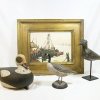
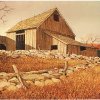
Martin J. Ferrick of Lincolnville, Maine, priced the mahogany Hepplewhite bowfront chest at $2800. The gilt Federal mirror above it was $395. The early country card table in birch with breadboard ends and molded legs was $1250. The painting August Foliage Waban Meadows, oil on board, signed Charles Curtis Allen, was $1450. The early wooden toy cart with original green paint, dovetailed construction, and square nails was $150. 
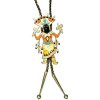
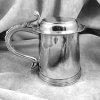
Pat Reese and John Rice of Portsmouth, New Hampshire, asked $225 for the mezzotint of a woodsman with dog (far left). The 1830s American portrait of a woman in oil on canvas was $750. The portrait of Louis XVI in pastel was $300. At top right, a fragment of a Continental (Spanish?) painted wooden cart was $300. The American silver pitcher sold. So did quite a lot of the Native American jewelry in the case on the table. After the show, the walrus tusks sold. 
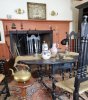
Webster Greene Antiques & Interiors, Methuen, Massachusetts, asked $595 for the 1920s 4' diameter mirror on the back wall. It sold. The dealer-designers also sold the 1940s American Chippendale-style side chair (left). Upholstered in Chinese red, it was priced at $295. The Edwardian-style desk with leather top was $895. The chair pulled up to the desk was $295. |
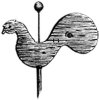
"Amazing!" That was the word many people used to describe their results at the Greater Boston Antiques Festival, held January 17 and 18 at Shriners Auditorium in Wilmington, Massachusetts. Given the terrible oddsfinancial, meteorological, and otherwisemany of the show's 160 dealers clearly had arrived with low expectations. The wind-chill factor made long johns the fashion statement of Friday's setup, with more below-zero cold predicted for the rest of the weekend and a blizzard in the works for Sunday. To make gloomy moods worse, promoter Marvin Getman included in his setup packet a letter containing the news that he had canceled what would have been his third annual Boston Antiques Weekend, scheduled for April. Then, lo and behold, when the doors opened on Saturday, a huge enthusiastic elbow-thrusting crowd rushed in. "It's like Brimfield," said a shopper from Amesbury, Massachusetts. "They're not saying 'Excuse me.'" That's bad for Miss Manners, but not for dealer morale. Roger Pheulpin of Gloucester, Massachusetts, said, "Maybe it has to do with the inauguration." As he spoke, more than a million people were already gathering in Washington, D.C., for Tuesday's historic ceremonies. "There just seems to be some real optimism and some real life to the crowd." Chris and Karen Doscher of Witt's End Antiques, Wallkill, New York, sold a slew of items, including a dramatic 1920's carved wooden eagle in gold gilt and polychrome paint with a Masonic emblem and inscription. More than 8' long, it was carried out of the show within the first 30 minutes. In quick succession they also sold a 1750-60 Hudson Valley cherry tavern table, a circa 1820 tiger maple corner work stand, a 19th-century wooden bowl in original green paint, and a tiger maple tilt-top candlestand. Mindy Schwarz and Scott Smith of High Street Antiques, York, Maine, showing at Wilmington for the first time, sold almost their entire booth full of items in an entirely different style and period from what the Doschers brought. Their display consisted mostly of Continental items meant for either garden or interior: an English cast-iron baker's table, a large group of French turn-of-the-20th-century metal stools, a 1940's French-style settle, a flock of granite birds, granite planters, wooden pillars and columns, and other decorative pieces in shades of white and gray. Lillian and Edward Miller of Pioneer Folk Antiques, Ellsworth, Maine, sold several trade signs, a 19th-century farm table, a pewter cupboard, two dressmaker's forms, a horse windmill weight, a milliner's model, and an oil on canvas painting by a listed artist. "This is a great start to the year," said Ed. Susan Mesick of Quirky Antiques, West Brookfield, Massachusetts, said she did $6000 worth of business in smalls. It's a figure within range of her take at this show in healthier economies. The sales included items at the high end, said Mesick. "There was enthusiasm for big-ticket items, unusual items, and for things that people simply don't need." The normally unflappable dealer seemed genuinely excited-and surprised. "If you took this show out of context, you wouldn't believe there was a recession going on. This is a bankable show." Most other dealers who did well on Saturday were equally surprised. A few were wary. What was the hitch? Surely luck-or whatever it was-would not continue on Sunday. But here's the kicker. Even in the blizzard, people came and shopped and bought. Pat Reese and John Rice of Portsmouth, New Hampshire, sold 42 items on Saturday, then made it to nearly 50 on Sunday. Sales for both days included a silver cross, a snuff bottle, a needle case, a pen wipe in the form of a wild boar, a car clock, two cribbage boards, four paintings, Native American jewelry, an embroidery of fruit, and an Oriental bowl. Bob Frishman of Bell-Time Clocks (this reporter's husband) sold six clocks on Saturday, then sold four more on Sunday, including one of his most expensive clocks, a Vienna regulator. Among his other sales were a Junghans German Westminster-chime bracket clock, a rare Boston Clock Company silver-case carriage clock, an early Chelsea car clock, a New Haven Clock Company eight-day steeple clock, and another New Haven model, a miniature striking banjo clock. Given the snowstorm, many people had expected Getman to close the show early on Sunday. He did not. Instead, before the doors opened he announced over the loudspeaker, "There's somebody waiting out there." When Marcia Sharp of Andover, Massachusetts, dressed in knee-high boots, walked in, she was applauded. She waved, but did not stop to bow. She was on a mission. A regular Bell-Time Clocks customer, as it happens, Sharp had been at the show on Saturday. On Sunday at 5 a.m., she said, she woke up realizing how foolish she had been for passing up a large gingerbread cookie cutter in the booth of Susan Sorrentino of Marblehead, Massachusetts. So Sharp was back, hoping to snag it, which she did. "It's very old and very rare," said Sharp and added, "The tradition goes on." Every Christmas her family makes cookies with an identical cutter. Now they have two. Sorrentino, whose business name is S.B. Adams Antiques, said she noticed other customers of hers being particularly drawn to unusual pieces, ones with personal significance, or in the case of the cookie cutter, both. Along those lines, she sold to a British man a set of six British pewter "pap boats," which are slim bowl-like containers with a long lip used to pour nourishment into the mouths of children and invalids. She also sold a "fabulous" brass footman with an articulated apron to a woman from Dedham, Massachusetts, who came back three times before she finally took out her wallet. Another shopper who braved the Sunday snowfall came in search of buttons. He provided the best sale of the weekend for Michele Piccolo of Dusty's Vintage Linens, Buttons, and Trim. "The gentleman and his wife were here yesterday, and the wife bought some," said Piccolo. "The husband came back in the snow to buy her some more. So it was an early Saint Valentine's Day gift." Yes, this show had it all, even a love story. Button sales in general were brisk. "There was button mania here on Saturdaymy sales were up twenty percent over last January," said Piccolo, who doesn't do the October show. "Very hot were the celluloid buttonsthat's early plastic, even earlier than Bakelitefrom the 1900's through the 1930's. Very popular also were Victorian buttons made of metal. The people who bought were fiber artists and antiques enthusiasts. They are making things to put the buttons on or using them to embellish things they already own." They were, in a word newly in vogue, "repurposing" them, she said. Of course, not every dealer had an extraordinary show. "I was pleased," said a dealer with moderate results. "Sales were decent," said another. "Above my expectations," said a third. Two more reported that their booths had been jammed with lookers on Saturday but that their sales had nonetheless been "slow" on both days. In a conversation after the show, Getman was asked to describe what his own expectations had been. "I went into it very optimistic," he said, "but then there was the weather. No one likes the prediction of a snowstorm, and this one didn't disappoint." Indeed, although Saturday's gate was up by 10% over last January's, Sunday's was down to a third of normal, or about 500. Still, even to have had that many in snow seems, well, amazing, we suggested. He agreed, "And my pre-show joke, about letting only the serious buyers in? Well, that's actually what seems to be what we got." Getman, whom many consider to be one of the best promoters in the business, praised his dealers for "knowing how to keep it together" on that second day in a space that sometimes felt very empty. "They were incredibly understanding and patient," he said. "The weekend was bittersweet for me because of my decision to cancel Boston," Getman continued. "That was weighing heavily on my mind. And then to have such a great weekend-it lifted my spirits, that's for sure. How could I not be pleased? That's my baby, and my baby is alive and well." For more information about the next Greater Boston Antiques Festival on the weekend of October 17 and 18 and other shows produced by Getman, contact New England Antique Shows at (781) 862-4039 or visit (www.NEAntiqueshows.com). Originally published in the April 2009 issue of Maine Antique Digest. (c) 2009 Maine Antique Digest
Login or Register to post a Comment |