










Thomas Drowne Cockerel Leaves Church Steeple for MFA
by Lita Solis-Cohen "You gotta believe. It has to be divine providence," said Raymond Egan, after recounting the story of his discovery of a 1772 weathercock atop a Newbury, Massachusetts, church, where it roosted for 140 years. Its sale to the Museum of Fine Arts, Boston allows a struggling church to keep its doors open and continue its environmental mission. "It was a year ago in March when I was visiting a college friend in Newbury and noticed the gleaming gold weathervane on the dilapidated First Parish Church," Egan began. "I never drive by a church without looking up to see what is on its steeple." Egan collects weathervanes. Once when he knocked on the door of a dilapidated building and asked if he could buy the weathervane on its steeple, it led to a lawsuit because some town residents were so upset to see it go. It was an Indian weathervane on the Grange Hall in Gilbertsville, New York. Egan had a replica of Uncas (named after the character in The Last of the Mohicans) made for the Grange (see M.A.D., February 2004), as he had promised, before the case was dismissed by the New York State Supreme Court. Egan sold all but four of his favorite vanes in 2006 when he downsized and moved from Princeton, New Jersey, to Boothbay, Maine. That has not kept him from looking. When Egan saw the gold cock gleaming against the sky above Newbury, he thought it might be a really old vane. He went back to Maine and wrote a letter to the pastor of the church, the Reverend Nancy Haverington, telling her that the weathervane on the steeple of her church might have significant value, possibly in the six figures. "When the Reverend Nancy Haverington said she would talk to me, I went back and looked at it again and tried to figure out why an eighteenth-century form was on a nineteenth-century church," Egan said. Haverington told him that it was the fifth church building for that parish, founded in 1635, and it was the third perch for this weathercock. It was put up on the building in 1869 when it was built to replace the one across the street that had burned the year before. The old weathercock had survived that fire. Egan went back a third time to look at it with a high-powered telescope and told Haverington that he could not know its value until it was down on the ground. He offered to pay to have it brought down and put back up if it proved to be a reproduction.
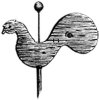
The Reverend Haverington said she called meetings with her small congregation and told them they might be sitting under the answer to the church's financial woes. Egan called dealer Patrick Bell of Olde Hope Antiques in Solebury, Pennsylvania, and called New Hampshire auctioneer Ronald Bourgeault of Northeast Auctions, who had sold the bulk of Ray and Susan Egan's collection in 2006. Egan told them he needed them to establish the value of the vane, if he were to buy it. It is a big vane, 32" tall x 46" long x 7" deep, made of copper and weighted with lead, and has blown-glass eyes. Egan said one of the parishioners helped him solve a high-school geometry problem with a right triangle, and they figured out that the vane was at least 120' in the air. "There was only one crane in Massachusetts that could do the job, and it had never been used before, but it was brought to the church parking lot, and it did the job. When the cock was on the ground, we faced the moment of truth. It was in remarkable condition; its blown-glass eyes were intact. It was probably given a coat of gold paint in the 1970's." What is it worth? Egan said Bell and Bourgeault told him it was worth a lot more than he could afford. "I didn't have the space or the money," Egan confessed. "We all agreed to help the church sell it and have a reproduction made. Ron and Pat thought it should be sold privately, and it should not leave Massachusetts." Pat Bell agreed to act as agent and oversee the making of a replica. Nancy Haverington went to the Peabody Essex Museum archives to look over the church records and found that the cock was placed on the church steeple in 1772, replacing an iron cock "that Colonel Nowes made in his dripping pan" for the first church in 1700. She did not find the name of the maker. The shape is similar to the cock weathervanes made by Shem Drowne and his son Thomas, who worked in 18th-century Boston. The vanes are described by Myrna Kaye in Yankee Weathervanes, published in 1975. Kaye includes black-and-white drawings of several similar gilded copper weathervanes from Massachusetts churches. Bell attributed the Newbury cock to Thomas Drowne, who in 1768 repaired the grasshopper vane his father, Shem Drowne, had made for Faneuil Hall, after it blew down in a storm. The year before, Thomas Drowne had made a rooster for the First Parish Church in Waltham. Kaye noted that Thomas Drowne also made a gilded copper weathercock with glass eyes for the East Meetinghouse in Salem. Bell said it was hard to come up with a value. He looked for comparables. "I know an iron Angel Gabriel made by a blacksmith in New York state sold for around a million [see M.A.D., April 2008], and we know that the six-foot Indian attributed to J.L. Mott sold for $5,840,000 at the Mr. and Mrs. Walter Buhl Ford [II] sale at Sotheby's in 2006 [see M.A.D., November 2006]. But weathercocks are not as rare as Gabriels," Bell volunteered. "There are two weathercocks still on top of churches in the vicinity of the First Parish Church, one in Newbury, one in Rowley. It was not as large as the Indian chief, nor did it have its original surface." Bell came up with a price and offered the vane to the Museum of Fine Arts, Boston. "Gerald Ward, curator of art of the Americas, was really excited about it," said Bell. Ward said that based on comparison to other known examples, he accepted Bell's attribution to Thomas Drowne, and he would do some more digging in the church records and hopes to find the name of the maker. "We do not have another eighteenth-century weathervane in our collection; we have several made a hundred years later," said Ward. "I see several places for it in our new wing-either overlooking a gallery of vernacular art or in a more public space. It will be there for all to see when we open late in 2010." The Boston Globe reported the price the museum paid was $575,000. Neither Bell, Egan, Ward, nor Haverington would confirm it. Ward said funds were raised from private donors, one very large gift and several smaller ones. The Reverend Haverington thinks the MFA is the perfect place for the weathercock. "I was afraid it would be lost in a private collection, and I wanted it to be available to everybody," she said. "It embodies all our values. Not just history but aesthetics. When we became an environmental church in 2006 and started our victory gardens, we linked with the Green Artists League, a group of artist activists, founded by one of our deacons, so that our environmental projects are based on good design." Haverington said there are 40 vegetable gardens on the land behind the church worked by gardeners from four surrounding towns. They have also dug a new 1200-square-foot garden to supply the local soup kitchen this summer that will be tended by volunteers and a youth group. "It is a huge collaboration for the community," she said. "Just as this program was blossoming, our endowment was dwindling, and I worried the church would not make it financially when the stock market took a dive. Then Ray Egan's letter came out of the blue. I was sitting at my desk, with my hands up to my face saying, 'God, what is going on here? This is a church for the community, not for ourselves. How can we run out of money?' I guess that is praying." The reproduction weathercock will be on the steeple of the First Parish Church in Newbury on Easter Sunday. "Because of the miracle of funding, the church will be repaired and an endowment in place," said the Reverend Haverington. "The raising of the crowing chanticleer in time for Easter is the resurrection of our spiritual commitment to our environmental mission as stewards of the earth and spirit." Haverington, who taught ethics as a doctoral candidate at Harvard Divinity School, said she had never before taught environmental ethics until her church became dedicated to caring for nature. "I have sold many weathervanes over the years, but never has a sale been more gratifying," said Patrick Bell. "It was a bittersweet day to see the vane taken off the church, but when the minister explained to me the mission of the church, I was comforted," said Ron Bourgeault. "I could not be happier with the outcome. The weathervane will now be on display at the MFA for everyone from Massachusetts, America, and the world to enjoy. It seems like divine intervention." Originally published in the May 2009 issue of Maine Antique Digest. (c) 2009 Maine Antique Digest
Login or Register to post a Comment |