








A Pair of Crowell Exhibits

A. Elmer Crowell and his son Cleon, standing in the doorway of their East Harwich, Massachusetts, workshop, 1927-30, holding recently completed carvings. Photo courtesy Heritage Museums & Gardens. |
Canton and Sandwich, Massachusetts by Jeanne Schinto It has been a banner year for Massachusetts museum exhibits featuring native son A. Elmer Crowell (1862-1952) of East Harwich, arguably the greatest decoy maker of all time. Two museums mounted significant shows, one of which was extended by popular demand and the other of which remains on view at least through 2010. Mass Audubon's exhibit A. Elmer Crowell: Master of Decoys & More is now closed, but a catalog is in the works. The exhibit included 11 decoys from the famed Harry V. Long collection that experts claim are among the most outstanding objects Crowell ever made. None had ever before been publicly displayed. One of them, a nesting goose with great form, perfect, original paint, and every other attribute on any collector's checklist, had spent the last 50 years on a Long family descendant's highboy. It, along with six of the others, will be sold by Stephen B. O'Brien Jr.'s Copley Fine Art Auctions in Plymouth, Massachusetts, on July 15 and 16. After the exhibit closed, two others, a pair of green-winged teal, were donated to the museum by Long family descendants, who wish to remain anonymous. I visited the exhibit at the Mass Audubon Visual Arts Center when it opened and returned on May 2, close to the end of its nearly eight-month run. What brought me back was an all-day symposium, "Elmer Crowell & Beyond: A Gathering of Collectors & Enthusiasts." On that second visit, I was lucky enough to be taken around by exhibit co-curator Gladys "Gigi" Hopkins, a well-known Crowell scholar and conservator with a studio in Acton, Massachusetts. "Thirty folk art collectors were here yesterday. They got it," said Hopkins, speaking of their appreciation for the decoys' aesthetics. Asked what objects particularly drew the folk art collectors, Hopkins unhesitatingly named the Long collection's nesting goose; another with Long provenance that was destined for the Copley auction, a yellowlegs in a highly unusual calling position; and early Crowell miniatures, some lent by the Peabody Essex Museum (PEM), Salem, Massachusetts, and others by private collectors Tina and Philip DeNormandie. 
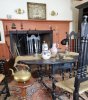
A replica of the Crowell workshop. Photo courtesy Heritage Museums & Gardens. © 2008 Lance Keimig Photographics. 
The Mass Audubon exhibit featured this running curlew by Crowell. It was sold to an anonymous collector on the phone for $186,500 (including buyers premium) by Copley Fine Art Auctions in July 2007. The price remains the record for a decorative shorebird by Crowell and, possibly, any maker. The exhibition signage stated, From the collection of Alexander Figge. Figge is the son of Thomas K. Figge, whose multimillion-dollar decoy collection is renowned. Photo courtesy Copley Fine Art Auctions. 
Joseph H. Ellis, author of the forthcoming Birds in Wood and Paint: American Miniature Bird Carvings and Their Carvers, 1900-1970, and Gigi Hopkins, co-curator (with Brian Cullity) of Mass Audubons exhibit A. Elmer Crowell: Master of Decoys & More. Behind them is a display of Crowell miniatures. Schinto photo. 
This is the cover of the forthcoming catalog A. Elmer Crowell: Master of Decoys, scheduled for fall 2009 publication. The 1000 copies in the limited edition will include over 100 full-color plates with photography by Cary Wolinsky, text by Gigi Hopkins, and foreword by folk art expert Robert Shaw. Mass Audubon is still seeking investor sponsorships, available in blocks of 100 books. For more information, phone Amy Montague at (781) 821-8853, e-mail her at <amontague@massaudubon.org>, or see the Web site (www.elmercrowell.com). Photo of the preening greater yellowlegs from the Alexander Figge collection, courtesy Cary Wolinsky, TrilliumStudios.com. |
The miniatures lent by PEM were made between 1901 and 1905 for Crowell patron Dr. John C. Phillips. The only known miniatures of ducks by Crowell, the group includes two common goldeneyes, a gadwall, a redhead, a wigeon, and a black duck. Each has all the attributes of his full-size decoys, e.g., carved crossed wingtips and turned heads. Some of those from the DeNormandies' collection-a brant, redhead, widgeon, goldeneye, and pintail-were made for another Crowell patron, John Cunningham, and all were inscribed on the underside "1st set Elmer Crowell, 1901." Joining us to look at the minis was Joseph H. Ellis of Cornwall, Connecticut, and New York City, whose book Birds in Wood and Paint: American Miniature Bird Carvings and Their Carvers, 1900-1970 is due to be published in October by University Press of New England. Ellis was on hand to give two talks at the gathering: one on Crowell in general, and another about him and 11 other carvers of miniatures that Ellis has identified as key, including Allen J. King (1878-1963) of North Scituate, Rhode Island. Expressly for the symposium, the Visual Arts Center brought out from storage a few of the approximately 100 A.J. King miniatures that Mass Audubon owns. It was a bonus for all exhibit-goers on that day. "King painted in the greatest detail of any carver and also in the tiniest scale," Ellis said. "His precision was the greatest. He is the consummate artist as miniaturist." Trained as a jeweler, King even painted lichen on the driftwood pedestals on which certain of his birds are perched. A.J. King is known for his extraordinary family groups. Three on display for the symposium were a pair of pheasants and their five chicks; wood ducks with eggs in a hollowed-out tree; and red-tailed hawks, the male keeping watch on a tree branch, the female with two chicks in a nest below him. An image of the superb hawk family was chosen to appear on the cover of Ellis's book. What I enjoyed seeing just as much as the carvings were the more unusual non-decoy parts of this exhibit. Those pieces included a Crowell watercolor and an oil painting attributed to Crowell, both lent by Ted and Judy Harmon, owners of Decoys Unlimited, West Barnstable, Massachusetts. The oil is an unsigned portrait of a black duck. The watercolor, the only one known by Crowell, shows a hunting scene at the Monomoy Brant Club, Chatham, Massachusetts. "A sand 'doughnut' was built at low tide, covered with sailcloth, decoys set on the sand," the signage stated. "When the flood tide came, the gunners were dry." Most unexpected was a tintype portrait of Crowell from a private collection. Showing the future master carver as a rosy-cheeked boy, the photo is set into a window in a floral-painted frame, inscribed "Elmer Crowell maker. 1884 painted." Painted when he was 22, the frame is one of the earliest dated examples of a Crowell work of any kind. Exhibit co-curator Brian Cullity of Sagamore, Massachusetts, said by phone that it was owned at one point by Crowell's granddaughter, Dorothy Robbins, who had recounted to him the intriguing detail, "Elmer did paint decorate a fair amount of furniture for his own family." Cullity's The Songless Aviary: The World of A.E. Crowell & Son remains the authoritative work on this seminal carver. An exceedingly rare book today, it was the catalog for a landmark exhibit at the Heritage Museums & Gardens, Sandwich, Massachusetts, in 1992-93. Now Heritage has mounted another Crowell exhibit, A Bird in the Hand: The Carvings of Elmer and Cleon Crowell. On view through the 2009 season until October 31, it will reopen for the 2010 season on April 1. Its curator, Jennifer Y. Madden, the museum's director of collections and exhibits, hinted that it may be up even longer. "My guess is that it will be up for the next several years," Madden said. As the world's largest repository of Crowell archival materialssome 1200 objectsHeritage emphasizes in its current exhibit the master's creative process. Workshop order books, various brands, rubber stamps, and other items of special value to scholars also serve to tell the Crowell life story, showing how he progressed from hunter to decoy maker to decorative bird carver to entrepreneur and mentor of a son who followed him into the business. Items from the Crowell workshophis tools and spectaclesare part of an evocative tableau. A pot-bellied stove, although not original, was bought especially for that display, said Madden. On the wall are a series of scanned photographs of the man, as well as an actual vintage shop sign, "A.E. Crowell Bird Models At Old Shop East Harwich Route 39." Also on hand are a series of bird carvings in various states of completion by Steve Weaver, a contemporary bird carver based in Sandwich. "They were carved using the traditional methods that Crowell used," said Madden. "So people can see how Crowell went about carving from a pattern to a finished bird." Another display focuses on the sequential events of the different ink stamps and brands that Crowell used to mark his finished birds. The much-studied oval-shaped brand, for example, used by Crowell from 1912 through circa 1928, broke its border circa 1922 and suffered progressive destruction thereafter, allowing experts to date the decoys according to the various patterns that the brand made. Yet another display features X-rays of Crowell's carvings, providing information about how exactly his birds were constructed, all the way down to their legs of umbrella stays. Other parts of the exhibit emphasize famous Crowell firsts, e.g., his earliest dated painting, an 1890 oil on canvas, The Wading Place Bridge, and his earliest dated miniature, an 1894 Canada goose. The signage on a comprehensive display of Crowell production minis gives numerous details about what and how they were sold, often to schools and natural history museums. After 1914, he produced sets of 48 native Cape Cod birds. After 1926, there were sets of 25 each of ducks, songbirds, and shorebirds. Prices in 1930 for sets of ducks or shorebirds were $100; songbird sets were $75. The birds could also be purchased individually for $2 each in 1927, $6 in 1933, and $15 in 1959. Collectors, where are your time machines? As the title of its exhibit suggests, Heritage has devoted space to Cleon Crowell (1891-1961). At work with his father by 1920, when he was 29 years old, Cleon was doing most of the carving by 1940 and continued the business until his death. A clip from a 1938 film by Sherman Burson Sr. on view in the exhibit shows about six minutes of Cleon and Elmer whittling. Madden said Burson filmed the Crowells in the course of documenting other scenes on Cape Cod in the 1930's, including cranberry harvesting, clam digging, a clambake, and a local auctioneer selling antiques. Apparently, the father and son were a tourist attraction. A copy of Queer Judson, a 1925 novel by Joseph C. Lincoln (1870-1944), is on display in one of the cases at Heritage. It was written by a close friend of Crowell (who was no relation to decoy carver Joe Lincoln), and the book's main character was modeled after Elmer Crowell. In the following passage, Lincoln portrays the character as a man with an almost preternatural connection to birds: "Scores of sea birds, gulls and terns and sandpipers, sailed and swooped, or fluttered and dipped, in their everlasting hunt for food. He regarded them with a sympathetic, understanding interest. They, or their relatives and ancestors, were old friends of his. He alone, of the two thousand and odd citizens of Wellmouth township
could have tagged each species of sea fowl with its ornithological name, could have told where it nested in the nesting season, how many and what sort of eggs were likely to be found in the hit-or-miss nests in the sand, how the fledglings were fed by the parents, everything concerning the birds, big or little. He envied them out there in the sunshine. He would have changed places with any one of them." For more information about the Mass Audubon Visual Arts Center exhibit, phone (781) 821-8853 or visit (www.massaudubon.org/visualarts). For more information about the Heritage Museums & Gardens exhibit, phone (508) 888-3300 or visit (www.heritagemuseumsandgardens.org). Originally published in the August 2009 issue of Maine Antique Digest. (c) 2009 Maine Antique Digest
Login or Register to post a Comment |