





The Graham Arader Sale

This may have been the bargain of the sale. Peter Rindisbacher (1806-1834), Hunting the Bison, signed P. Rindisbacher 1825 and inscribed on the back in another hand Hunting the Buffalo and Captain R.O. Pelly, Cheltenham. Pelly was the governor of the Red River Colony, near Winnipeg, in 1925. The painting is watercolor and pen and ink on laid paper, watermarked J Whatman, image 8¼" x 14¼" (sheet 10½" x 16"). It sold for $158,500 (est. $120,000/150,000) to a collector from the Midwest.
Rindisbacher had moved with his family from Switzerland to the Red River Colony, near present-day Winnipeg, in 1821 at age 15. He sold his depictions of Native Americans to supplement his salary from the Hudsons Bay Company. After a flood decimated the area, the family moved to Wisconsin and then to St. Louis, where Rindisbacher continued to paint until he died of cholera when he was 28. His Canadian watercolors are the earliest to depict the lives of the Western Plains Native Americans, preceding George Catlin, whose first trip was from 1830 to 1836. Arader said he had paid a dealer $275,000 for it. I took a beating on it, he said. 
George Catlin, North American Indian Portfolio: Hunting Scenes and Amusements of the Rocky Mountains and Prairies of America. This was published by James Ackerman (R. Craighead, printer) in 1845. The American edition was pirated from the English original without Catlins knowledge or consent. Ackerman, who published three versions (issued in color on paper as this one, tinted on paper, and colored on card) undersold the original London edition and included his own preface criticizing Catlin for not publishing the work in the U.S. The Ackerman edition is scarcer than the English one, and some say the coloring is better. This one has clean and bright plates and sold for a record $230,500 (est. $180,000/ 250,000). In December 2003 Arader bought this lot at Christies for $197,900. 
Albertus Seba, Locupletissimi rerum naturalium thesauri accurata descriptio, et iconibus artificiosissimis expressio, per universam physices historiam, published in Amsterdam by J. Wetsten, William Smith, and Jansson Waesberg (volumes 1-2); Jansson Waesberg (volume 3); H.C. Arkestee, H. Merkus, and Peter Schouten (volume 4); 1724-35, 1759, 1765. Four volumes, folio. This is a first edition of the most complete record of any 18th-century cabinet collection of natural history. Estimated at $70,000/90,000, it sold for $98,500. Albert Seba was an apothecary in Amsterdam who became wealthy in the service to the East India Company. He built an enormous wunderkammer of specimens from far-flung places. He sold his first collection to Peter the Great of Russia for the princely sum of 15,000 guilders. This catalog was for his second, and even better, collection, which was a tourist attraction. Sebas cabinet collection also played a significant role in Linnaeuss classification of the natural world. Seba died in 1736, the last two volumes awaiting publication. The collection was sold off to finance the completion of the catalog. Many of Sebas specimens still survive in European museums. |
Sotheby's, New York City by Lita Solis-Cohen Photos courtesy Sotheby's This spring when gallery business stalled, Graham Arader came up with an idea to jump-start it and get it on the road again. The Madison Avenue dealer in prints, maps, and paintings announced that he wanted to consign $20 million worth of his stock with Sotheby's and give 20% of the hammer price to any charity of the buyer's choice. "Institutions need our help. I wish I could give them more; this way I can give more," he said. Arader told his clients that he was offering a broad selection of artworks that had captivated him for the last 40 years. This selection included oil paintings, color-plate books, watercolors, maps, and engravings by John James Audubon, Mark Catesby, Pierre-Joseph Redouté, George Catlin, Karl Bodmer, John Abbot, Jacques le Moyne de Morgues, Michael Mercator, Johannes Blaeu, Thomas Moran, Maria Sibylla Merian, Edward Lear, and others. Sotheby's David Redden and Selby Kiffer bought the idea, but by the time the catalog for the June 19 sale was posted on line and mailed to subscribers, the 204 lots had a presale estimate of $7,517,700/9,884,800, not $20 million. When the sale was over, 113 of the 204 lots sold for a total of $3,259,884 (includes buyers' premiums). That is a 55.4% sold total by lot. Arader said he has since donated $300,000 to a broad range of charitiesseveral institutions, some churches, and family foundations. "I wish it were five million," he said. "Sotheby's beat me down; they would not accept my reserves. I wanted reserves at my cost, and I bought most of it at Sotheby's," he said, explaining why it was a much smaller sale than he had planned. Sotheby's apparently did not want a "cleaning of the bins" sale and would not accept many lots worth less than $3000. Sotheby's made Arader sweeten the sale with some treasures with reasonable reserves and encouraged him to offer some 50 lots with estimates from $2000 to $18,000 without reserves. The unreserved lots all sold over estimates. The exhibition on Sotheby's tenth floor was stunning. All the flat art, watercolors, prints, and maps were framed beautifully, and the color-plate books were laid out on tables for closely supervised inspection. "We should have pictured the images framed in the catalog and on line," said Selby Kiffer after the sale. "Each frame was easily worth a thousand dollars or more retail." Arader said he was thrilled with the results. "I am delighted to get back what did not sell, and I ended up with two point four million in my pocket. Sotheby's got six hundred thousand dollars commission, and charities and institutions will get half a million dollars. It was a success!" he crowed. On July 23 Arader hosted a public presentation of the donations at his gallery at 1016 Madison Avenue at 4 p.m., followed by a celebratory dinner for all the institutions and buyers who participated as well as those who bought works at the gallery after the sale until July 23. "We've had more than a million dollars in sales at the gallery since the auction," he said. "I hope we can do another sale with others consigning to benefit charities." The sale opened with some unreserved lots that were greeted with enthusiasm, such as a group of framed small watercolors on vellum by Pierre-Joseph Redouté, the originals for the plates for his masterwork, Les Liliacées. The 468 originals were once bound in eight volumes and in the collection of Empress Josephine, Redouté's supporter and backer. Arader formed a buying syndicate and in one bid bought the lot for $5.5 million in November 1985 at Sotheby's. The individual paintings were then sold by lottery to the investors. At the Arader sale, 18 smaller watercolors that had remained in Arader's stock were offered unreserved and brought prices over estimates ranging from $13,750 to $22,500. It was a good way of marketing them. Redouté's color-plate book Les Liliacées in eight volumes with stipple engravings, published from 1802-16, carried a $350,000/450,000 estimate and failed to sell. That also was the fate of Redouté's Les Roses, a three-volume folio with 169 color plates (est. $300,000/ 400,000). Framed plates from Les Liliacées, offered in pairs, sold for $4043 to $8750, and the double-plate Amaryllis went at $28,750. In 2005 Arader acquired at auction for about $1 million, he said, 80 watercolors in a bound manuscript florilegium by Jacques le Moyne de Morgues. Fifteen of these illustrations were offered, but only two sold. Clove Pinks fetched $37,500, and Larkspur brought $27,500. In 1564 Jacques le Moyne de Morgues, the earliest European professional artist to visit America, traveled as the cartographer and official recording artist on the ill-fated expedition to establish a Huguenot settlement in Florida. Surviving a Spanish raid and a harrowing voyage back to Europe, le Moyne de Morgues later wrote a narrative of his experience and the disasters that befell the expedition that was published in 1591 by Theodore de Bry with 42 engraved maps and illustrations of the inhabitants of Florida. Le Moyne de Morgues's main career was producing pioneering artworks on botany that included watercolors and gouaches made for aristocrats who wanted a record of the rare plants in their gardens. He died in England in 1588. Natural history was the strongest segment of the sale and included some real high marks. François Levaillant's color-plate book Histoire naturelle des perroquets, 1801-05, described as "one of the glories of Napoleonic France," sold for $194,500. Color-plate books by George Brookshaw, John Gould, and Daniel Giraud Eliot all found buyers. Locupletissimi rerum naturalium thesauri accurata descriptio, et iconibus artificiosissimis expressio, per universam physices historiam, a record of Albert ("Albertus" in the book) Seba's cabinet collection, sold for $98,500, but Maria Sibylla Merian's color-plate book of European insects, Dissertatio de generatione et metamorphosibus insectorum, failed to sell (est. $180,000/200,000), as did copies of Edward Lear's Parrots (est. $125,000/150,000). 
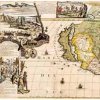
Thomas Jeffreys, The American Atlas: or, A Geographical Description of the Whole Continent of America (London, 1776), printed and sold by R. Sayer and J. Bennett, $116,500 (est. $80,000/90,000). It is considered one of the most authoritative and comprehensive atlases of America, large folio, with 23 maps, on 30 double pages or folding engraved map sheets except for one single page by Henry Mouzon, William Scull, and Lewis Evans. Most maps were colored in outline by a contemporary hand. The atlas provides a comprehensive record of the 13 colonies during the Revolutionary War and includes reconnaissance mapping of French Canada including Newfoundland. |
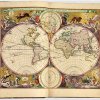
Lear's original watercolor of the Great Auk, painted for the second volume of Prideaux John Selby's Illustrations of British Ornithology (London, 1819-34), estimated at $75,000/100,000, failed to find a buyer. It had been acquired for $66,000 by Arader in June 1989 at one of Sotheby's sales of the library of H. Bradley Martin. Writing in the British Antiques Trade Gazette, Ian McKay pointed out that natural history color-plate books do not make the sort of prices they made at the Bradley Martin sales 20 years ago, when copies of Edward Lear's Parrots sold for $209,000 and $231,000. McKay also pointed to the star of the sale, a 49 7/8" x 34½" oil on canvas by Robert Havell Jr. of a red-tailed hawk and osprey fighting over a fish. Circa 1870, it sold for a strong $134,500. Havell Jr., who worked with his father as John James Audubon's London engraver, immigrated to America and became a painter. This painting, which fused two of Audubon's images, had stayed in the Havell family until Arader acquired it. Audubon's prints from Havell's elephant folio brought more than estimated. A Hooping Crane sold for $86,500 (est. $50,000/60,000). A Green Heron fetched $74,500 (est. $30,000/40,000). Raven sold for $13,125 (est. $50,000/60,000), and Brazilian Caracara Eagle, expected to sell for $12,000 at most, went at $23,750. Unreserved Audubon elephant folio prints of small birds sold over estimates for $3438 to $6250. George Catlin's North American Indian Portfolio: Hunting Scenes and Amusements of the Rocky Mountains and Prairies of America, 1845, sold for $230,500, a record for the portfolio. In December 2003 Arader had bought this lot at Christie's for $197,900. Maps were the weakest section of the sale, though a collector bought The American Atlas by Thomas Jeffreys, 1776, for $116,500. The sale demonstrated that no section of the market is unaffected by the economic downturn, but happily there are still some passionate collectors with money to spend. "In the scheme of today's economy, any sale above three million dollars is a good sale," said Selby Kiffer, Sotheby's books and manuscripts specialist. "The charities benefited; Sotheby's benefited; and some private collectors got some great pieces." Arader said the sale was followed by a flurry of gallery business in the usually quiet month of July. For more information, contact Sotheby's at (212) 606-7000; Web site (www.sothebys.com). Originally published in the September 2009 issue of Maine Antique Digest. (c) 2009 Maine Antique Digest
Login or Register to post a Comment |