














A New Facility Is Christened

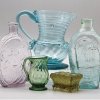
High lot of the Evans sale was this Dugan Glass Co. syrup pitcher. The 6¼" green opalescent vessel dates from the early 20th century and is undamaged and free of wear. This extremely rare example is decorated with the so-called swastika design. It is highly sought after by collectors since the design was produced in fewer shapes and sizes than other patterns. Before the late 1920s, the so-called spinning logs or sun wheel design was associated with good luck and general well-being. Unfortunately, those meanings were lost, and today the symbol is associated with Nazi Germany. The little pitcher created quite a stir, spinning its way to $4887.50 (est. $800/1200), won by a bidder on the telephone. 
The opaque blue hen-on-nest covered dish by Bayel Glass, in excellent condition with some minor mold roughness, measures 5" high overall and sits atop a 4" x 5 1/8" oval base decorated with wheat stalks and a rope-shaped rim. It sold to an absentee bidder on a single bid for $373.75 (est. $75/125). 
This syrup pitcher is from Pittsburgh maker Geo. Duncan & Sons and dates from the late 19th century. This is Duncans No 2000 pitcher. It is a short (5¾") colorless paneled jug with amber-stained scroll decoration. The colorless handle is applied, and the lid is period. The catalog notes that the undertray is an unrecorded item but appears to be original to the piece. Both the pitcher and the undertray are undamaged, and the lot brought $1380 (est. $300/500). |
Jeffrey S. Evans & Associates, Mt. Crawford, Virginia by Walter C. Newman Photos courtesy Jeffrey S. Evans & Associates It is often the practice for a newly launched ship to be taken on a shakedown cruise. Newly constructed buildings go through a similar trial run. On June 27 Jeffrey S. Evans & Associates held its inaugural auction in its new gallery in Mt. Crawford, Virginia. Evans and his crew were anxious to see how well their new auction facility handled in a real-world situation. The much anticipated completion and opening generated obvious excitement among those who were present and came as a relief for those closely associated with the project. M.A.D. readers will recall that nearly two years ago, Jeff Evans announced plans to renovate and expand the facility at his old company, Green Valley Auctions (see M.A.D., December 2007). Over time, those plans evolved more dramatically than had been first anticipated. During that evolutionary process, Evans and his wife, Beverley, relinquished their interest in Green Valley Auctions. They formed a new company, Jeffrey S. Evans & Associates, and began construction of the new freestanding, 7500-square-foot facility at another site on the Green Valley property. Green Valley Auctions remains a viable concern and is owned entirely by Jeff's brother, Greg. As is the case with many construction projects, work on the new gallery suffered several setbacks and delays. In fact, the Evans staff was still assembling display cases and setting up the new building until the morning of the sale. Even then, there were a few loose ends that had to be left for another day. Some internal room divider doors had not been installed, and the new chairs had not been delivered. Evans assured the assembled patrons that they would "really love the cushioned chairs-whenever they get here." In addition to the new physical structure, auction-goers who were familiar with the old Green Valley company were confronted with a change in the logistics for handling the individual auction lots during the sale. In the new scheme it is no longer the practice for individual items to be hand-held at the front of the salesroom when a lot is called. During the sale, all items remain in large lighted display cases in a room adjoining the gallery. Items too large for the cases are arranged around the perimeter of the gallery. Photos of each lot are shown on five large flat-panel television screens that are mounted from the ceiling. Evans stated that the new procedure will allow for a smoother sale and a more efficient checkout for the patrons. With the ground rules carefully explained, terms and conditions presented, and announcements out of the way, Jeff Evans called, "Lot number one," and the good ship Jeffrey S. Evans & Associates was underway. This sale was composed entirely of glass: Victorian glass, art glass, Greentown, and milk glass. There was the Watt and Janet White collection of sugar shakers and syrup jugs, as well as a portion of the Helen Liveten milk glass collection, and items consigned by the Fenton art glass museum. Owing to the size of the consigned collections, this was the perfect sale at which to acquire a very nice example of virtually any category of collectible glass. If animal-form covered dishes are your thing, there were more than 100 lots from which to choose: hens, chicks, rabbits, dogs, cats, lambs, swans, foxes, ducks, roosters, elephants, turtles, turkeys, frogs, owls, horses, bulls, and even a wild boar. Similar volume and variety was found among the sugar shakers and syrup pitchers. The sale proceeded quickly and with only a few interruptions. A dropped Internet connection here and a blank television screen there were minor glitches in what was otherwise a very smooth opening. The only true surprise came with one of the syrup pitchers. The pitcher, from the Dugan Glass Company, came late in the sale and earned the distinction of high lot of the day. The green opalescent pitcher with a very distinctive pattern of white swastikas was from the Watt and Janet White collection. Estimated at $800/1200, it received very active bidding from all quarters and sold to a telephone bidder for $4887.50 (includes buyer's premium). Jeff Evans stated that this particular pattern is the holy grail for certain collectors. The pattern was made for only a limited time and available in a limited number of shapes. Several individuals speculated that its rarity could have increased because of the negative stigma associated with the swastika decoration, which may have led to the destruction of some examples. By all accounts, the initial sale was a success. The new building is fresh, efficient, and well suited for its purpose. This reporter, however, will miss a few things about the old facility. The new building is smaller, and there is less room to walk around during the sale and chat with others without causing a stir. The snack bar is a bit more upscale than in the old location. I will miss the chili and slaw hot dogs. My wife allows me to eat one when I go to Mt. Crawford, so now that delight is gone. Most of all, I will miss the fact that the individual lots are no longer physically presented as they are sold. The new flat-screen photos are wonderful, and with all honesty, a 4" miniature pitcher is very difficult to see from 40' or 50' away. But watching the choreography of the Evans staff loading and unloading hundreds of glass and pottery lots onto the old 6' tall top-heavy trolleys, maneuvering them into the queue of lots awaiting presentation at the front of the sales floor, and then walking the sold item to the storage area is an auction ritual that will be missed. In nearly five years I never saw them drop a single piece. If they did, it didn't wake me. For more information, contact Jeffrey S. Evans & Associates at (540) 434-3939 or visit (www.jeffreysevans.com). Originally published in the October 2009 issue of Maine Antique Digest. (c) 2009 Maine Antique Digest
Login or Register to post a Comment |