












The Ellsworth Antiques Show

Neville Lewis of The Barometer Shop, Cushing, Maine, brought barometers, of course. This circa 1840 American marine barometer by Frederick Pool of Boston, in a mahogany case with ivory plates and on its original brass gimbal, was $11,000. 
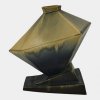
For the first time, the Ellsworth show included a dealer who specializes in 20th-century art objects. Greg Nanamura of New York City, who focuses on art and sculpture between 1880 and 1980, asked $4800 for the Lucite pyramid by Norman Mercer (1916-2007) with suspended dyed panels. Norman Mercer was also a chemist and scientist, Nanamura explained. He worked with DuPont and invented the process of suspending dyes in Lucite. With the sheer function of making Lucite in geometric forms, he really did a lot of amazing work. |
Ellsworth, Maine by Mark Sisco After a spring and summer of dismal shows and lackluster sales, a small number of top-flight dealers looked toward the three-day Ellsworth Antiques Show, held August 13-15, to be their saving grace. Now in its fourth year at the Woodlawn Museum in Ellsworth, Maine, and in its eighth decade of operation since its inception in the late 1930's, the nation's oldest continuously operating antiques show has survived wars, depressions, recessions, inflation, deflation, and every other challenge that 70-plus years can bring. Yarmouth, Maine, dealer W.M. Schwind has been the show's chairman for nearly half of the show's life, and this year at the helm he faced a few new challenges, among which was finding quality replacements for the half-dozen or so non-returning dealers who chose not to participate, put off by the expense of the three-day affair and not confident enough to pony up. "This year was the toughest year I've ever had for staging the show," Schwind noted. "The antiques business is so on the floor, it's in the subbasement." Among others, he needed to find a replacement for the badly injured Paul Scott of New Hampshire. He found Stephen and Beverly White of Skaneateles, New York, who were thrilled to pitch in. The cooperation of the museum working in sync with the dealers was important. "The museum invested the money in putting a French drain around [the outdoor site] in case there was a downpour, and it really worked," Schwind explained. "You can be sure in that four or five days, you're going to get rain
You've got to deal with floors or you'll have a disaster." The end result was a happy one for the museum, with probably another $25,000 heading its way as a result of the show. There are some other important factors that weigh heavily into the success of the Ellsworth show, and money heads the list. "We have some very well-heeled clients who patronize that show," Schwind said. "You have an extraordinary concentration of summer wealth
We have lots of old money, and we have new money too, plus the extraordinary natural beauty of the place." Even so, attendance this year was markedly reduced, down by about 250 from last year's gate. "It was probably the thinnest attendance we had in a long time," Schwind noted. "We struggled to get eight fifty." Nonetheless, the people who did come brought money and generally left with considerably less. Did the show produce the David Ortiz-style walk-off home run that everyone was hoping for to brighten the late summer season? According to most dealers we spoke with, the answer was "yes," or at least something close to a "yes." Steve White said, "They did vote us back in for next year
We didn't make any money to speak of, but we got out alive, mainly on one sale, a Zedekiah Belknap portrait...We really like the atmosphere of the show
The museum people were wonderful
The preview got all the right people in the door, [but] we didn't connect with any of them as far as sales go." The Whites' Belknap painting had been listed in the diary that Belknap kept, and it sold to a well-known Maine dealer. White was down on furniture sales, though. "The only stick of furniture I sold was a blue-painted blanket box," Steve White said. His tongue-in-cheek advice on buying furniture was "If it's brown, don't buy it," but he remained upbeat. "The whole experience was really great, and I got my cholesterol right back up where it belongs because I had three lobster dinners!" John Fiske of Ipswich, Massachusetts, agreed. "My general impression of it was a very positive one
This was certainly one of our better shows of the year," he said. "We and some other dealers detected some green shoots of recovery
As always, we all came with some tempered expectations." David Allan Ramsay of Cape Porpoise, Maine, stated unequivocally, "It was our best show of the summer season
I have about half a dozen pieces that are on hold for a decorator
and I was able to sell a wonderful set of turn-of-the-century Ohio chairs with North Wind faces." At the Wednesday evening preview party, he sold a fine American Black genre painting that set the pace for the rest of his show. 
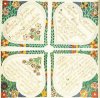
Pictured is a rather spectacular, albeit small, handpainted dressing screen offered by John Hunt Marshall of Westhampton, Massachusetts. At about 42" tall, it seemed halfway between a fire screen and a dressing screen, as if the lady of the house was mindful of being modest only from the waist down. Marshall supposed it was Italian, early 19th century, and it seemed to be a good deal at $2250. |
As if to put a fitting conclusion to a successful three-day event, Martha Stewart and her entourage showed up near the end of the third day and invited some of the dealers to a post-show dinner party at her Skylands estate in Seal Harbor. "She was so gracious and so generous," Schwind said, "and what emerged was how much she liked Woodlawn and the antiques show. That was a wonderful way to end the show." Coming off his sour experience at the Maine Antiques Dealers Association's Antiques in the Gardens show, Schwind's success at Ellsworth was especially sweet. He summed it up nicely. "I did more business here last night in the preview than I did during the entire Philadelphia show
I had a feeling that this year Ellsworth might turn the corner
[The buyers] were really expansive, they were in the mood, and they bought well." Later he added, "Ellsworth was a bright spot in this dismal swamp of a summer." For more information, contact the Woodlawn Museum at (207) 667-8671; Web site (www.woodlawnmuseum.com). Originally published in the November 2009 issue of Maine Antique Digest. (c) 2009 Maine Antique Digest
Login or Register to post a Comment |