













In the Trade: David Rudd and Debbie Goldwein of Dalton's, Syracuse, New York

David Rudd and Debbie Goldwein. 
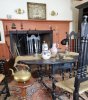
A very partial view of Daltons large shop. 
A pair of rockers from 1902-04 in original finish, $10,500 the pair, flank a circa 1907 Gustav Stickley cedar-lined blanket chest with its original surface and iron hardware, $32,000. Rudd said the pair of rockers has always been together. Pairs always seem to bring a premium, he said. A single might be thirty-eight hundred. |
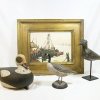
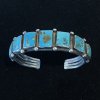
In the Trade by Frank Donegan You might reasonably assume that upstate New York would be a collecting hotbed for material of the Arts and Crafts movement. After all, many of the great names worked upstate and produced pioneering designs. Gustav Stickley was in Syracuse, as was potter Adelaide Alsop Robineau; L. and J.G. Stickley were nearby in Fayetteville; Elbert Hubbard and the Roycroft folks were in East Aurora; Charles Rohlfs was in Buffalo; Charles Fergus Binns, often called the father of modern studio ceramics, was teaching art pottery at Alfred University; and any number of smaller enterprises, such as Heintz Art Metal, the Onondaga Metal Shops, and Benedict Studios, were in the area. On the other hand, upstate New York has a well-earned reputation for being a notoriously hard place in which to sell any antiques, with the occasional exception of a colonial piece that has a connection to someplace like the Mohawk River valley. If you're trying to get five-figure prices for Mission furniture that the locals remember as the stuff they sent out to their cabin by the lake or their Adirondack camp, then business might be something of a challenge. Nevertheless, David Rudd and Debbie Goldwein have been selling serious Arts and Crafts furniture, metalwork, pottery, prints, textiles, photography, paintings, and lighting for 30 years from their shop, Dalton's, in the comfortable Eastwood section of Syracuse, New York. (Why is it called Dalton's? "It's my middle name," Rudd said, "and I thought it sounded better than Rudd's or Dave's Antiques.") One does get the impression that selling antiques in this section of the state has, at times, indeed been a challenge. Even after three decades in the same location, Rudd said, "Ninety percent of our business is from out of town," but he considers it a sign of progress that fewer people now tell him that his inventory looks like what they sold at their last garage sale. Rudd and Goldwein graduated from Syracuse University. Rudd was an Army brat whose parents happened to be living in the Syracuse area when it was time for him to go to college; he studied photography and sculpture. Goldwein was from the Wilkes-Barre area of Pennsylvania; she majored in social work, which was good, she said, because she was able to get jobs that supplied them with health insurance and a regular paycheck "until the business could support us"-a period of about a dozen years. In 1980 the couple opened their shop in a "corner store," the type of place you find in residential neighborhoods that predate the era of 7-Elevens and strip malls. The building also had a drugstore and a barbershop. "We started with no funding," Rudd said. "In the first year I had general-line stuff mixed with Arts and Crafts. We had fallen in love with the Arts and Crafts style for our own house. In 1982 I had a little show of Edward Curtis photographs and moved out everything that wasn't Arts and Crafts." Eventually the couple expanded into the drugstore and the barbershop and bought the building. Their shop now comprises some 3000 square feet. Rudd recalled how slow business was in the early years. "I'd buy a Gustav Stickley chest and put it in my window for nine hundred dollars, and it would just sit there until I'd have to move it because the UV light was damaging the surface. It was hard for me to convince local dealers to haul a piece of Mission out of a house because it was so heavy." Today, Rudd and Goldwein have a Gustav Stickley chest in stock priced at $45,000. The Arts and Crafts field has been a streaky area of collecting. As is often the case with such relatively new fields, spotty scholarship and the naïve enthusiasm of novice collectors can create cycles of boom and bust. A chart of prices in this field during the past three decades would show a pattern of peaks and valleys, but, as Rudd pointed out, "Each valley is usually higher than the previous valley." The field is also maturing. Rudd said, "It's only in the last ten years that there's been scholarship so that we know what the great stuff is. In the eighties a form surfaced, and we all got excited; then we saw the same form a thousand times in the next twenty years and got less and less excited." Today, Rudd said, "Business is slow but starting to pick up." That makes it way better than a year earlier. "Last year was like somebody turned the faucet off," he said. "There were no e-mails, no phone calls." Rudd said the West Coast has been particularly hard hit. "The Hollywood crowd was hot on it [Arts and Crafts] then moved on to something else. I have friends out there, and they now have to take their things elsewhere to sell them." Furniture accounts for about 40% of Dalton's sales; the other 60% is distributed among the many other areas of Arts and Crafts material. This, said Rudd and Goldwein, is a relatively recent development. "I think it took a long time for people to look beyond furniture," Goldwein remarked. Rudd agreed, "People ignored the wall for a long time." That is certainly no longer the case. Take, for example, the field of woodblock prints, which many collectors consider the perfect complement to Arts and Crafts furniture. "Woodblocks are starting to bring real money," Rudd said. "You used to get everything under two thousand dollars. Now a Gustave Baumann [print] can be twelve thousand." Or even more; see photo. Rudd is particularly drawn to Gustav Stickley's products. Dalton's is only about ten blocks from Gustav's first factory, and for a couple of years in the mid-1990's, Rudd was co-owner of Gustav's Syracuse home. "I'm just impressed by the designs and by the type of business person he was," Rudd said. "I wouldn't say his construction was superior to L. and J.G. [Stickley] or Limbert, but he had a sensitivity to design that some of the others lacked." Rudd thinks that sensitivity is what doomed Gustav Stickley's business. "I think he was an idealist and really believed in what he was doing," Rudd explained. "His idealism brought an end to him. He couldn't adjust to newer times when Arts and Crafts fell out of favor." Other manufacturers of Mission furniture survived by producing a motley mix of furniture into the 1920's and beyond. Gustav Stickley, however, never really had his heart in anything but Arts and Crafts. Rudd is on the board of trustees of the Stickley Museum at Craftsman Farms in Parsippany-Troy Hills, New Jersey. The main building, called the Log House, has been designated a National Historic Landmark. Gustav Stickley envisioned the place as a farm school for young men, but it was sold off in 1917 when he went bankrupt. "When you're in the Log House down there, you get a real feeling of what he was about," Rudd said. With the increase in scholarship has come increased appreciation for original surfaces. Rudd said attention to original surfaces is more intense today than ever before. A first surface can easily increase a piece's value fourfold. This raises the question: how easy is it to fake early finishes on this furniture? After all, one might conjecture that it would be considerably less complex to reproduce a "period" finish on a 1910 oak sideboard than on a 1760 highboy. Rudd said, "Whenever money is involved, there's going to be fraud, and some people are very good. I've seen pieces go through major auctions being sold as original surface but which have, at least, had work if not a total refinish." A substantial problem, Rudd said, is fake shop marks. "Ninety-five percent of the pieces of any of the Stickley companies had a mark," he explains, so adorning an anonymous, unmarked piece with an authentic-looking decal or brand can materially alter the value of an object, at least among less knowledgeable buyers. Complicating things further is the fact that authentic L. & J.G. Stickley decals from the factory have been unearthed and have entered the market. "Once or twice a year I'll see a good fake," he said. Rudd thinks that the heavy interest on original finishes may actually provide an opportunity for collectors. "Some of the early forms that have been refinished may be undervalued," he said. "You can buy a 1903 refinished Gustav dresser for not a whole lot more than a reproduction." Reproductions, in fact, pose a problem for dealers in this field that dealers in other areas rarely experience. Serious collectors of 18th-century furniture or Shaker or folk art are unlikely to mix modern repros into their collections. Yet in the Arts and Crafts field, that happens with some frequency. Given that the Arts and Crafts look has become the default decorating mode in much of the country during the last decade, repro furniture is easy to find and is still produced under the Stickley brand. "We're up against that big-time," Rudd said. "People will buy a period bookcase or Morris chair, and then they'll buy a new Prairie settle." Some of this behavior may stem from pure impatience. Serious collectors face a daunting challenge if they want to acquire important, early pieces. "One of the biggest problems for the person who wants to collect pre-1904 stuff is that there's not much available," Rudd remarked. "To furnish a room could take quite a while." One thing that may strike an outsider as odd about this field is the relative lack of interest in one-of-a-kind handcrafted items made by unknown or little-known makers. After all, reviving craftsmanship that had been lost during the Industrial Revolution was exactly what the founders of the Arts and Crafts movement, such as John Ruskin and William Morris, sought to accomplish. They dreamt of a society populated by medieval yeomen filling the needs of their community, yet items made in that spirit are generally hard to sell and don't command big prices. Why? "I look at Arts and Crafts as the beginning of the modern movement," Rudd answered. "I don't judge it by the definition that Ruskin or Morris would have used. People like Stickley embraced the machine." His viewpoint appears to be the one that dominates the field. Consistent with this modernist approach, Rudd and Goldwein have enthusiastically embraced the computer. Their Web site, they say, has been crucial to operating in these tough economic times. "The Web site has been fabulous," Goldwein said. "If we didn't have the Web site, we'd be out of business." They've even launched a Dalton's page on Facebook. So, business goes on in upstate New York. Goldwein said, "Last Saturday we had two couples from Illinois who came in at the same time and didn't know each other." To which Rudd added, "If people are within a hundred miles of us, they seem to make an effort to stop in." For more information, contact Dalton's, 1931 James Street, Syracuse, NY 13206; (315) 463-1568; (315) 727-3497 (cell); (315) 463-1615 (fax); e-mail <rudd@daltons.com>; Web site (www.daltons.com). Open Monday through Friday, 10 a.m. to 5 p.m.; Saturday, 10 a.m. to 3 p.m.; also by appointment. The shop is closed when the couple is away at shows. They do The American Antiques Show in New York City in January; the Grove Park Inn Arts and Crafts Conference in Asheville, North Carolina, in February; and the Philadelphia Antiques Show in April. Originally published in the November 2009 issue of Maine Antique Digest. (c) 2009 Maine Antique Digest
Login or Register to post a Comment |