






Letter from London
by Ian McKay, e-mail: ianmckay1@btinternet.com 
Part of the collection of letters from Lord Byron to Francis Hodgson that sold for $455,466 at Sotheby's. |
"The partridges are plentiful
& the girls on the manor just coming into season
" [Lord Byron]Time was when British Prime Ministers were expected to be serious bookmen-to be well read, to turn their hand to writing, and to be possessed of a fine library. From the last century, Churchill stands head and shoulders above the othershe even won the Nobel Prize for Literaturebut it was the late 19th century that saw a particularly strong run of literary and literate chaps in Britain's top job. When, in 1894, Archibald Philip Primrose, 5th Earl of Rosebery, began his relatively brief term in office, he was following in the footsteps of Benjamin Disraeli, a novelist as well as great statesman, William Ewart Gladstone, who is said to have read 10,000 books whilst at No. 10 Downing Street, and Lord Salisbury, who had at one time been a reviewer for the Quarterly
and Saturday Review
. As both a young man at Oxford and as an elder statesman, Rosebery was considered one of the more accomplished and widely read men of his generation. A wealthy young man, he had begun buying books whilst at school, but his marriage in 1878 to Hannah de Rothschild facilitated even greater expenditure, and his wife once joked to their daughter about James Bain's bookshop in London's Haymarket, "It's your father's toyshop, my dear." Buying privately and, through Bain, at auction dispersals of the libraries of noted bibliophiles, including that of his father-in-law's Mentmore library, he built up a superb collection that was distributed among the libraries at his various residences in England, Scotland, and even Italy. English books and manuscripts from one of his Scottish homes, Barnbougle Castle, that were offered at Sotheby's on October 29, 2009, included a group of letters sent by the poet Byron to his old Cambridge friend and "brother minstrel," Francis Hodgson. Many of Byron's letters to Hodgson were published during the 19th century, but often in censored form, and the letters that Rosebery had acquired directly from Hodgson's descendants in 1885 included some more unguarded, colourful, and controversial passages that had never before been published. Rosebery's Byron archive comprised 15 complete letters and other substantial fragments that were wide ranging in choice of topic, as one would expect of a correspondence between close friends. The letters date from the years 1808-21, from a time when Byron had yet to establish himself as a poet to the period of his self-imposed exile from England, and touch on such diverse matters as poetry, religion, travel, revolution, and, inevitably, his much documented private life. In one prophetic note Byron wrote, "I almost rejoice when one I love dies young, for I could never bear to see them old or altered
," but his musings on mortality also accommodate the death of a favourite dog. "
Boatswain is to be buried in a vault waiting for myself, I have also written an epitaph
." In one of the letters that touch on poetry, he writes of sending proofs of the poem that was to make him famous overnight, Childe Harold. In another, it is Milton's epic that concerns him: "Who is the hero of Paradise Lost? Why Satan
." On religion, Byron can be cheerily dismissive, "
we are miserable enough in this life, without the absurdity of speculating on another," or, in those letters relating to Hodgson's determination to take Holy Orders, adopt a more serious tone: "
the Basis of your religion is injustice, the Son of God
, the innocent is sacrificed for the Guilty, this proves his heroism, but no more does away Man's guilt, than a schoolboy's volunteering to be flogged for another would exculpate the dunce from negligence, or preserve him from the Rod
." Three early letters date from Byron's experiences on the Grand Tour that in his time was an essential part of the education of those of higher rank and station. From Portugal, he writes, "
the inhabitants have few vices except Lice and sodomy
," and from Constantinople, after telling Hodgson of his prowess in swimming from Sestos to Abydos, he describes meeting a man who was to fire this imagination and find a place in Childe Harold, Ali Pasha: "
a fine portly person with two hundred women and as many boys, many of the last I saw and very pretty creatures they were." A less appealing side of the young Byron, the bad and dangerous-to-know side, is found in a letter sent from Newstead Abbey in 1811, where "
the partridges are plentiful
pheasants not quite so good, & the girls on the manor just coming into season
." One of the "more promising" new faces Byron had identified as a prospect for one of his "little sensual comforts" was Susan Vaughan. He did indeed indulge himself in a brief affair with Miss Vaughan, and the callous side of his character shows in an account of what happened when he summarily put an end to their relationship. "
She descended from her apartment 'fierce as ten furies' attacked R. till he was covered with blood, tried to throw herself into one of the filthy pieces of water in & about the premises
threatening perdition, 'thunder, horror guts & death'
I presume she will rave herself quiet
." Susan probably lost her reputation, but Byron still manages to cast himself as the victim of the affair"I can't blame the girl, but my own vanity in believing that 'such a thing as I am' could be loved." The most important Byron autograph lot to have come to auction since 1976, when the manuscript of his poem Beppo was sold for around $100,000, these letters from the Rosebery collections raised $455,466.

Sold for $55,105 as part of the November 10 Bonhams sale of pictures from London's The Arts Club, Solomon J. Solomon's portrait of the actress Mrs. Patrick Campbell shows her in the part of Paula Tanqueray, the eponymous heroine of Arthur Pinero's play. This was the play in which she made her name, but her most famous roledespite the fact she was 49 when she first performed it in 1914was as Eliza Doolittle in George Bernard Shaw's Pygmalion. The part was specially created for her by Shaw, with whom the beautiful and witty actress had conducted a long and public affair. |
Mrs. Patrick Campbell Leaves The Arts ClubFounded in 1863 by a small group of aesthetes, artists, and writers, among them the painter Frederic Leighton and Charles Dickenswho, having argued with Thackeray, had abandoned the Garrick Clubthe establishment now known as The Arts Club was originally intended as a congenial meeting place for those involved with art, music, and literature, either professionally or as patrons. Distinguished early members included Millais, Whistler, Monet, Rodin, and Degas, and, among the writers, Kipling and Turgenev, but that membership broadened out over the years to encompass those with other talents, from architects and designers to filmmakers and broadcasters. In more recent times, its membership has become broader still and younger overall. Around 40% of today's members are women-a notion that would have appalled the majority of the early members and turned their port to vinegarbut the club's current chief executive and secretary, Brian Clivaz, whose starting brief was to "make it profitable or close it down," has taken the club boldly into the modern age. The club's first home had been in Hanover Square, but it later relocated to an 18th-century town house that was rebuilt after being completely destroyed during the bombing of London in World War II. Now, No. 40 Dover Street is about to undergo another makeover, and part of the picture collection that it has amassed over the yearsmany of the works, of course, by memberswas sold at Bonhams on November 10, 2009, to help pay for the refurbishment. While a veil must necessarily be drawn over the habits and peccadilloes of the 1200 current members, old and young, male and female, a piece written for the Bonhams house magazine by John Walsh, an assistant editor on the U.K. newspaper The Independent and current president of The Author's Club (which moved into The Arts Club's Dover Street premises in 1976), provides some colourful background on the early days. It may have been seen for many years as an establishment club, but as Walsh points out, moral virtues and Christian ways were in short supply. The writer Wilkie Collins kept not one, but two mistresses in neighbouring houses, while both Rossetti and Swinburne were opium users, and Swinburne was keen on flagellation. One member, Edgar Boehm, met his end in very delicate circumstances indeed. A Bavarian-born singer and sculptor, Boehm was one of the Moray Minstrels, a sort of glee club that included among its members a number of artists who were also members of the Artist Riflesa volunteer militia commanded by Arts Club founder Frederic Leighton. Boehm gave sculpture lessons to Queen Victoria's youngest daughter, Princess Louise, and the official line on his demise is that she found him dead one day in his studio. But, as Walsh explains, he had in fact died wrapped in the royal arms, bursting a blood vessel in his energetic lovemaking. James Abbott McNeill Whistler often found himself in trouble for failing to pay his subscription fee and was notoriously quick to take offence. It was at the club that he first saw Ruskin's damning review of his painting, Nocturne, and took the ill-judged decision to sue that was to cost him so much. When the novelist George Du Maurier used Whistler as a model for a character in Trilby, the easily offended artist demanded that he should leave the club, and when this did not happen, Whistler left instead and formed the Chelsea Arts Clubor Chelsea Arts Pub as the No. 40 Dover Street members call it. Among the 200 pictures being sold at Bonhams was Solomon J. Solomon's 1894 oil portrait of the actress Mrs. Patrick Campbell as Paula in Arthur Pinero's play The Second Mrs. Tanqueray. A portrait that deliberately reflects, in its pose and composition, Sir Joshua Reynolds's famous portrait of the greatest actress of the late 18th century, Mrs. Siddons as the Tragic Muse, the picture was exhibited at the Royal Academy show of that year but was afterwards given to The Arts Club. Somehow it survived the 1940 bombing and in the Knightsbridge sale was sold for $55,105.

There were a few surprises in the very successful secondary Chinese art sale held by Christie's South Kensington on November 6. The 11" high Qianlong famille rose figure (shown above) of Amitayus, the Buddha of long life, merit, and wisdom, modelled seated in dhyanasana on a separate waisted lotus base and holding an urn containing the elixir of life, was estimated at $8250/13,200 on the grounds that its condition was not ideal, but it sold in the end for $301,056. The 17th-century cloisonné enamelled and gilt bronze censer modelled as a duck (seen below) was another item that left its estimate far, far behind. Valued at $4950/8250, it went on to sell for $151,566. 

Kalachakra, also known as the yidam or tutelary god of the Wheel of Time, was worshipped in Tibet and Mongolia during the long reign of the Qianlong emperor. A devout Buddhist and follower of Tibetan Lamaist teachings, Qianlong had gilt bronze statues of the many deities of the Tibetan Buddhist pantheon made in the Palace Workshops, figures that could be used as gifts to members of the Tibetan hierarchy or placed in the numerous Buddhist shrines within the Forbidden City compound. A formidable figure with four heads, each with a third eye, and depicted here with 16 arms, Kalachakra was a protector who could be called upon in time of crisis, but is most commonly represented, as here, in his peaceful form, and in an embrace with his female counterpart or shakti. This 14¾" high parcel-gilt bronze figure of the Qianlong period was sold for $556,460 at Sotheby's on November 4. |
The Dragon Roars: An Asia Week Success StorySeven Asian art sales held in London in early November 2009 underlined the strength of a Chinese works of art market that has performed well over a year in which other collecting areas have suffered, and these sales provided a welcome tonic for the London salesrooms. With so much on offer and perhaps some too-optimistic reserves, there were failures of course. Bought-in figures by lot varied from 16% to 42%, but sales by value were far higher. At Sotheby's, for example, where only 58% of the lots were sold, this figure translates into 85% in monetary terms. Overall, bidding from old established and, more significantly, a new breed of mainland Chinese collectors, either directly or via dealers, was strong and highly competitive. The headline act was the fern green jade dragon seal made to celebrate the 80th birthday of the Qianlong emperor in 1790, which sold for a huge and six times estimate $5.879 million* in the Sotheby's sale of November 4, but many other exceptional pieces sold at sums way beyond what had been predicted. Bonhams, too, had an Imperial seal in their November 5 Chinese arts sale, but the major attraction in the New Bond Street rooms was a 25-lot group of archaic bronzes from the Cunliffe collection-one in which an established and well-known provenance was a safeguard in an area in which fakes are a serious concern and in a market in which international restrictions are imposed on the sale of archaeological treasures whose origins are undocumented. Lord Cunliffe's purchases were made in a period that sits well outside the restricted decades. The Chinese collections of Rolf, 2nd Baron Cunliffe (1899-1963) grew out of a birthday present bought for his brother that he decided to keep for himself. What began as an off-duty distraction for a senior RAF officer stationed in London during the latter years of World War II developed into a passion in the immediate postwar years, and Cunliffe was both shrewd and fortunate enough to be buying at a time when large quantities of material were coming onto the market. Though others, among them Percival David and George Eumorfopoulos, were building great collections, there was plenty to go around, and Asian buyers were not the market force that they are today. Cunliffe's London apartment, across Carlos Place from the Connaught Hotel, was ideally placed for visits to the salesrooms and to the major specialist dealers, and as his son Roger, the present Lord Cunliffe, recalls: "A countryman at heart, my father always had his city suits made with a 'poacher's pocket.' How better to discreetly bring home a formidable-looking bronze dagger?" He also remembers the problems of display in a relatively small living space. "Pieces were changed about frequently, and then returned to the celadon-green steel office cabinets squeezed into his bathroom. Thus it was that visiting collectors like the King of Sweden would spend happy hours sitting with my father on the edge of the bath while discussing the finer points of an archaic gui or a pair of inlaid belt buckles." Bonhams, who sold the Cunliffe collections of Chinese jade and porcelain in November 2002, saw some spectacular results in this latest Cunliffe offering, and, overall, their November 5 sale raised in excess of $8 million. There were signs, too, that the Japanese market might be perking up a little. At Bonhams on November 5, a Meiji period cloisonné enamel model of an ornate ox-drawn carriage was bid to $415,800, and a cloisonné enamel model of a traditional go-ban, or go game board, reached $356,400both sums being far in excess of what had been suggested. These and a selection of other pieces from the London sales are illustrated and described in the accompanying caption stories. *In a Toulouse (France) auction of June 2008, a soapstone seal from the reign of the Kangxi emperor was sold for a record $8.6 million.  Acquired in Paris in the 1970's, this massive Imperial Khotan green jade seal, 5" square and carved with a pair of addorsed and intertwined dragons with bulging eyes, flaring nostrils, and bared teeth, is carved to the base with six raised Chinese characters that translate as "Treasure of concern over phenomena at Eighty." It was made in 1790 to mark the 80th birthday and 55th year of the reign of the Qianlong emperor, a coincidence strengthened by the traditional regard for multiples of five as milestones and one that called for special celebration. This is the most important of the new seals ordered as part of that celebration, and the inscription relates to the eighth of the nine component parts of the "Great Plan" chapter of a 6th-century B.C. text, the Shangsu, that the emperor thought appropriate to the occasion. A detailed explanation of the seal's origins and meaning of the inscription was provided by Guo Fuxiang of the Beijing Palace Museum in the Sotheby's catalogue of November 4, but I fear that it is far too complex to repeat here, and though I had hoped to provide a Web link for anyone keen to learn more, that text is not on line. Two telephone bidders made the running, but the seal sold in the end to New York City and London specialists Littleton and Hennessy Asian Art, for $5,878,911. One of Richard Littleton's customers is Edward Johnson of Fidelity Investments, a major U.S. collector of Chinese art, and an article in the U.K. journal The Economist reported a widely held belief that the seal was acquired on his behalf. 
Another magnificent example of Meiji period cloisonné enamel work from the November 5 Bonhams Japanese arts sale, this 9" x 16 1/16" go-ban, or go game board, by Honda Kozaburo of Nagoya, its underside as exquisitely finished as the sides, is such a special piece that it must surely have been a special commission or something made for international exhibition. Like the ox carriage featured here, it made much more than predicted, at $356,400 to a collector. 
Bought by a Chinese collector for $794,060 at Sotheby's on November 4, this pair of pale celadon jade ruyi sceptres of the Qing Dynasty (19th century) had been valued at just $20,000/30,000 by Sotheby's, but as other recent sales have shown, jade can sometimes make a nonsense of estimates. Just over 17" long, the sceptres are carved in relief to the ruyi-shaped terminals with figures of the god of longevity and good fortune, Shou-lao, and his assistant, under a pine tree and below a rocky outcrop, surmounted by a bat, while the shafts are decorated with chrysanthemum and terminate in bats that have a flowering plant in their mouths. Dating to the Shang Dynasty (12th/11th century B.C.), this bronze ritual wine vessel, or gu, went to a telephone bidder at $620,575 at Bonhams on November 5-a notable advance on the $400 that Wing Commander, Lord Cunliffe had paid London dealer John Sparks for it in 1946.
In Chinese terms, this is almost retro ware. From the first year of his reign, 1722, the Yongzheng emperor showed a predilection combining imitation of the antique with innovative design in his commissions from the Palace Workshops. Under the supervision of Tang Ying (1682-1756), simplicity of form and absence of decoration became the stylistic trend, and research into the celebrated Song Dynasty glazes saw the reappearance of monochrome porcelain wares covered in luminous pale glazes to simulate the earlier wares-but on contemporary and sometimes unique forms. This 12¼" high, ru-type bottle vase, bearing the Yongzheng seal mark and of the period, would seem to be an amalgamation of porcelain and bronze vessels. It sold at Sotheby's on November 4 for $457,460.

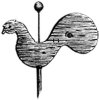
Purchased in 1953 for what would be something short of $500 at today's exchange rates from London dealer John Sparks, whose shop Lord Cunliffe could see from his apartment window, this 10½" wide archaic bronze ritual food vessel, or gui, is an early Western Zhou Dynasty (10th century B.C.) piece with loop handles emerging from the heads of mythical horned beasts and the sides cast with bold taotie masks. Part of the Cunliffe family collection seen at Bonhams on November 5, it sold for $804,250 to a Shanghai dealer. One wonders whether its appearance as lot no. 8 in the cataloguethe luckiest number in Chinese numerologywas entirely accidental? This delightful black and red lacquered wood Kyogen rabbit mask of the Momoyama/Edo period (that is to say, anything from the 16th to 19th century) was sold for $26,740 by Bonhams on November 5. Kyogen, literally mad words or wild speech, is a form of traditional Japanese theatre that was performed as a sort of comical intermission at the more formal Noh theatre performances.
In a Christie's sale of November 3, this 17½" high, finely enamelled, famille rose pink-ground model of a Buddhist stupa of the Qianlong period (1736-95) was sold for $373,907 to an Asian dealer. Stupas were originally memorials built over the remains of the Sakyamuni, or Gautama Buddha, and other important religious figures. This example shows strong Tibetan influences in its architectural form, but the rounded dome is Indian in origin. The segmented conical spire represents the 13 stages of enlightenment.
An elaborately decorated cloisonné enamel model of a goshoguruma, an ox-drawn carriage used by members of the emperor's family and other aristocrats, that sold for a far, far higher than predicted sum in the November 5 Bonhams sale of Japanese art. The 11 1/16" high model, which has several detachable sections, is attributed to Kawaguchi Bunzaemon. There were apparently those who thought it a lesser copy of a piece that the craftsman made for the Imperial collections, but two bidders thought it worth a fight, and against an estimate of roughly $40,000/50,000, it went on to sell for $415,800 to a telephone bidder.

Engraved with the message "Love your people as you would your own children," this 4¼" long Imperial white jade double dragon seal dates from the troubled reign of the Guangxu emperor, 1875-1908, and has been identified as one made for his personal use. In a European collection since at least the early 1960's, it sold at Bonhams on November 5 for $504,240. |

The Augsburg marquetry table cabinet that sold for $1.86 million at Christie's. |
Awesome of AugsburgIt was in the mid-16th century that Augsburg, in southern Germany, began to develop as a major centre for furniture making, and its production of marquetry-decorated pieces undoubtedly contributed to the city's growth as an international centre of excellence. A large range of indigenous woods was readily available, and the invention of improved types of saws and other equipment facilitated the manufacture of a distinctive Augsburg style that almost invariably saw ruins incorporated into the decorative theme. Contemporary prints often provided the inspiration for this decoration. Dated to the second half of the 16th century, a gilt-metal-mounted ash, sycamore, and fruitwood marquetry table cabinet offered by Christie's on November 5, 2009, was decorated all over with a breathtaking mix of musical trophies and astronomical instruments, surreal landscapes and ruins, grotesque figures, and exotic animals, not to mention foliate scrolls and strapwork cartouches. A pair of doors conceal an elaborately decorated interior fitted with 21 ash-lined drawers and slides. There are also three compartments with hinged doors, two of which are removable and further fitted, one with a writing slide, with more hidden compartments. Table cabinets such as this were intended to store small and precious objectsexotic shells, coins and medals, jewellery, etc. One of the finest such cabinets produced in Augsburg at this time, it came to auction from the palazzo of a Milanese noble family, and as a well-preserved, virtually untouched example of 16th-century cabinetmaking, it was given an estimate of $91,000/150,000 in this European furniture sale. That proved well short of the mark, and this extraordinary cabinetmaking confection sold in the end for $1,860,623! Another fine example of Augsburg marquetry work can be seen in a table cabinet of 1580-1600 acquired by the Museum of Fine Arts, Boston in 2001 from the Galerie Neuse in Bremen (Germany).

The "Swarbrick Nun," sold for $49,500 by Bonhams. 
Sold for a far higher than expected $17,425 by Bonhams was this 6½" tall Steiff "Roly Poly" bear of circa 1909. |
The Nun and the "Roly Poly" BearKnown as the "Swarbrick Nun," the rare and early English wooden doll seen here can be traced back to 1680, when, dressed in the clothes she still wears to this day, the doll was returned to England by Father James Swarbrick, a Jesuit priest, whose sister wanted her mother to have it. Members of a prominent Roman Catholic family, James and his sister had been sent from England as young children to be educated at Cardinal Allen's Seminary at Douai (France) and later in Rome, and his sister had dressed her doll to show her mother and younger sister, back home in England, the habit of the Order that she now wore. Her brother carried it back to their family at Swarbrick Hall near Singleton (Lancashire) in 1680 before taking up his post as a Jesuit missionary priest to the mission of Thurnham and Fylde, where he became known as "The Riding Priest." Following the Jacobite uprising in support of the Old Pretender and the deposed and exiled Stuart kings, James and his brother in-law, Richard Gillow (an ancestor of the Gillow family of furniture makers), were imprisoned in 1716 in Lancaster Castle, where James, by then aged 72, died under torture before he could be executed. Richard Gillow, also in his 70's, died in Preston jail. With a carved wooden and gesso-covered head with simply painted dark brown eyes and painted arched eyebrows, strongly carved mouth with red-painted lips, nostrils, and rouged cheeks, the "Swarbrick Nun" shares many features with other wooden dolls of the period, the most famous being "Lord and Lady Clapham," who now live in the Victoria and Albert Museum in London. She wears her original clothes of stiffened cotton wimple, black wool gauze veil, hand-woven woollen habit, and two petticoatsone in coarse weave blue wool, the other of a lighter weave cream wooland is still in the wooden box in which she travelled back to England in 1680. The "Swarbrick Nun" was sold for $49,500 in a Bonhams toy and doll sale of November 17 and 18, 2009, which also saw an unexpectedly high bid of $17,425 on something very different in the toy department. A Steiff "Roly Poly" bear of circa 1909 with pronounced snout, swivelling head, jointed arms, and a body containing a rattle, this came from the same "Collection of a Titled Lady" as the "Swarbrick Nun," but now showing some bald patches to the light brown mohair coat, it had been valued at only $750/1200.
Stocking Tops and Riding CropsIn October 2009, when Skinner in Boston sold the doll and other more general collections of the late Richard Wright, owner of Richard Wright Antiques & Dolls, Birchrunville, Pennsylvania, and a regular on the Antiques Roadshow, they got a bid of $94,800 on his example of what might be described a patinated bronze doll for more specialised tastes-Bruno Zach's The Riding Crop. Modelled by the Austrian sculptor around 1925, this patinated bronze figure of a partly dressed young woman holding a riding crop behind her backMiss Whiplash for art lovershas always had its admirers, but the price paid in Boston was probably an auction record. It was to prove a short-lived record, however, for just a few weeks later, on November 11, Bonhams offered another example of the larger, 32" high version of The Riding Crop in London. This example on a later marble base was bid to $118,080! To oblige connoisseurs of The Riding Crop, we naturally provide front and rear views of their haughty bronze mistress.
Nevinson's Battlefields and a Life in Pictures
Nerves of an Army, one of 100 signed copies of a 1918 drypoint that sold for $41,880 as part of the Attenborough collection. Certain images in my movies, said Attenborough, have been directly influenced by art, and "
Nevinson's etching of four soldiers up a telegraph pole during the First World War is painstakingly re-created in my first film as a director, Oh What a Lovely War." 
The skies above southern England were The Battlefields of Britain in the early years of World War II, and Nevinson's oil of 1941-42, in which the tiny silhouettes of aircraft can barely be seen in the far distance, sold for $363,937 as part of "A Life in Pictures," a November 11 Sotheby's sale of pictures from the collections of Lord and Lady Attenborough. |
Lord Richard Attenborough, or "Dickie" Attenborough as millions of moviegoers across the world will know this actor and director, has been a picture collector for much of his life. To be more accurate, "Dickie" and his wife, Sheila, Lady Attenborough, have been buying pictures together for some 60 years now. It was all that time ago that the couple moved into the Richmond house that remains their home to this day, unable at the time to afford carpets or curtains (drapes) for their new home but clutching a recently acquired Graham Sutherland and a few other pictures to hang on the walls. Now they feel that they have more pictures than the walls can support, and some of them were shipped off to Sotheby's for sale on November 11, 2009, under the title "A Life in Pictures." A packed salesroom ensured that most of the 50 lots exceeded estimates. A later-acquired work by Graham Sutherland, Thorn Head of 1947, sold for $806,190, and the top lot in their modern British collection was one of L.S. Lowry's unmistakable oils of matchstick men in grim urban landscapes, Old Houses of 1948, which reached $1.476 million, but the artist in focus in this piece is Christopher Richard Wynne Nevinson (1889-1946). A leading British exponent of the Italian-born Futurist movement, Nevinson saw action in the early part of World War I with an ambulance unit and the Royal Army Medical Corps but was invalided out in 1916 and that same year put on a hugely successful show of his war pictures at London's Leicester Galleries. In addition to his oil paintings, he produced drypoint versions that could be made available to a wider audience, and his mix of realism and modernism struck a chord with the art loving public. Some of the earlier works reflected his Futurist leanings, being particularly effective in representing movement, but as the war progressed, Nevinson's imagery became more documentary, frequently concentrating on smaller groups or individuals engaged in simple tasks. Nevertheless, his war pictures never lost their potency, and Nevinson always refused to glamorize war. On one occasion, the GHQ censor, a Major Lee, complained that a group of soldiers shown in one of his pictures was insufficiently ennobling. To this charge, Nevinson, having pointed out that his subjects were randomly chosen from real soldiers as they came back from France on leave, asked Lee "which stage favourite and darling of the matinee" he should have taken as a model for their features. Nevinson's name will forever be linked with images of the Western Front in the Great War, but he lived to see another war, and a few years before his death, he produced a striking oil, The Battlefields of Britain, that tackled in a very different manner the threat that hung over these shores during World War II. The viewpoint is taken from above the broken clouds, beneath which we get glimpses of a river winding its way through a patchwork of fields. Only when one looks closely does one see the tiny dots of a three-aircraft, "Vic" formation of fighters. The summer skies of southern England are the Flanders Fields here, and when the Attenboroughs bought this painting at Sotheby's in November 1984, it was actually called Battle of Britain. It was in fact one of three paintings produced under the group title of "The Battlefields of Britain," two of which were exhibited at the Royal Academy in 1942. One of these was presented to the nation later that same year and for many years hung in the Council Room of the Air Ministry. Both The Battlefields of Britain and French Troops Resting, a rare Nevinson drypoint, set auction records for paintings and prints by the artist. 
French Troops Resting, a richly inked impression of Nevinson's drypoint of 1916, signed in pencil, sold for $132,760 at Sotheby's. |
Cross and Cockade Sales of aeronauticaphotographs, paintings, models, artefacts, and memorabilia of all sortshave become something of a specialist sideline for Dominic Winter Book Auctions, a South Cerney (Gloucestershire) salesroom whose principal specialisation has long been the world of books, maps, and prints. Pictured here are a handful of lots from their last such sale, held November 5, 2009, that continue the World War I theme set by the Nevinson piece.
The piece of wing fabric bearing the distinctive Balkan Cross motif, seen here, comes from the wing of a German aircraft captured or shot down during World War I. Though now worn, faded, and repaired (and in one case this is not recent, but a contemporary patch on a bullet hole), the fragment features the familiar five-colour lozenge camouflage widely adopted by German aircraft in the Great War. That characteristic camouflage pattern can be seen more clearly in the detail shown below and as used on the ¼-scale model of a Fokker DVII, also seen below. The model, once a flyer but no longer worth the risk, I imagine, was sold for $1940, but that 4' square Balkan Cross fragment of wing fabric was bid to $23,265. 
The larger, 5' x 7' section of wing fabric featuring part of a British cockade or roundel is of similar vintage, 1916-17, but it proved a little less appealing to buyers and managed only $8140. 
Propellors are always a feature of these Dominic Winter sales, and the monster pictured here is a laminated mahogany prop that would have been attached to the Rolls-Royce Eagle VIII engines of the Handley Page 0/400. A bomber, huge by the standards of the day, that had been developed from the 0/100, affectionately known as the "Bloody Paralyser," the 0/400 entered service with the newly formed RAF only in the last year of the war, 1918, but was later adapted for commercial use. The chap providing the scale for a prop that sold for $9305 is none other than Dominic Winter himself.
Originally published in the January 2010 issue of Maine Antique Digest. (c) 2009 Maine Antique Digest
Login or Register to post a Comment |