














Berkeley, California, dealer Thomas Livingston was asking $12,500 for this American Aesthetic Movement gilt and marble-top console that had been sold in San Francisco on November 22, 1884. The initials WF are stenciled on the back; Livingston wondered if they stood for Wells Fargo. The top of the console is original but repaired. How was business? Not gangbusters, like the old days, said Livingston, one of only three original show exhibitors. Nothing has been the same since the NASDAQ crash [March 2000]. Tastes have changed since then. But there are still enough of us who love the old stuff.
At Paris dealer Bernard Steinitzs booth, which is always large and elaborate, this 16th-century Japanese Momoyama period lacquer and sharkskin trunk was $320,000. Benjamin Steinitz said that he was always happy to come to San Francisco.
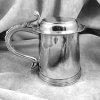
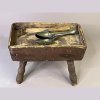
ArgentumThe Leopards Head, San Francisco silver specialists headquartered in Jackson Square, showed (from left) a cann by Samuel Minott, Boston, circa 1780 ($7500); a salver by Hugh Wishart, New York City, circa 1800 ($7500); and a marrow spoon possibly by Abraham Schuyler, Albany, circa 1770 ($1100). Silversmith Ruth Rhoten found this show better than the 2008 one. The gallerys Cynthia Foster explained that the 2008 show took place soon after the collapse of Lehman Brothers, but this time she was seeing lots of old customers, and we met some new ones too. We had pieces people liked, Rhoten added, and more San Francisco silver than ever.
San Francisco, California
by Alice Kaufman
Sometimes the saga of the San Francisco Fall Antiques Show reads like The Perils of Pauline. In the recent past, the show's opening night preview party, a legend on the antiques show circuit, and the four days of exhibits and special lectures have been threatened by a World Series in which the hometown Giants were competing, Halloween on the night of the preview party, an earthquake, and a temporary labor problem/import ban that kept material being shipped to San Francisco for the show loaded on ships outside the harbor (several dealers mounted color photos in their booths to replace their displays).
On opening night of the October 28-November 1, 2009, show, the Oakland-San Francisco Bay Bridge was suddenly and unexpectedly closed because pieces of metal were flying onto the roadway from a recent repair undone by a strong wind. This strangled traffic all over the Bay Area and seriously affected people's ability to get to the show. In addition, the Dow Jones went down about 250 points during the week of the show.
The economy affected dealers and collectors. There were many first-time exhibitors, and three who hadn't exhibited at the show for a while. That was an optimistic sign, but each replaced a veteran exhibitor, which was not as hopeful. Only three 2009 exhibitors were among the original exhibitors at the show in 1981, Therien & Co., Argentum-The Leopard's Head, and Thomas Livingston Antiques, all based in the Bay Area.
Show chair Michelle Goss, who worked with the dealers, said that the new exhibitors added a freshness to the show that was a real plus. Every new dealer, to quote Lisa Podos, who produced the show in 2007 and returned as the 2009 strategic and creative consultant, "left very happy."
Perhaps happiest was first-time exhibitor contemporary Damian Garrido Orfebres, contemporary Spanish silversmiths. Podos described the Garrido booth on opening night as "a madhouse. Designers in particular were attracted, and I heard about people fighting over one of the mirrors." Including contemporary work in the show is, said Podos, "a new direction and a good decision."
Podos said that attendance at the preview party was higher than in 2008, explaining that few of their regulars come across the Bay Bridge from the East Bay. The general admission, she added, was "higher than targeted," and more than 500 people attended the show's lectures on Saturday.
Podos credited the good attendance to developing "cultural partnerships" with museums and art organizations, which promote the show by offering special deals to their members, and to the show's on-line presence, including a blog.
Show dates for fall 2010 are still under discussion. For further information, call (415) 392-7600 or visit (www.sffas.org).
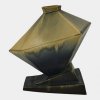
First-year exhibitors epoca from San Francisco (Were thrilled to be here) asked $7875 for a circa 1810 English Regency mahogany pyramid-form cabinet/cellarette with a drop drawer and two doors (in keeping with the Egyptian theme of the show). On top, the circa 1930 French Art Deco purple opaline vase with etched Middle Eastern decoration, signed Verart France (a trademark of Sabino glass), was $3550.
Originally published in the February 2010 issue of Maine Antique Digest. (c) 2009 Maine Antique Digest