







Sollo-Rago 20th-Century Modern

This exceptional 36½" x 117" x 30" buffet, created by Wharton Esherick, has a sculpted walnut top on a curved base with seven drawers flanked by two doors concealing a blonde maple interior. It is signed W.E. 1969 on the lower right door. The buffet sold for $335,500 (est. $275,000/375,000). 
Designed and branded by Pedro Friedeberg, this Hand chair with three-footed base and gilded finish sold for $19,520 (est. $3000/5000). 
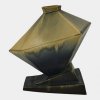
Claude Conover created this large (15¾" x 17") stoneware vessel Colima (titled and numbered 91.2 40) early in his career. Estimated at $4000/8000, it sold on the phone for $18,300, the highest price of the ten Claude Conover vessels in the sale. Another Conover titled vessel, Yibal, with an incised pattern as had Colima, sold for $15,860. One other Conover pot sold for as little as $3660. 
A 15" x 48" polyhedron clear glass Venini chandelier sold for $10,980 (est. $3000/ 4000), indicating that the strong market for choice lighting continues. |
Rago Arts, Lambertville, New Jersey by Lita Solis-Cohen Photos courtesy Rago Arts "The sale achieved my goals," said John Sollo after his last sale with David Rago. Sollo has retired from their partnership selling modern design objects and furniture at the Lambertville, New Jersey, auction gallery. "I wanted to empty the warehouse, and I wanted to end up with a profit, and we did that," Sollo said. The hefty sale catalog for the October 24 and 25, 2009, sale illustrated 877 lots, of which 639 sold for a total of $3,004,000 (including the 22% buyers' premiums). The hammer total was $2,442,300, more than a million less than the $3,569,300 hoped for, although the 73% sold rate seems respectable in these tough economic times. Rago gives a 2% discount for property purchased by cash, check, wire transfer, or money order, if paid within 15 days of the sale. Most buyers take advantage of the discount. Internet buyers must pay a 23% buyer's premium with no discount. Sollo and Rago said the sale did better than they had hoped. "We had good participation with around two hundred sixty phone bidders, one hundred seventy people on the Internet with LiveAuctions, and private buyers and some dealers bidding in the salesroom," said Sollo. Before the sale, Sollo and Rago sent out e-mails alerting bidders that post-sale purchases would have a buyer's premium of 24%, an attempt to discourage people from waiting until after the sale to try to make a deal. Sollo said at their last modern sale, $150,000 worth of items were sold after the sale. Upping the buyer's premium on post-sales may have pushed up the percentage sold at auction. Who knows? After the sale, unsold lots are posted on the Web site. Estimates were reasonable, and there were some bargains and some strong prices for works of high merit. "We had support from wealthy private buyers and some dealers. Lots of people came to preview. We were open for viewing for two weeks before the sale, and we accommodated anyone who wanted to take a look at any time," Sollo volunteered. Among the high points was an exceptional Wharton Esherick buffet with a sculpted walnut top on a curved base with seven drawers flanked by two doors concealing a blonde maple interior. It was signed "W.E. 1969" on the right door. Estimated at $275,000/375,000, it sold to a collector for $335,500. A Wharton Esherick hammer-handle chair with burgundy leather webbed seat from the Hedgerow Theatre school in Rose Valley, Pennsylvania, sold for $13,420 (est. $8000/12,000). An Esherick sculpted two-door cherry cabinet with a robin's-egg blue interior (est. $30,000/50,000) failed to sell, as did a sculpted walnut bookcase with a chartreuse-painted interior (est. $15,000/ 25,000). Buyers of George Nakashima furniture were also picky. Some ordinary pieces with reasonable reserves sold under estimates, and some did not sell. A few special pieces sold for their high estimates or more. For instance, a walnut double chest with eight drawers and a naturally tree-contoured free-edge top, estimated at $20,000/40,000, sold for $45,750 to an absentee bidder. A Minguren II walnut coffee table with a free-edge top and a single rosewood butterfly sold for $25,620 (est. $15,000/25,000), and a rare Nakashima chessboard, possibly the only one George Nakashima ever made, sold on one bid for $30,500 (est. $30,000/50,000). In the summer of 2009 the house of Phillip Lloyd Powell (1919-2008) on Route 202 in New Hope, Pennsylvania, was demolished. The large wooden door that looked medieval, made by Powell for his house, was salvaged and offered with a $45,000/65,000 estimate. It sold on one bid for $54,900 to Bruce Katsiff, director of the James A. Michener Art Museum in nearby Doylestown, Pennsylvania. That museum is known for its Nakashima room. Now it will have a door by another accomplished New Hope, Bucks County, woodworker. Other minor works by Powell failed to sell. The market for works by New Hope furniture maker Paul Evans was spotty. Sollo said there were no "drop-dead" pieces in the sale. Buyers responded with caution. A sculpted steel credenza with three inset slate pieces over four patinated and gilded doors sold for $19,520 (est. $20,000/ 40,000), but a hanging cabinet with a sculpted front and slate top, with a similar estimate, failed to sell. Two sculpted bronze barrel chairs with their original orange upholstery and swivel bases brought $9760 and $6100. The furniture of T.H. Robsjohn-Gibbings for Widdicomb was in demand. There was applause after a Mesa free-form coffee table with a Widdicomb label (est. $20,000/40,000) sold for $51,850 on the phone. A pair of T.H. Robsjohn-Gibbings for Widdicomb benches with webbed seats and brass legs sold for $5795. A pair of spindle chairs with ebonized wood and cream-colored fabric cushions sold for $3172. Furniture by Tommi Parzinger seemed popular. A nine-drawer black lacquer chest with etched brass pulls, estimated to sell for $18,000 at most, sold for $28,060, and the matching nightstands, estimated to sell at $9000 at most, fetched $17,080. Some of the sculptural chairs by Vladimir Kagan sold over estimates. For example, a rocker and ottoman sold for $12,200, well over the $9000 high estimate, and $7930 was paid for a walnut Contour armchair with cushions covered in moss green fabric, topping its $6000 high estimate. Some of Kagan's other designs did not sell or sold below expectations. Some studio ceramics topped their estimates, but prices generally seemed reasonable compared with those of three years ago. Jun Kaneko, who lives and works in Nebraska, is known for creating huge ceramics. He often makes what he calls Dango forms (dango means dumpling, i.e., rounded form, in Japanese). In the past he made smaller Dango forms. A 22¼" Dango form in this sale, signed and dated '98, sold for $13,420 (est. $4000/6000) to collectors in the salesroom. (There are five large Dango forms currently on view at the Philadelphia Museum of Art, celebrating the artist's design for the opera Madama Butterfly.) Among other ceramics offered, vessels by Claude Conover sold for as much as $15,860 and $18,300 and as little as $3660. Ten by Conover were offered, and ten sold. A Peter Voulkos charger in his rough, granite-like glaze, signed and dated, sold for $12,200 (est. $10,000/15,000). A massive (17½" x 23½") stoneware blue-gray vessel by Ruth Duckworth with inlaid abstract design, signed "R 80," sold for $7320 (est. $4000/ 6000). Buyers snapped up silver, including flatware sets, at good prices, especially by Georg Jensen. A 1927 lunch service for eight (and seven serving pieces) in the Pyramid pattern by Harald Nielsen for Georg Jensen sold for $4575. Of the nine sculptures cataloged as created by Harry Bertoia, seven were actually by his son, Val Bertoia (b. 1949). Two small sculptures, called Bush forms in the trade, were consigned by Harry Bertoia's good friend and neighbor Guy Tomme, who was upset that his genuine pieces were sold in the company of knockoffs. John Sollo said he meant to withdraw the Val Bertoia sculptures and added that he would rescind the sales of the two that sold. One of the small Bush sculptures brought $18,300 from a member of the trade. The other failed to find a buyer. There were also 13 two-dimensional artworks by Harry Bertoia, many of which sold. The photos and captions show more of the stars of the sale, which Sollo said was the best he and Rago could muster from consignors reluctant to sell in an uncertain market. Sollo said he will miss driving truckloads of furniture across the country, and he is not sure what his next career will be. "I have a house in Montana in the wild, wild West and property in Colorado, and I still own half of this auction house and an interest in the estate sales, so I guess I am into real estate now. I am fifty-three and not ready to retire and become a farmer like my brother. I have never done anything longer than ten years, and David and I have been partners for twelve. I think I have one more career in me, but I am not sure what it will be. I was in the leather and hide business before I sold it and came into the modern auction market, when this market was at the end of the beginning. Now it's a mature market. I like being a pioneer. I'm not much for building towns; I like a new frontier. I am not sure what is next." For more information, call (866) 724-6278 or visit (www.ragoarts.com). Modern sales will continue at Rago Arts with David Rago and his wife, Suzanne Perrault, in charge, with the help of Chris Kennedy and others. Stay tuned. Originally published in the February 2010 issue of Maine Antique Digest. (c) 2009 Maine Antique Digest
Login or Register to post a Comment |