















The American Antiques Show, 2010

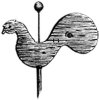
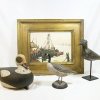
Stephen Score of Boston asked $20,000 for this large birdhouse. He said he needed to be in the picture to give it scale. 
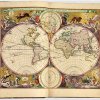
Russack & Loto Books LLC, Northwood, New Hampshire, used big letters to tell shoppers what they had for sale. 
Greg Kramer of Robesonia, Pennsylvania, offered a table, chairs, and a buffet from a Mississippi riverboat for $85,000. |
New York City by Lita Solis-Cohen Since the 1970's, the third week in January has been Americana Week in New York City. Nine years ago The American Antiques Show (TAAS) became a new addition to this jam-packed week of auctions and shows. TAAS took over the Metropolitan Pavilion at 125 West 18th Street, and it has remained there ever since. This year the show was held January 20-24. Over the years the show has changed; some dealers moved on to exhibit at the New York Winter Antiques Show, and others chose to exhibit at the less-costly Antiques at the Armory on Lexington Avenue at 26th Street. This year, acknowledging tough economic times, the show committee saw the need to reinvent the show. In the effort to inject new energy into the show, Ned Jalbert, an interior designer who is also a dealer in Native American art and an exhibitor, came up with a new floor plan that offered more spacious stands with multiple entrances in the front of the show and smaller functional stands in the rear. Carpeted aisles gave the show an elegant ambiance. Dealers felt good about being there, and sales were made. Who says brown furniture isn't selling? Gary Sullivan of Sharon, Massachusetts, and Peter Eaton of Newbury, Massachusetts, each sold ten or more pieces of brown furniture. (Eaton will tell you he sells his furniture as art, not just to store underwear in.) The word was out in ads that TAAS has more than just folk art. Folk art still dominates, but there is far more Americana of all sorts at TAAS than at the Winter Show, where only 12 of the 75 dealers sell American furniture or folk art, and there are half a dozen dealers in American paintings or sculpture. Gary Sullivan, who exhibits at one show a year, chose TAAS as his venue. Clocks are his specialty, and he sold tall-case clocks, dwarf clocks, shelf clocks, a banjo clock, two chests of drawers, a high chest, a Queen Anne armchair, andirons, and a barometer. Peter Eaton sold 11 pieces of brown furniture, including a William and Mary gate-leg table, a splayed-leg tea table, two candlestands, and a veneered flat-top high chest. He sold five pieces of furniture the week before the show when he pictured his stock on his Web site. Silver dealers Spencer Gordon and Mark McHugh of Spencer Marks, Ltd., Southampton, Massachusetts, said they sold plenty of silver, including three tea services. A six-piece coffee and tea service by Dominick & Haff went to the Detroit Institute of Arts. The dealers said it was the best example of Dominick & Haff's Aesthetic Movement style they had ever seen. The Corning Museum of Glass is going to buy the American Aesthetic Movement sterling and cut-glass canoe-form butter dish and condiment dish, circa 1890, that was advertised in the catalog. Spencer Marks also sold three pieces of Arts and Crafts silver by Arthur Stone and an English Art Deco silver tea set made by Charles Boyton in 1932. "It was our best show in three years," said Spencer Gordon. Peter Eaton explained that there are three parts to any show. "There's the run-up to the show when old customers call to find out what you are bringing or respond to your preshow ads; the show itself when people come and look and where new customers are made; and then the weeks after the show when those who have picked up your business card call and decide to buy what they have seen at the show or what they find when they visit your Web site." Eaton's wife, Joan Brownstein, said she made three sales the week after the show. At the show she sold a pair of portraits of Black children, made of leather and cloth, and a portrait of Israel Forster, attributed to Rufus Hathaway, that she had advertised. She also sold a Hudson River scene by Thomas Chambers and nine pieces of studio pottery by Edwin Scheier. Brownstein said that traffic at her Web site, which she launched in 2003, was 50% higher in 2009 than in 2008, and that January 2010 was a record month. "Those who say the market is dead must not be aware of the interest," said Brownstein. "Even if people did not buy last year, they kept looking, and this year began with enthusiastic buying." Others agreed. Timothy Hill of Hill Gallery, Birmingham, Michigan, said his Web site got more hits in January than any other month in the last three years. "We have been more attentive to keeping it up to date," he said. Such revelations demonstrate how important shows are to the trade. With high exhibiting costs and attendance down in recent years, many have wondered about the future of shows. If TAAS can be used as a bellwether, the future looks good. The gate was up, there was energy and enthusiasm at the opening Wednesday night and during the first three days of the show, and on Sunday people came back to buy. But TAAS is in New York City in January! Folk art dominated this show that benefits the American Folk Art Museum, whose endowment has fallen on hard times. The museum is in the process of financial restructuring. If the number of people who came to the $1000 ticket 6 p.m. opening of the gala benefit preview is any indication, there are some people with deep pockets who could bail out the museum. (If the preview ticket had been less than $1000, the crowd would have been a whole lot bigger.) The show benefits the museum's educational programs, including its innovative teen docent program that trains young people to lead peer groups through the museum. "It functions well in summer when they lead younger campers," said the museum's director, Maria Ann Conelli. "More than eight thousand schoolchildren enjoy the museum every year." Folk art dealer Allan Katz sold eight major works for big prices from his stunning booth right up front. A wooden cow weathervane ($145,000), a peacock sculpture ($165,000), a tobacconist figure ($85,000), a tea trade figure ($115,000), a group of three cast-iron firebacks with a Native American theme made in Chicago ($45,000), a wooden rooster, and at least six sculptures ranging from $10,000 to $20,000 all were gone by the end of the weekend. "People who collect Americana know they need to be in New York in January. Knowing this, we were determined to put our best foot forward. We made a great effort to make our booth fresh and alive," said Katz. "Most of those who bought are not decorating. They are collecting, and they make quick decisions and then worry about where they are going to put it." Katz said he found that tremendous energy is back in the marketplace. "I saw the market come back at this show; even those dealers who did not have spectacular shows did OK," he said. Only a few dealers sold as well as Katz. Leon and Steven Weiss of Gemini Antiques said they made 39 sales, with 13 on Sunday, including banks, toys, paintings, and three hooked rugs. "My mother bought my Noah's ark," said Steven Weiss. Textiles sold well. Stella Rubin of Darnestown, Maryland, sold quilts but not her most expensive ones. Amy Finkel of M. Finkel & Daughter, Philadelphia, sold her most expensive samplers and some that were moderately priced. Raccoon Creek Antiques L.L.C. at Oley Forge sold hooked rugs, ceramics, a lace-maker's lamp, a bucket bench, a blanket chest, and a late 19th-century Mennonite quilt, but a rare 1753 well-documented Pennsylvania German wrought-iron weathervane, worthy of a museum, remained unsold at $850,000. Stephen S. Powers of Brooklyn, New York, had a carved and painted cat by Oscar Peterson that was a show-stopper, but its $390,000 price scared buyers away. John Molloy of New York City had the earliest documented pair of Woodland Indian moccasins, but they remained unsold at $85,000. There were four dealers in American Indian arts with first-rate material, and there was interest in their wares from new and seasoned collectors. Ned Jalbert said he sold a second phase chief's blanket for a six-figure price. Ted Trotta of Shrub Oak, New York, found buyers for two mantas and a retablo. John Molloy sold kachinas and a Northwest Coast carved figure. Marcy Burns of New York City said she sold lots of jewelry, as well as baskets and textiles, which shows that the market is heading in the right direction, but she said there is still resistance to buying high-ticket items. Although Molloy said he sold from his top range, it was not selling like hotcakes. "It is a good time for savvy money to be in the marketplace," he said. Dealers have to sell a lot of items under $5000 to make booth rent, which at TAAS is $10,000 to $20,000 and more. Decoy and wildlife painting specialist Stephen O'Brien Jr. of Boston said his sales were in the lowest range. Just Folk, Summerland, California, sold an anniversary tin, but none of their Bill Traylor paintings, priced from $95,000 to $125,000. The Martin Ramirez painting at Ricco Maresca Gallery, New York City, remained unsold, but a large bent pencil, probably a trade sign, that turned up in New Hampshire last summer and was owned by several dealers until it found its way to Ricco Maresca during setup found a buyer at about $15,000. It caught everyone's eye. One could have amassed instant collections of anniversary tin or folk musical instruments at Just Folk; architectural banks from Gemini Antiques; treen plates from Stephen S. Powers; Indian beadwork made from Minnesota to Niagara Falls, much of it Iroquois, from Hill Gallery; or carvings by Clifton Sulser at Carl Hammer Gallery, all decorative and compelling en masse. TAAS gave the Americana market a jump-start and a shot of enthusiasm in the new year. For more information, check the Web site (www.theamericanantiquesshow.org). Originally published in the April 2010 issue of Maine Antique Digest. (c) 2009 Maine Antique Digest
Login or Register to post a Comment |