










A Silver Spoon and a Golden Yacht
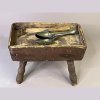
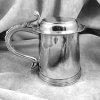
Thomaston Place Auction Galleries, Thomaston, Maine by Mark Sisco Although a James and John Bard portrait of a paddle steamer led the February 9 and 10 midwinter auction at Thomaston Place Auction Galleries in Thomaston, Maine, it was a ship model and a silver spoon that generated the best buzz. The leading lot of the day was the first of two steamboat portraits by the Bard brothers, James (1815-1897) and John (1815-1856). For reasons unknown, the brothers went their separate ways in 1850. John disappeared for five years, but he later turned up in an almshouse and hospital in New York City where he died. James continued painting until about 1890. The 17" x 34¾" (sight size) oil on canvas portrait of the steamboat Perry had been restretched and cleaned and a minor hole repaired. This is the painting that was reproduced in The Bard Brothers: Painting America Under Steam and Sail (1997), published by the Mariners' Museum in collaboration with Anthony Peluso, Jr. Signed and dated "Painted By J & J Bard 1845," it cleared its $30,000/ 40,000 estimate and brought a solid $48,950 (including buyer's premium). The next lot was a similar oil of another side-wheeler, the St. Nicholas, also by the Bard brothers. Signed and dated lower right "Painted By J & J Bard 1845," this ship portrait had some inpainting in the sky and water and a small repaired puncture or two. Auctioneer Kaja Veilleux reported that in April 1859 the St. Nicholas was on her way from St. Louis to New Orleans when the boilers exploded, killing the captain and 44 others and destroying the boat and cargo. The painting sold below its $20,000/30,000 estimate for $16,500. We suspect we're going to be learning more about Maine artist Jonas W. Holman (1805-1873) in the near future. The sitter for a 29" x 24" oil on canvas portrait by Holman was clearly identified with an inscription on the back, "John Chase Ag'd 20/ Bangor Aug 17/ 1835/ J.W. Holman Pinx't." Veilleux's research revealed that the long-lived Chase (1812-1912) built the first steam mill on the Penobscot River. In the painting he wears a beaded sash, indicating that he was a veteran of the Seminole Indian Wars. His son, John F. Chase, was wounded at Gettysburg and won the Congressional Medal of Honor at Chancellorsville. We found an on-line reference to a master's thesis being prepared on Holman, stating that he was a minister and a portrait painter in Boston in the 1830's, then graduated from Harvard Medical College in 1843. By 1857 he had moved to New York City, where he was again listed as a clergyman. Someone bought the portrait for $3025. Should the new owner want to sell it, it might be a good idea to wait until the thesis is published. All that was missing from a major ship model was caviar on the captain's table. The astonishingly complete and detailed 1:48 scale model represented pioneer automobile manufacturer Horace Dodge's private motor yacht, the Delphine, circa 1921. Everything on the model that looked like brass was actually gold plate, and the interior was illuminated by working electric lights. Of the three Herreshoff steam reduction engines, one worked inside the model, and another, mounted alongside the boat, was run by an electrically activated pulley system housed in the cabinet below. Ironically, both Horace Dodge and his brother, John, his business partner, died in 1920, shortly before the boat was launched. At that time, she was the largest yacht by tonnage ever built in the U.S., and the gargantuan vessel was used primarily for parties and other entertainment. In 1926 the behemoth came to an untimely, if temporary, demise. She caught fire and sank, but Anna Dodge, Horace Dodge's widow, ordered it recovered and restored. In 1942 the vessel was commandeered by the navy to serve in the war effort, but Anna bought it back following its wartime service. Now the vessel lives on under the ownership of a European businessman. The model was purchased in 1971 directly from the estate of Anna Thompson Dodge by the late television host Gene Rayburn (The Match Game), who was the son of the model's maker, Milan Rubessa, a Croatian machinist who immigrated to the United States. Rayburn wrote an article about the model, explaining how, upon determining to leave Croatia, his father and uncle could only afford passage for one. So the uncle nailed his nephew into a packing crate and had him shipped, with the uncle opening the crate each night so Milan Rubessa could eat and stretch. When the hammer fell, the model had a new owner for $39,600 (est. $15,000/25,000). The sale's most historically significant item was an enormous 18th-century coin silver serving spoon bearing three touchmarks of Philadelphia silversmith Philip Syng, Jr. (1703-1789), made for William West, Sr., a Philadelphia dry goods merchant. Syng became acquainted with Benjamin Franklin around the time of Syng's trip to England in 1726 and was a participant in many of Franklin's electrical experiments, a cofounder along with Franklin of the American Philosophical Society, and was the maker of an inkstand for the Pennsylvania Assembly, which was used for the signing of the Declaration of Independence. All three menWest, Syng, and Franklinwere signers of the Non-Importation Agreement of 1774, aggressively citing their opposition to the Stamp Act of 1765. An explanatory note suggested that the spoon may have been commissioned by Franklin as a wedding gift for West and his bride, Mary "Polly" Hodges, who were married on August 18, 1757. History and rarity made for a strong selling price of $19,800. For more information, contact Thomaston Place at (207) 354-8141; Web site (www.thomastonauction.com). © 2008 Maine Antique Digest
Login or Register to post a Comment |