

















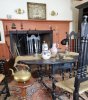


The Collector's Find: The Lost Shakespeare
The Collector's Find The Lost Shakespeareby Ben Mijuskovic Part I Approximately four and a half decades ago, museum curators, specializing in American Victorian furniture and the decorative arts, initiated a surge in research activity focusing on furniture pieces and decorative objects made between the 1840's and the 1890's in the United States, a period when the Industrial Revolution had propelled American commerce and trade to the forefront of the economic world. It was a time when economic enterprise in the United States was in a clear stage of ascendancy. Accordingly, during the third and fourth quarters of the 19th century our country witnessed the rapid expansion of furniture manufacturing centers from the industrial north and the agrarian south and onward toward the Mississippi River and the expansive west: from Boston, New York, Philadelphia, and Baltimore to Cincinnati, Grand Rapids, St. Louis, New Orleans, and eventually to San Francisco. At the same time, the captains of industry and finance were seeking to establish their own singular identities, striving to connect artistically with their respective European heritages while endeavoring to create and fashion their unique marks of individuality. a new American cultural context was undergoing transformation into a recognizable domestic imprint. As each industrialist sought to establish his own personal brand of immortality through connecting with past reminiscences of classical beauty, he purchased his furnishings from a finite number of well-known cabinetmakers and manufacturing firms. Thus, those who had amassed great wealth rather quickly also sought to be recognized just as rapidly for their aesthetic standards as well as for their more publicly acknowledged business acumen. For example, Henry Huntington of Huntington Library fame in San Marino, California, created an imposing library and scholarly reputation for himself at a single stroke. as a testimony to his intellectual tastes and values, he purchased an entire library with virtually an ex nihilo installation. To a great extent, this newly founded aristocracy of wealth replaced the ancient European historical connections with grand displays of a distinctly American style of beauty and grandeur. It was also during this time that some of these famous "robber barons" strove to establish themselves, each by his own particular style and by various aesthetic principles and methods in architecture, gardening, household furnishings, rich drapes and curtains, floor carpets and hanging tapestries, lighting, ceiling elements, sculptures, and paintings, and in a wide variety of the decorative arts and in household and kitchen appliances. (Note how ornate a seemingly simple product such as an embossed Arcade lemon squeezer, an apple peeler with its various gears, an Enterprise coffee grinder, a Singer sewing machine with its colorful decals, or a silvery nickel and ebony iron stove can be.) As this cultural phenomenon spanned the entire length and breadth of the nation, from William Vanderbilt's mansion on 5th Avenue in New York City, when he was the richest man in the world, to the Milton Latham estate, Thurlow Lodge, in Menlo Park, California, a palatial residence whose interiors and furniture were designed and embellished by the Herter Brothers establishment, we see the development of a powerful and distinctly American form of furnishings and decorative style come into a domineering prominence. Accordingly, a full half-century of exuberant and sophisticated aesthetic production was generated, which was ruled by master carvers, cabinetmakers, manufacturers, and their firms, which in turn were founded by such now well-known names as John Henry Belter, Alexander Roux, Pottier & Stymus, Kimbel & Cabus, the Herter Brothers, and Louis Comfort Tiffany in New York; Thomas Brooks in Brooklyn; John Jelliff in Newark; the Allen brothers and Daniel Pabst in Philadelphia; Mitchell & Rammelsberg in Cincinnati; Berkey & Gay in Grand Rapids; as well as many others. Some of these celebrated establishments provided an entire set of decorative possibilities to the growing class of the nouveau riche by treating the entire interior of the residence, including furniture products, ceiling fixtures, wallpaper, lincrusta, anaglypta, rugs, tapestries, staircase treatments, lighting fixtures, clock cases, wall paneling, newel posts, and curtains. Kimbel & Cabus was among the first to exhibit an entire room display at the 1876 U.S. International Centennial Exhibition in Philadelphia. Unfortunately, following the intractable heels of time, this dynamic industrial progress with its concomitant exuberant aesthetic expression was followed by a lengthy period of decline: a time when Victorian residences and their artistic interiors languished and were allowed to decay; when these seemingly overly articulate creations, with all their turrets and elaborate gingerbread decorations and cosmetic corbels, were considered overblown and inefficient. Many of the stately and magnificent Victorian mansions became partitioned and vivisected into boarding houses and small apartments. Tiffany lamps were regarded as gaudy and carelessly and unceremoniously discarded, and Victorian furniture was painted as a sacrifice of beauty in deference to utilitarian pragmatism. Thus it came to pass many years later that an aesthetic revolution was initiated when Albert Sack authored Fine Points of Furniture: Early American. It was almost 60 years ago when he, virtually at a single stroke, educated the more sophisticated and wealthy consumers within the public sector toward a deeper and more comprehensive appreciation of the furniture that had flourished from the period of the American Revolution and beyond into the 1820's. Whereas Wallace Nutting's twin tomes exposed readers to viewing photographs, limited to the visual appreciation of a wide variety of traditional pieces, Albert Sack undertook to edify collectors to the complexities of beauty and craftsmanship, to instruct them in the deeper penetrations of aesthetic values by pointing out how creative design, mastery of technique and execution, proportion, harmony, and quality of material all conspired to result in the best pieces of American furniture. Neither as sudden nor as dramatic were the concentrated efforts of a growing group of researchers and museum curators who some four and a half decades ago began producing a fundamental shift in our increasing appreciation of American Victorian furniture from rococo to aesthetic movement. Among the major research studies playing major roles in this gentle revolution were scholarly works: American Furniture (1962) by Helen Comstock; American Furniture of the Nineteenth Century (1965) by Celia Otis Jackson; American Antiques: 1800-1900 (1965) by Joseph Butler; The American Chair (1972) by Robert Bishop; The Furniture of John Henry Belter and the Rococo Revival (1981) by Marvin Schwartz, Edward Stanek, and Douglas True; Nineteenth Century Furniture: Innovation, Revival and Reform (1982), edited by Mary Jean Madigan; American Furniture of the 19th Century: 1840-1880 (1983) by Eileen and Richard Dubrow; American Furniture (1985) by John Bowman; In Pursuit of Beauty: Americans and the Aesthetic Movement (1986), Metropolitan Museum of Art; Herter Brothers: Furniture and Interiors for a Gilded Age (1994), edited by Katherine Howe; Four Centuries of American Furniture (1995), edited by Oscar Fitzgerald; Masterpieces of American Furniture from the Munson-Williams-Proctor Institute (1999), edited by Anna D'Ambrosio; and Art & Enterprise: American Decorative Art, 1825-1917, The Virginia Carroll Crawford Collection (1999) by Donald Peirce. As a point of historic fact and credit, it may be stressed that the current revival of interest in American furniture and decorative arts began around 1960 when the Brooklyn Museum held an exhibition christened Victoriana: Exhibition of the Arts of the Victorian Era in America. This public presentation offered an impressive survey of the accomplishments of American arts between 1830 and 1900 with the sequences of styles differentiated and discussed (see Schwartz, Stanek, and True, page 3). As an additional parenthetical note, it may be interesting to consider just what sort of people take an interest in such "objects of desire" and to reflect upon the three rather different motivational interests animating the pursuit of not only American Victorian furniture in particular but of all antique examples of aesthetic objects in general. Although these three psychological drives may be conceptually distinguished, and each fully capable of standing separately, nothing prevents them from being mixed together in the same individual. The first interest is that of the curator. Its founding principle is primarily objectively impersonal, historical, cultural, contextual, and social. It seeks to place objects within a larger whole. It strives to establish the artifact in relation to other creations of the same genre. Its special talent is grounded in research and considerable knowledge. It is the purest form of appreciation and interest. As Aristotle states, in the opening lines of Metaphysics, it is knowledge enjoyed for its own sake and intrinsic value. The second drive is primarily and essentially mercenary. It consists in a sphere of activity populated by dealer- hunters whose consuming thrill is secured by competing against other hunter-dealers and whose achievements are measured by the amount of remuneration ultimately achieved in compensation for the successful sale by gaining the greatest amount of money the market will bear. Its conclusion is trumpeted and heralded by an extrinsic sense of satisfaction, which translates into the hard sound of silver and gold. Last, there is the narcissistic desire of the collector who thrives on personal and intimate acquisitions. The narcissist delights in viewing himself, but also each rejoices by being admired by others. Every treasure secured only adds to a personal sense of aesthetic identity. -Part IIEvery second Sunday of the month, the Rose Bowl in Pasadena, California, hosts an antiques flea market that is rather well attended. Since Ruth and I live 50 miles away, we seldom travel the long distance, and although it's frequently not a successful adventure for us, nevertheless, on this particular occasion, having nowhere better to venture, we decided to take a chance. This outing turned out to be no exception to the rule. Often the interest, however, is generated by the variability of the crowd, and we spent about three hours wandering through the meandering rows of dealers, generally more pleasantly distracted by the human elements in the crowd rather than captivated by the proffered wares displayed by the dealers. Eventually, however, we did buy a nice N.C. Wyeth illustrated book, Drums, in very good condition, and an extra-large coffee glass jar with attractive labels on each side. They each cost $20. Feeling somewhat disappointed but not discouraged, we pushed on to the antiques malls on Fair Oaks Avenue in the central part of the town. At the first one, we ran into a dealer tending his stall who had not long ago operated a nice small shop half a block away, so we were rather surprised to see him in his new and much reduced setting. He told us that business had been slow for a long time, so he had decided to downsize. After we left the mall, we walked over to his old store and found it already occupied; it was their first day of business. Within minutes of entering the shop, we discovered a large Belter gentleman's chair. It had a beautifully sculpted head in a pronounced likeness of Shakespeare resting atop a sinuously curved crest, and the familiar rounded and laminated back. One problem, which concerned us upon closer inspection, was that the front legs appeared to be replaced. Otherwise, the finish looked original.
It was a consignment piece, and Marcus, the shopkeeper, was somewhat aware of its value although perhaps not of its relative rarity. Ruth and I remembered the form and the style from the Dubrows' book, as well as the Schwartz, Stanek, and True book, listed above, which both feature a Belter suite of four side chairs, two récamiers, and a couch. The women's chairs and the fainting couch all have crests with sculpted heads of Classical poets (Homer, Virgil, Dante, Chaucer, Milton, and, allegedly, Shakespeare [twice?]), while the sofa exhibits the busts of Washington, Jefferson, and Franklin. Despite our continuing concerns regarding the front legs, we both readily agreed that it was a special find, and there was no point in waiting another 35 years-the previous duration of our obsession with American antique furniture-on the chance of finding a more perfect example of the form. -Part III
Once we brought the chair home, it gave us the chance to compare it with the photographs in the two studies. The first thing that was obvious is that our chair was the only man's chair, while the others in the two books were women's seats. Second, the sculpted portraiture on our chair was definitely a much closer resemblance to Shakespeare, while the one on the side chair (Schwartz, Stanek, and True, page 48) and the récamier (page 66) in the pictured works clearly bore little resemblance to the Bard from Avon. In addition, the two busts of Shakespeare, on the woman's chair and the récamier, were very different. In both books, the portrait busts are reported to represent classic authorsVirgil, Dante, Chaucer, Homer (not pictured)on the chairs, and Milton and, supposedly, Shakespeare on the récamier. Again, however, ours is a close copy of the famous historical painting owned by James Brydges, the first Duke of Chandos, which exhibits the well-known receding arched domed forehead of Shakespeare, along with the accompanying inverted triangular collar at the base of the neck. The most worrisome aspect for us, as stated above, was grounded in the fact that the front legs on our chair betrayed a noticeable troublesome variation on the fluting of the legs, with ours displaying additional incising, and that was the source of our original discomfort and why we anxiously began to question the authenticity of the legs, specifically below the knees. The skirt or rail carvings, however, seemed to be genuine and appeared identical to the decorative features adorning the "Founding Fathers" couch exhibited in the Schwartz, Stanek, and True book (page 60) but different from the récamiers (page 66) companioned with the women's chairs.
Ruth and I naturally continued to speculate that our Shakespeare chair might be a missing element from the Manneys' Metropolitan Museum of Art set. The variation of the molded skirt elements, however, needed to be accounted for and explained. Another intriguing aspect of the puzzle was that there were no armchairs in the Manney collection. One would have expected probably two men's chairs in the grouping. In a certain sense, it seemed strange that such a clearly masculine literary theme, possibly intended for a library, consisted of four women's chairs and twin fainting couches but the absence of a single armchair. In an effort to resolve some of our uncertainties, we contacted the Metropolitan Museum of Art, providing them with a full set of photographs of our chair from a variety of perspectives. We had been aware that the Manney collection had been on loan for many years, so the Met was the obvious arbiter for our concerns. What follows is, in part, the Met's response as written by Nicholas Vincent. "The front legs on your chair appear to have been replaced just below the carved knee, and it looks like they were originally identical to the legs shown in detail on page 48 [of the Schwartz, Stanek, and True book]. Looking at the detail of the leg in the book, if you were to substitute the lower section of that leg (from the thin turned ring just below the carved knee and down to the casters) with the lower section on your chair (from the turned spool just below the carved knee and down to the pad foot), you would have a unified piece.
"The sofa on page 66 has a lower leg design that is an identical albeit compressed version of the chair on page 48 (and your chair originally). Since the sofa has the same crest design on its bottom rail, it is possible that your chair and the sofa were part of the same suite. "Interestingly enough, the Manney suite has been removed from the Metropolitan Museum, and it has been sold through a high end Belter dealer in Texas. I have shown him photographs of our find, and he thinks it is likely that the chair was part of the original grouping, 'since it matches the set in the Stanek book of the Manney collection.' He is also guessing that besides a second armchair probably another sofa constituted the complete set as well." Frankly, the decision to replace the legs was as easy as the original decision to purchase the chair in the first place. As stated at the beginning of this article, unlike the family heirlooms, which have been preserved and cherished for generations, descending from families connected with the Revolutionary War, Victorian pieces went through a long period of neglect. Restoration essentially meant rescuing thousands of museum-quality pieces that would otherwise have been lost. The restoration of the legs on our chair was performed by Angela McDowell, a graduate of the University of Manchester in England and a recipient of the Sonneborn and Rieck Student Award from the British Antique Furniture Restorers Association. -Speculative Conclusions The Manney set was acquired as a complete suite. Thematically, it consists of two major themes. The first symbolizes a historical spectrum of great poets: Homer, Virgil, Dante, Chaucer, Milton, and, I would argue, two unaccounted poets. The Shakespeare chair would go a long way in bridging that representational literary hiatus. By contrast, the "Founding Fathers" couch displays the portrait busts of three prominent early American political figures: Washington, Jefferson, and Franklin. My feeling is that the original owner of the suite, not unlike Henry Huntington, wished to intimately exhibit his twin values, which consisted in a sincere appreciation for great literature and an equally deep sense of patriotism. As to the question of the variation of the decorative elements on the rails of the Shakespeare chair and the remaining poets' chairs and récamiers, I would submit two very compatible possibilities. First, that the identical carvings on the skirts of our larger chair and the Manney sofa serve as an aesthetic transitioning link connecting the couch with the less expansive seating pieces; and second, that the man's larger rail surface provided the opportunity to display a wider decorative element. In short, I believe it is very likely that the Shakespeare chair is directly related to its Manney siblings. Perhaps one way to tell whether they do share a common genealogy would be to assemble the entire literary family together and test their finishes. If all the chairs and récamiers, ours included, have retained their original finishes, then presumably a chemical "DNA" analysis would reveal their true identities. Whatever the Shakespeare chair has endured, whatever travels and trials it has experienced in the past, its future is secure. It will enjoy a secure place in our parlor, paired on one side of a J. & J.W. Meeks center table and partnered with a Henry Ford man's chair on the opposite side, a bottle of brandy and two glasses on the table between them, along with a half-completed chess game. © 2008 Maine Antique Digest
Login or Register to post a Comment |