












Three Days in Portsmouth End Productive August for Northeast Auctions
Northeast Auctions, Portsmouth, New Hampshire 
The pen and ink, gouache, and watercolor of long-haired squirrels on 23½" x 18½" Whatman paper is the original by John James Audubon for The Viviparous Quadrupeds of North America, 1841-45. Nothing is known about its earliest years other than it was found in the street stalls of a Boston bookseller in the 1930s. A phone bidder took it here for $458,000. |
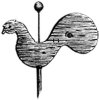
The number of maritime, China trade, and sporting art lots waiting to be sold in Portsmouth, New Hampshire, at Ronald Bourgeault's Northeast Auctions' August 15-17 event can seem overwhelming to newcomers to these sales as well as those who come back year after year. There were 1756 lots at various locations: at the warehouse, up in the third-floor offices of the Treadwell House, hanging inside on walls, stacked and hung up on the second floor, or on tables down in the basement. It's not quantity over quality here, though. Bourgeault and relief auctioneers Peter Coccoluto and John Lipinski sell as fast as humanly possible, and the threesome rack up the numbers day after day, often at over 100 lots an hour, but when the threat of a thunderstorm approaches, as it did late on Saturday, Bourgeault proved he could spit out the lots at an over-two-lots-per-minute rate. Do that with a bank of ten phone bid takers competing against left bids and a full crowd under the tent, and it seems more like an Olympic event than an auction. On Friday, the first day, the gross sales were $1.5 million; Saturday, $3.5 million; and Sunday, $2.924 million. Total for the three days was $7.924 million. Despite the many mainstream $150 to $1500 lots, there are always several lots in every session that drive bidders bonkers and satisfy both the consignor and the auctioneer. On Friday, for example, just after a codfish weathervane sold for $936 (includes buyer's premium), a seven-volume set of Audubon's Birds of America sold for $70,200, and two lots later an original Audubon watercolor of long-haired squirrels fetched $458,000. Saturday was devoted entirely to the famed J. Welles Henderson maritime collection, and even the Northeast staff was surprised to see the numbers it racked up. Cut-paper ship records and ship silhouettes sold for $32,760 and $46,800; a pair of rather primitive oils of a Nantucket whale ship at work in 1821-22 sold for $370,000 to someone representing the Nantucket Historical Association; a figure of a jolly Jack Tar, the very same figure used on the cover of Henderson's book, brought $337,000 from dealer Alan Granby of Hyland Granby Antiques bidding by phone; and on and on it went. Granby picked up six lots from the Henderson collection and another 15 from the various collections scattered throughout the three-day sale, including material from Philadelphia collector S. Robert Teitelman. "I sold Jack Tar to Welles," Alan Granby said in a follow-up conversation. "This was a rather emotional sale for us. Both Welles and Bob Teitelman were mentors for Janice [Hyland, his wife] and me. They spent almost a week with us every summer for the last twenty years, so losing them was tough."  | This is Jack Tar, the prize among lovers of ship figureheads, trade figures, and cigar-store Indians, and the figure used on the jacket of Hendersons book, Marine Art & Antiques: Jack Tar, A Sailors Life 1750-1910. Jack Tar is 86½" high and attributed to New York carver Jeremiah Dodge (1781-1860). It used to belong to Frederick Fried, the author of Artists in Wood and A Pictorial History of the Carousel. Northeasts head of client services M.L. Coolidge handled the phone when it sold, and after getting it for that bidder, said, Alan says thank you, Ron. That told everyone concerned that her bidder, number 660, was Alan Granby of the celebrated Hyland Granby Antiques, a maritime antiques shop, who had sold Henderson many of the pieces in the collection, including Jack Tar. To get it back cost Granby $337,000. Henderson collection. |
If anyone expected the numbers to drop at Sunday's offerings, they were wrong. An 82" long carved spread-wing eagle from a sternboard of a 19th-century ship brought $183,000; a rare China trade reverse portrait on glass (est. $40,000/60,000) sold for $93,600; a scrimshawed whale's tooth with Pitcairn Island association (est. $30,000/45,000) brought $144,500; and a pair of oil on linen views of the hongs at Canton and the Praya Grande at Macao by Chinese artist Sunqua soared to $216,000. 
The carved spread-wing eagle with E Pluribus Unum banner and furled flags is 82" long and carried a $40,000/60,000 estimate. Massachusetts dealers DR Fine Arts got the sternboard eagle for $183,000. |
The mind-numbing 1756 lots spread over three full days exhausted staff and bidders alike. But golly, this was one hell of a sale! Now for the details of the lead collection, the J. Welles Henderson maritime collection. Henderson, who died in 2007 at 86, began collecting marine objects and material concerning his favored port of Philadelphia at age seven and was still collecting up until his death. He supported and/or donated to all the museums connected to his chosen subjects. Those institutions were well represented at the Saturday single-owner sale. Lori Dillard Rech, the president of the Independence Seaport Museum, was seated in the front row; Daniel Finamore of the Peabody Essex Museum sat in the rear; and bidders for the U.S.S. Constitution Museum, the Kendall Whaling Museum, and the Nantucket Historical Association were on hand. The material Henderson amassed for his acclaimed book, Marine Art & Antiques: Jack Tar, A Sailor's Life 1750-1910 (Antique Collectors' Club, 1999), written with the assistance of Rodney P. Carlisle, was wonderfully diverse. Anything connected to an average seaman of that time was collected by Henderson, from items commemorating the wealthy ship owners and their vessels to the tools-weapons, really-the cat-o'-nine-tails and cudgels, used by the sometimes tyrannical officers to maintain order; from the clothes they wore to the carved dippers they drank from and their solitary arts-scrimshawed pieces, shell collections fashioned into valentines, intricately carved beckets for their sea chests; and the memorials made by the ones they left behind. It was all fair game for Henderson. The museums were particularly attracted to the documentary material Henderson amassed over his nearly 80 years of collecting, such as sketchbooks and diaries kept by sailors, the letters they wrote home, and photographs and logs. There was even a photograph of the baseball team composed of men from the battleship Maine, taken sometime before February 15, 1898, when the Maine exploded and sank in Havana harbor. Only one of the players in the photo survived the blast. How do you value that rarity? (The question was answered with a $1638 winning bid.) The allover embroidered sailor's ditty bag, "the ditty bag to end all ditty bags," Bourgeault called it, had eagles, a shield, cannons, the Washington Monument at Baltimore, flags, and multicolored stars, motifs that remind viewers of the blocks found on Baltimore album quilts. What's it worth? Representatives of the Peabody Essex Museum took it for $42,120. 
The ditty bag to end all ditty bags! Ron Bourgeault called it, and he was right. Thirty inches of white linen decorated with absolutely great embroidery. Claimed by the Peabody Essex Museum for $42,120. Henderson collection. |
The China trade shipper's log detailing the loading of the ship Thomas Scattergood in Canton for trips to Philadelphia in 1818 and 1821 was worth $9360 to someone. The manuscript journal of the 125-day passage from Canton to Boston by the ship Astrea, via the Sunda Strait, where she lay anchored for 18 days when the winds vanished, had a description of the volcanic activity surrounding Krakatau in 1790. Northeast guessed it might be worth $400/800, but it sold for $18,720. Eight lots of sketches, drawings, and watercolor paintings on papers of various sizes by Lieutenant John B. Dale from the Wilkes Expedition of 1838-42 and the U.S.S. Constitution's around-the-world cruise of 1844-46, of various locations and subjects, including one group made in Hawaii, brought a combined total of $217,620. The canvas-bound diary with watercolor illustrations kept by British sailor George Hodge, "Consisting of Difrint ports & Ships that I have being in since the year 1790, Aged 13 years," sold to rare book dealer Greg Gibson for $128,000. Obviously unschooled, Hodge still created something worth a figure he never could have imagined. Those figures were unexpected, as Northeast's assistant auctioneer Peter Coccoluto noted. "We figured a lot of those paper lots would bring maybe four thousand to five thousand each, tops, if they even did that well, not the sixteen thousand to thirty thousand some are bringing, and up. Those are just phenomenal prices." The J. Welles Henderson sale was an event, one that should find a place among other memorable marine sales of the past, such as the Barbara Johnson whaling collection sales at Sotheby's, 1981-83. For more information, call Northeast Auctions at (603) 433-8400 or see (www.northeastauctions.com).
The Importance of Primary Sources and Original ManuscriptsDealer Gregory Gibson wears at least two hats. He is the proprietor of Gloucester's Ten Pound Island Book Company, specializing in material dealing with the sea, whaling, and maritime art in general. He also sells rare clipper ship cards, a great specialty among trade card collectors. Gibson is the celebrated author of several widely acclaimed books, including his latest, Hubert's Freaks, the adventures of a dealer in rare books who discovers a treasure load of Diane Arbus's photos among the detritus of a New York City freak show (see M.A.D. June 2008, p. 36-A). 
A sample page from a British sailors diary from about 1790-1833. George Hodge recorded going to sea on the brig Margery at age 13, a later impressment, and being a prisoner during the Napoleonic Wars, and the sights, sounds, and smells he encountered during those years. A Gloucester author (who is also a bookseller, collector, and dealer) paid $128,000 for it. He also paid $22,230 for an 1812 account of the trial of a ship captain for murder, piracy and manstealing. Henderson collection. |
Greg Gibson was an active bidder at the sale, making ten purchases on Saturday, including the rare 1790-1833 diary of British sailor George Hodge for $128,000. He spent just under a quarter of a million dollars on his purchases. We reached him at his Gloucester bookshop. "It was a gratifying event for me for a number of reasons," Gibson said, "the first of which is Welles had been a customer of mine for many years, and I helped him assemble quite a bit of the stuff, so it was like revisiting old friends. "The results of the auction, including not just the stuff I bought but a lot of the stuff in general, just emphasized something that has been becoming more and more clear to me over the past few years. It is that books have kind of reached their level as far as value. Everybody knows what they're worth. The big ones are really expensive, and they are only accessible to people with unlimited resources. All that information about the great books is out there; everybody has access to it. There are no surprises; there are no bargains. If you want a Cook's Voyage you are going to pay top dollar for it no matter where it shows up, some Podunk auction or a big sale like this one. "But this has got a corollary, this is the important part, and this is what I've been not only preaching for years but following myself because it's dictated a change in my own business. "Manuscript material by its nature is unique. There are no comparative values. "When a set of The Voyages of Captain Cook comes up you can compare it to auction records from catalog sales of the past thousand years. [But when] a manuscript of one of the sailors on Cook's expedition comes up, it's unique. It has no comparison. "Its value is based upon the story behind it, the knowledge of the people that buy it, the knowledge of the people that sell it. And what happened in this auction that caused Ron to be delighted and surprised and caused everybody else to be shocked was this manuscript material. People are beginning to realize that this is an enormously undervalued part of the goods that we deal in. And manuscripts are becoming recognized, and people are starting to understand the potential of manuscript material. "Let me give you an example now. The Voyage of the Potomac around the World [lot 555], it was the beginning of America's imperialistic power. We stopped off at this place in Sumatra called Quallah Battoo, bombed the heck out of them as a reprisal for attacking one of our ships the year before. In a little country auction twenty years ago, I was the underbidder for another sailor's account, and it went for an enormous amount of money. It went for thirty-five hundred dollars. Well, now this thing came up, and it costs me eleven thousand to buy it. And I think it's worth a hell of a lot more than that. "It's the manuscript material. It's uniqueness. "People have to work a lot harder to get it, to understand it. You know, Thomas Handasyd Perkins was one of the great China traders. His log of his trip to China in 1790 in the Astrea [lot 714], it was probably his second or third voyage out there. Five years ago that would have gone for a few thousand dollars. This year it cost almost twenty thousand dollars to buy it. People are starting to get that this stuff is really important. We're going to be finding Cook's Voyages forever. But we're never going to find another journal of Thomas Handasyd Perkins. "I've been trying to educate the customers about this importance, and it's so gratifying to me to see that it's finally starting to get some traction in the marketplace. © 2008 Maine Antique Digest
Login or Register to post a Comment |