


















Book Reviews
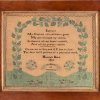
Book ReviewsThe Human & The Eternal: Shaker Art in Its Many Forms by Sabbathday Lake Shaker Museum (United Society of Shakers, 2008, 69 pp., softbound, $30 postpaid [check or money order only] from United Society of Shakers, 707 Shaker Road, New Gloucester, ME 04260; [207] 926-4597; [www.shaker.lib.me.us]). This past summer and fall, as part of the 2008 Maine Folk Art Trail (a series of folk art exhibitions at 11 museums statewide), the Sabbathday Lake Shaker Museum in New Gloucester, Maine, mounted the exhibition The Human and the Eternal: Shaker Art in Its Many Forms, which closed on October 13. This book, published to accompany the exhibition, includes examples of Shaker work from the 18th to the 21st centuries from nine Shaker villages. Many of the items pictured are of a more personal nature than what is usually associated with the Shakers. The 119 objectspaintings, textiles, woodenware, baskets, books, and pieces of furnitureare illustrated in color with descriptive captions that identify the maker, when known. Essays accompanying the catalog include "The Place of Gift Drawings in Shaker Life" by folklorist Daniel W. Patterson; "Shaker Arts and Crafts: An Unexpected Legacy" by Gerard C. Wertkin, former director of the American Folk Art Museum; and "Many Beautiful Useless Things: Shakers and Their Folk Art Tradition" by Brother Arnold S. Hadd of Sabbathday Lake. A number of remembrances of Shaker community members by Sister Frances A. Carr are also included. In his notes in the catalog, curator Michael S. Graham comments that some might "scoff at the juxtaposition" of objects such as decorated plastic boxes or a paint-by-numbers scene with "quintessential Shaker artforms" such as gift drawings. He argues that these items represent not what is Shaker but "rather who the Shakers were and are today," providing insights into the "personal expression, creativity and talents of the people who have aspired to live the Shaker life."
Van Gogh and the Colors of the Night by Sjraar van Heugten, Joachim Pissarro, and Chris Stolwijk, with contributions by Geeta Bruin, Maite van Dijk, and Jennifer Field (Museum of Modern Art / Van Gogh Museum, 2008, 160 pp., softbound, $30 from the Museum of Modern Art, [www.momastore.org] or [800] 447-6662). Who doesn't appreciate van Gogh's iconic jewel-toned The Starry Night of 1889, a detail of which is shown on the cover of this fine book? This publication accompanies the exhibition of the same title showing at the Museum of Modern Art (MoMA) in New York City until January 5, 2009, and scheduled for the Van Gogh Museum in Amsterdam, the Netherlands from February 13 to June 7, 2009. Focusing on Vincent van Gogh's stunning nocturnal interiors and his expressionistic landscapes at twilight, the book's authors explore the artist's artistic and literary influences, his interest in peasant life, the spiritual quality in his landscapes termed "the poetry of the night," and his Modernist approach to painting twilight. Van Gogh's melding of the natural life with his imagination is confirmed through quotes from his writings and such nocturnal images as The Evening Walk and Country Road in Provence by Night. Van Gogh stated, "It often seems to me that the night is much more alive and richly colored than the day." This is affirmed through visuals depictingand text coveringthe artist's fascination with night in its many aspects, including dusk, the setting sun, the glow of lights, the need to rest at night, and artificial and natural night light. Various chapters discuss the nocturnal theme in van Gogh's own writings, the technical and stylistic aspects of his night scenes, inspirational literary references, and, most notably, the artist's extraordinary achievement in his use of color in depicting twilight and night. Reproductions of masterpieces such as The Potato Eaters (van Gogh's first major canvas and his first interior night scene), The Night Café, The Dance Hall in Arles, The Sower, and Terrace of a Café at Night are enhanced by a look at visual detail, historic background, and important associations. Also included in the book are images of works by influential artists, notably Millet, Corot, Rembrandt, Rousseau, Breton, Monet, Seurat, and Gauguin. In addition to references to van Gogh's writings, which clarify the artist's intent to turn darkness into color and which certainly help the authors "get inside" van Gogh's mind, this volume traces the artist's travels and his artistic effort, including studies and sketches. An excellent bibliography is included, as are separate indices of people, places, and works of art. Rose Safran
The Pottery of Zoar, Ohio: Research and Photos of Known Zoar Pieces by Jack E. Adamson (The Zoar Community Association, 2007, 122 pp., hardbound, $60 plus postage from the Zoar Community Association, c/o Jack Adamson Antiques, PO Box 429, Zoar, OH 44697; [330] 874-3918). The village of Zoar, Ohio, was founded in 1817 by German separatists, who lived in a society in which they held "all things in common" and produced almost everything that they needed to be self-sufficient. The region had rich clay deposits, and community members began producing their own pottery, bricks, and roof tiles, many examples of which are pictured in color with complete descriptions. Although the Zoar Society disbanded in 1898 and divided its assets among the members, many continued producing items from the local clay. The book's illustrations include vintage photographs and ephemera, offering a glimpse into the work of the town after the sect dissolved. A bibliography and glossary of terms are also included.
American Bookplates by William E. Butler (Primrose Hill Press, 2000, 166 pp., hardbound, $29.95 from Primrose Hill Press, Inc., 155 Mt. Rock Road, Newville, PA 17241-8916; [717] 776-7359; Pennsylvania residents add sales tax). "Books Received" customarily includes only recently published books. Nonetheless, this book and An Engraver's Globe are included this month because only this year have they become easily available in the U.S. American Bookplates begins with information on identifying and collecting bookplates, joining a society for collectors, and commissioning your own bookplate. Much of the text is devoted to brief biographies of the masters of American bookplate design. A generous selection of bookplates, mostly in black and white, illustrate the text. Lesser-known designers are listed together in one chapter. Rounding out the book are chapters on "Recommended Reading," "Bookplates and Information Technology," and "Technical Symbols for Bookplate Design" and an index. Unfortunately, most of the listings in the "Information Technology" section are now out of date, but a Web search of selected keywords quickly located more up-to-date Web addresses.
An Engraver's Globe: Wood Engraving World-Wide in the Twenty-First Century by Simon Brett (Primrose Hill Press, Inc., 2002, 475 pp., hardbound, $75 from Primrose Hill Press, Inc., 155 Mt. Rock Road, Newville, PA 17241-8916; [717] 776-7359; Pennsylvania residents add sales tax). This book opens with an overview of wood engraving and its methods. The bulk of the book offers brief biographies of 225 contemporary wood engravers from around the world, listed alphabetically by name and accompanied in most cases by several examples of each artist's work. The book closes with a listing of the artists by their country of residence and gives a brief overview of the current state of wood engraving in each country. This book provides a splendid opportunity to view and compare in a single volume the diverse styles and techniques of many fine graphic artists.
Album Quilts of Ohio's Miami Valley by Sue C. Cummings (Ohio University Press, 2008, 128 pp., softbound, $19.95 from Ohio University Press, [www.ohioswallow.com] or [800] 621-2736). Album quilts were made for presentation to specific individuals and contained personal messages and genealogical information. An appliquéd eagle was a motif common to the album quilts of the Miami Valley of Ohio from 1888 to 1918. The author has collected these quilts for over 35 years, and during that time she has meticulously researched the quilts, their makers, and their recipients. Part textile history, part genealogy, and part detective story, this book shares Cummings's research journeys while giving the reader a look into life in southwestern Ohio around the end of the 19th century. It contains more than two dozen color photographs of these folk art quilts, plus area maps and vintage photographs, and includes a full index, a glossary, and a bibliography.
Electra to the Rescue: Saving a Steamboat and the Story of Shelburne Museum by Valerie Biebuyck (David R. Godine, 2008, 48 pp., hardbound, $17.95 from David R. Godine, [www.godine.com] or [800] 344-4771). Have you ever looked for a book about folk art and antiques that might suit a young reader? Such books are not common, but here is a nicely illustrated one. The heroine is Electra Havemeyer Webb, the vivacious matriarch of collecting folk art and an inspiration for many other patrons of the arts. Trying to imagine how I would respond to the story if I were a child, it came alive best in places such as when she boated to a condemned lighthouse, wiped aside decades of spider webs in its rooms, and decided right then to move it to her museum for safe keeping. The archival pictures and their captions help enlarge the story considerably. The book is supplied with a charming, generously spirited afterword by one of Electra's great-grandchildren (who also loves art), a one-page glossary of names with miniature explanations suitable for young readers, and a short bibliography of suggested reading to further the pursuit of folk art and, by extension, the appreciation of arts and antiques in general.
Warman's Antiques & Collectibles 2009 Price Guide by Ellen T. Schroy, edited by Tracy L. Schmidt (Krause Publications, 2008, 800 pp., softbound, $24.99 from KP Books, [www.krausebooks.com] or [800] 258-0929). The latest edition of this annual price guide devotes over half of the book to ceramics, furniture, glass, jewelry, and toys; the rest covers miscellaneous categories. Thousands of items are listed alphabetically and priced-the prices obtained from auctions and from dealersand over 2000 objects are pictured in color. The page edges are color-coded by subject, the type is easy to read, the format very user-friendly, and the book fully indexed. The introduction explains the layout and organization of the book and offers thoughts on the state of the market. We hope the rest of the book has been more carefully edited and fact-checked than the section on references, which lists six publications. One of the six (Antique Review) ceased publishing at the end of 2006, and the listings for three of the others (including M.A.D.) provide incorrect mailing or Web site addresses.
Silk Art Embroidery: A Women's History of Ornament & Empowerment by Donna Cardwell (Schiffer Publishing Ltd., 2008, 160 pp., softbound, $29.99 from Schiffer Publishing, [www.schifferbooks.com] or [610] 593-1777). Silk art embroidery was popular in Victorian America from 1877 until around 1912. Commonly embroidered items included decorative items for the home, such as centerpieces, doilies, tea cloths, and napkins, and Cardwell lists the "universal hallmarks" of this specialized area of embroidery, also known as "needle-painting." This book illustrates typical motifs, which were created in a realistic style, types of stitches, fabrics, and edging and finishing techniques. Many beautiful examples are illustrated, along with details such as size, fabric, condition, and dates. The book devotes a chapter to Candace Wheeler and The Society of Decorative Art, which Wheeler started to help women of meager incomes, "to encourage profitable industries among women who possessed artistic talent, and to furnish a standard of excellence and a market for their work." The society held classes in needlework and china painting and provided exhibition space for women artists. The "matchless beauty" of silk art embroidery creations is that "they were created by someone who labored over each stitch and took pride in their work." This is an interesting book about a small piece of American women's history, homemade decorative arts, and antique linens. © 2008 Maine Antique Digest
Login or Register to post a Comment |