













In the Trade: Wayne Edsforth, Greenwich Hardware Antiques, Greenwich, New York
by Frank Donegan 
Exterior of the shop in Greenwich, New York, with the old stained-glass sign that spans the front of the building. 
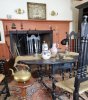
Wayne Edsforth in his shop. 
Group of pleasant, useful Windsors, some with minor repairs, ranging from $95 to $395. |
We visited Wayne Edsforth during one of the worst weeks the stock market has endured since the Great Depression. The Dow was dropping six or seven hundred points a day. Banks were either collapsing or getting taken over by the government. Folks like me, who normally have trouble balancing our checkbooks, were worrying about derivatives, naked shorts, mortgage-backed securities, and credit default swaps. Edsforth, however, seemed remarkably calm about this state of affairs as we chatted in his chock-full shop-the type of large and comfortable local antiques shop that used to be common but that you don't see much anymore. His calm may stem from the fact that he's been through all this before. It was exactly this sort of market turmoil 18 years ago that prompted him to open his antiques shop in the charming country town of Greenwich, New York, about 15 miles east of Saratoga Springs and ten miles west of the Vermont border. During the 1970's and '80's Edsforth and his wife, Maureen, were living the suburban life in northern New Jersey. They had met while attending the University of Dayton. He spent four hours a day commuting back and forth to New York City working for various banks, eventually landing at Drexel Burnham Lambert where he was head of human resources for 13 years. Drexelas those of us of a certain age rememberwas the junk bond pioneer that collapsed in 1990. There are those who see a direct line from Drexel's "innovations" to the bizarre financial products that recently undid such institutions as Lehman Brothers and Bear Stearns. In any case, Edsforth woke up one morning in 1990 to find he was no longer head of human resources at Drexel. He was one of thousands who had lost their jobs. "Some guys at the top took too much risk and went bankrupt," he said. "And I lost all my retirement funds." That was enough, he said with considerable understatement, for him and his wife to ask themselves, "Why don't we do something different?" So they did. The couple had earlier bought a weekend house in Greenwich. (It's not pronounced like the Connecticut "Gren-itch." Rather it's "Green" as in the color and "witch" pronounced like the people who fly on broomsticks. A green witch is the mascot of the local sports teams.) After the Drexel collapsewhile Edsforth cleared up details from his former life-his wife took their two sons to the house upstate. "They came up for the summer," he said, "and never came back." The couple had been collecting antiques-mostly countrysince the 1970's and decided that the "something different" they would do with their lives would be to open an antiques shop in Greenwich. They looked for a building to buy. There were lots for sale. Greenwich then was not the thriving town it appears to be today. "There were a bunch of empty stores," Edsforth said, "but most of the buildings had apartments, and we didn't want to be landlords." But in small towns word gets around. "A guy in his sixties had a clothing store. He called and said he would be retiring," Edsforth said. The building was smack in the center of town. It didn't have apartments. It was two blocks from home. They bought it. The building that houses the 3000-square-foot two-floor shop (with a small barn out back, too) was built in 1842. Among other things, it has housed a hat maker, a coffin and chair maker, and a tailor, but for most of the time after 1880 it had been a hardware store. Underneath some boards on the front of the building Edsforth uncovered a stained-glass sign, "Greenwich Hardware," hence the name of the shop. Before too long, Maureen, who has a master's degree in educational technology from Pepperdine University, got a job with the local school system, so the business has been Wayne's project for most of its existence. Edsforth credits Riverdale, New Jersey, dealers Joan and Jim Fenstermacher for encouraging his early forays into antiques at their shop, Colonial Farm Antiques. "We always enjoyed their company and still have a lot of stuff we bought from them," Edsforth said. He stocks his shop with the sort of pleasant, affordable country things he and his wife bought early in their marriage. He pretty much sells stuff as he finds it, although he will occasionally scrape pieces down to earlier paint. "And I'll do minor repairs to make a piece useful again, such as repairing a broken foot or worn drawer runners," he added. Edsforth writes pretty much everything he knows about a piece on his price tags, including repairs. "I tend to be verbose on my tags for that person who comes in and doesn't know stuff," he said. He guarantees everything he sells. "My target audience is everyday people," Edsforth said. "I focus on things people are going to buy anyway-tables, cupboards, chairs-at prices that give them an alternative to buying new. It's everyday things for everyday people." Consequently, his shop is crammed with pieces that are generally in the hundreds rather than thousands of dollars; the most expensive pieces rarely cost much more than $2000. On the day we spoke, he was, for example, enthusiastic about his latest acquisition. "I went out yesterday and picked up a little Empire stand, and I can sell it for a hundred and thirty bucks. There are a lot of good things you can buy that are not expensive." He has retained the excitement that got many of us into this business in the first place-the idea that there's interesting old stuff that costs no more than boring new stuff. For dealers who can't afford $5,000,000 Queen Anne stools or $100,000 painted boxes, Edsforth's approach may provide an instructive example. It should be pointed out that he has an MBA from Pace University, so his approach to the business, while casual, is definitely not haphazard. Although he may aim for the retail crowd, Edsforth also does substantial business with dealers. "People who do shows like the Vermont dealers' show or the New Hampshire show," he said. He feels he attracts dealers because "I don't try to hold stuff. I try to do volume. I'm not trying to make a killing on any one piece." But he noted that dealer business this past summer was "way down." The sheer size of his inventory makes his shop particularly attractive to anyone seeking to furnish a home in country style. He noted, for example, that well-known country dealer and designer Kathy Seibel has been "very helpful." "Not long ago she brought a client up, and they bought a lot of stuff," he said. Edsforth rarely buys at auction. (The author can attest to this. I've been going to auctions in upstate New York since 1976, and I've never yet seen him at one.) He said, "At an auction there are three things that dealers would want, and there are twenty-five dealers there, so your chances of buying a piece are slim." Instead, he said, "I like single-proprietor shops, where people get into houses. If you wander into a shop like that, and a guy has just gotten into a house, he'll deal. He wants to move stuff." He noted, however, that this sort of dealer is getting harder and harder to find. "I'm seeing a lot of closures, especially lesser shops. I think the next couple of years are going to be quite difficult." Edsforth also doesn't like shows. "It's a lot of work. I had a guy in here after the Vermont show, and he said he didn't sell a thing. All you do is lug stuff in and lug it out," he said. Edsforth has a Web site and calls it "the wave of the future." He doesn't sell a lot from it, although on the day we visited, he had just sold a 10' long table from the site. It was going to Georgia. "It amazes me that people buy furniture like this, but I made sure I sent pictures of every possible defect I could think of," he said. This sort of sale, however, is relatively rare. "I use the Web site to give people an idea of what the shop is like," he said. What advertising he does, which is almost exclusively in this publication, is meant to drive people to the Web site. Edsforth doesn't plan to make any major changes in his business. "I'll just continue what I'm doing. I'm comfortable here. I didn't get in this business to hassle myself." And you sure can't beat the commute. For information, contact Wayne Edsforth, Greenwich Hardware Antiques, 120 Main Street (Route 29), Greenwich, NY 12834; (518) 692-7745; e-mail <wedsforth@hotmail.com>; Web site (www.greenwichantiques.net). The shop is open Wednesday, Friday, and Saturday, 10 a.m. to 5p.m., and most Sundays, noon to 5 p.m.; other days by chance or appointment. © 2008 Maine Antique Digest
Login or Register to post a Comment |