As far as we can tell, this is only the fourth example of the first edition of The American Coast Pilot, dated 1796, to come to the auction market. It had the original owner's inscription on the front endpapers, "Lemuel Moody's 1796/ Portland." It sold for $48,875, the top price of the auction. Gould photos.
The 78-page handwritten diary of Private William Moody, brother of Lemuel Moody and son of Enoch Moody, contained some extraordinary details of the ill-fated Penobscot Expedition (also known as the Bagaduce Expedition and the Battle of Castine) of the Revolutionary War. It sold for $24,150 to the Maine State Museum. Gould photo.
Lemuel Moody's wallet, impressed with gilt lettering and dated 1804, and his 1812 English sterling silver pocket watch sold for $2587.50. Gould photo.
A collection of 97 Lemuel Moody documents relating to the construction of the Portland Observatory (shown here in a 19th-century photograph) sold for $18,400 to Hamlen Row Books, Portland, Maine. Gould photo.
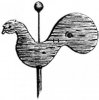
Full-bodied codfish weathervane in the original gilded surface, 26" long, sold for $2587.50. |
Gould Auction Company, Gardiner, Maine
by Mark Sisco
The Gould Auction Company sale on May 12 in Gardiner, Maine, could easily be divided into two sections--the Lemuel Moody lots and everything else.
Auctioneer and owner Tim Gould described the Moody lots with little hyperbole as "arguably the most significant cache of historically important nautical Maine material ever found."
Lemuel Moody was born in 1767 (or 1768 according to some sources) and died in 1846. He was about eight years old when the American Revolution broke out. At age 11 he served as an army waterboy. In May of 1799, as captain of the schooner Betsey, he and his crew were captured by French privateers, and they returned to Portland, Maine, about two months later. By 1807, he had completed construction of the Portland Observatory on Munjoy Hill. But it was far more than just an observatory, as the complex included a banquet and dance hall, a stable, and a bowling alley, in addition to Moody's own house. Presumably it was from the tower that Moody was the first to spot the United States brig Enterprise towing the defeated H.M.S. Boxer into Portland harbor in the aftermath of the 1813 battle between the two ships during the War of 1812.
The centerpiece of the auction consisted of hundreds of historical Moody documents and artifacts, divided into 17 lots. Altogether the collection sold for an amazing total of $177,387.50 (includes buyers' premiums).
In 1899, the Maine Historical Society acquired much of the Moody collection including artifacts, documents, and watercolors. After transcribing some of the written works, the society returned the items to the family member from whom they had been obtained, and a descendant consigned them to the Gould auction.
Gould commented before the sale, "It's hard to imagine that in the year 2012, there can be things like that that have been stuck away since 1899, when some of the institutions had a chance at some of it and took some things away and decided to leave what we have, which is a bountiful, bountiful supply." Included in the treasure-trove was a printed document describing a bill introduced to Congress in 1841, providing Moody a pension as a Revolutionary War soldier.
Leading all individual lots in the sale was Moody's copy of The American Coast Pilot, dated 1796. Said to be only the fourth example of the first edition ever to come to the auction market, it had the original owner's inscription on the front endpapers, "Lemuel Moody's 1796/ Portland," and it sold for $48,875 to Connecticut bookseller William Reese.
Coming close to that amount was a group of 36 of Lemuel Moody's charts and documents dating from 1825 to 1839. The lot sold for $46,000 to the Osher Map Library of the University of Southern Maine in Portland.
Lemuel Moody was one of five sons of Enoch Moody, all of whom served in the Revolution. His older brother William served in the Penobscot Expedition (also known as the Bagaduce Expedition and the Battle of Castine). That American misadventure is credited with being the largest American naval expedition of the Revolutionary War and also the worst American naval defeat until Pearl Harbor. In June 1779, British Army forces occupied the Majabigwaduce Peninsula in Penobscot Bay, intending to establish a military presence and a new colony. The Continental Congress raised an expedition to drive them out. The American troops landed in July to lay siege to the fort but were defeated, and their ships were virtually annihilated by the arriving British fleet in August. The survivors were forced to march overland back to Massachusetts.
William Moody's handwritten journal of the expedition contains an extraordinary detailing of the expedition. Here are just a few excerpts from the Maine Historical Society transcription, made in the 1890's:
"July 14. The transports with 2 brigs & a sloop, a prize with 10 guns, arrived here to carry the Troops. Drew one day's allowance.
"July 20. Last night a soldier fired a gun and blowed his hand off, died. The Hampden a 20 gun ship arrived.
"July 28. At day-break had orders to land under cover of our guns on board the shipping. Commenced landing half an hour before sunrise. The enemy lay in ambush and firing upon us killed 1 capt. [probably Major Welch] of marines belonging to the Admiral and several others. We took 3 prisoners and killed 7. Have possession of the ground and soon hope to have all their works. 2 men wounded, one lost his leg and the other his arm. Went over to the Island after [Samuel] Knight. He was sick there....
"Sunday, Aug. 1. Major [Samuel] Sawyer of the York [county] forces mortally wounded. He died this day....
"Aug. 14. News that the fleet of the enemy are at the mouth of the [Penobscot] Bay. We began our retreat about one o'clock. Ran with our Ships and Transports to Fort Penobscot and called on the Commissary for provisions. The enemy in sight and under cloud of sail. Some of our Ships are taken and some are run ashore. I took the boats and went aboard the Centurion for provisions and then put ashore, landed it and then took off the men. Our people set fire to the shipping and then took to the woods. Our company [Capt. Peter Warren's] encamped in the woods. Took what provisions we could carry. Had 4 prisoners to guard.
"Sunday, Aug. 15. Took up our line of march at daybreak, lost our way and came across about 200 of our Regt. And sailors and marines. Went across a large meadow; struck a road in the woods and kept on till 7 o'clock; took breakfast and proceeded on to Belfast where we arrived at 12 o'clock. Exceedingly warm. Came to a river and crossed in canoes. Capt. Warren purchased 2 sheep and paid 18 dollars for them. Took dinner. Arrived at a fine plantation and had a good dish of tea. Gen. [Peleg] Wadsworth and Capt. [Ebenezer] Buck supped with us. Had a fine barn to sleep in and rested comfortably.
"Aug. 16. Marched early through marshes, beaches and thick woods, over mountains and valleys to Ducktrap [Northport] where we arrived, the sun an hour high. P.M. One of our prisoners deserted this morning.
"Sunday, Aug. 22. Lieut. [Peter] Babb set off for home or Falmouth with some four men because we had no provisions. [Zach.] Baker, [John] Clough, Thomas Harper, [Benjamin] Mussey and myself [William Moody] started for St. George between 11 and 12 o'clock."
The complete 78-page handwritten diary sold for $24,150 and now has a permanent home with the Maine State Museum. For more information, visit Gould's Web site (www.gouldauctions.com) or call (207) 362-6405.
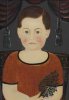
Arriving late to the sale were these two portraits, solidly attributed to Maine primitivist Sturtevant Hamblen (1817-1884). The subjects were sea captain Rufus Fales (1812-1858) and his wife, Julia Thompson Fales (1811-1892), of South Thomaston, Maine. In lemon gold frames and with no alterations other than an early coat of varnish the pair brought $3450. |
|
|
|
|