















See All Ads

Optimism Reigns at the Shenandoah Antiques Expo

Walter C. Newman | October 10th, 2012


One thing you can always find at Fishersville is a piece of “project” furniture. This walnut blanket chest pushes the boundaries of just how much of a project one may be willing to undertake. It was in the booth of Larry and Linda Fox. The Foxes are from Valencia, Pennsylvania, and trade as Larry Fox Antiques. The chest is probably from Pennsylvania and exhibits several immediate concerns. It has lost its feet; the top has been turned back-to-front and re-attached; the sides of all of the drawers have been replaced; and there is severe damage to one side of the front panel, decay, and an area where the blind dovetailing is exposed. On the plus side there is the underlying inlaid tulip and vine decoration on the front panel, as well as an inlaid date of “1810.” Larry Fox thinks that the right person will envision the finished product and negotiate an agreeable price. Larry is starting the discussion at $950.

Buck Marshall of Port Republic, Virginia, believes in honesty in advertising. He unapologetically trades as Buck’s Junk and was set up in the infield at Fishersville. Some of his “junk” is arranged here. The handwrought, and often repaired, copper kettle was tagged $250. The wooden tool box under the kettle was $45, and the more detailed tool box was $85. The wooden block plane is tagged $25.


The booth of Karen and Michael Zeigler of Pine Ridge Antiques, Christiansburg, Virginia, was full of items related to railroading and firefighting. The leather fireman’s helmets were priced from $365 to $395. The railroad lanterns were both by Deitz. The red globe model was missing its fuel cap and priced at $265. The clear globe model, nickel-plated, was $295. In the background are Pennsylvania Railroad calendars from 1953 and 1951. They were $125 and $145 respectively. The surveyor’s instrument advertisement was marked $85.

Fishersville, Virginia

by Walter C. Newman

For the first time in several years, an antiquing friend joined me on my expedition to the Shenandoah Antiques Expo at Fishersville, Virginia. Ordinarily, I make the two-hour drive alone, since the day routinely turns out to be long and unpredictable. My friend was adamant that he was not concerned with either of those potential problems, so off we went. When we arrived at the show, my friend and I decided to go our separate ways but agreed to meet at predetermined intervals to compare notes.

It is a good idea to attend a show like Fishersville along with a friend. Companionship is always a good thing, but that second pair of eyes really comes in handy. Not only might the second person notice something interesting that you may have overlooked, but he or she might also confirm the relevance of something that you have already seen and filed into your memory bank, or discounted altogether.

The October 12-14, 2012, event marked the 51st installment of the show. Over the past dozen years, I have faithfully attended most of them. The first thing I noticed was that it was packed. Not only were all of the vendor stalls filled, but there were more people in attendance than has been the case in recent years. The sluggish economy has been the bane of show promoters for at least five years, but there was no sign of a soft antiques market on this Saturday.

When I caught up with the promoter, Ray Stokes of Heritage Promotions, he echoed that observation. He stated that he was “simply delighted” with how the weekend had turned out. He went on to say that there had been 1600 buyers on Friday for the show’s early buying session. That represents the best early buying day in the show’s 26-year history. Saturday’s paid attendance was in excess of 4000. That is not a record, but it is certainly one of the best gates in recent memory. For its part, the Sunday crowd held its own. All in all, the numbers were excellent.

Dealer participation also appeared to be strong. Stokes stated that he had been able to fill all of the available reserved vendor spaces. In addition, there had been 35 “drive-ups” on Saturday to top off the infield dealer population.

Without the advantage of ticket counters and such, my personal gauge of the show has always been a scan of the parking areas at 2 p.m. on Saturday. As unscientific as that may be, it does give me a relative comparison from show to show. At 2 p.m. on October 13 the parking areas were still packed. I take that as a good sign and confirmation of Stokes’s overall numbers.

Not only were people showing up; they were buying. Several dealers told me that by noon on Saturday they had surpassed their total sales for the past several full three-day shows. It was not only smalls that were being bagged and taken to the parking areas; everything seemed to be selling. At the risk of sounding overly giddy, people were buying even brown furniture.

One show does not make a trend, but the signs at Fishersville were very encouraging. Attendance is a key measure by anyone’s standards; and active buying, as anecdotal as it often is, breeds optimism. Optimism is often another key to success.

The Fishersville show seemed to work out well for most everyone. My friend and I were able to coordinate our rendezvous. We swapped stories and observations. He put me on to a walnut blanket chest that he felt was interesting, although he did say that it “needs a little work.” My friend is a long-time furniture restorer and refers to himself as “an optimistic woodpecker.” I took a look at the chest and have included it in the photo section. The reader may wish to judge what “needs a little work” really means, regardless of how optimistic you may be.

For additional information, contact Heritage Promotions at (434) 847-8242 or (434) 846-7452 or visit the Web site (www.heritagepromotions.net).

Keith and Diane Fryling set up their large booth along one of the long walls in what is referred to as the “new” exhibit hall. The couple from Green Lane, Pennsylvania, trade as Fryling’s American Antiques & Folk Art. The items displayed on this table and shelf unit represent only a fraction of the things available in their space. The redware items on the table ranged from $650 to $1100; the deep toleware tray was tagged $850; and the 1750’s hand-carved burl bowl was marked $7800. The carved birds on the top shelf ranged from $1750 for the pair of blue jays to $175 for the small pheasant on the right. On the center shelf, the rabbit-form molds were $85 each, and the blue and white enamel spatterware pitcher was $225. On the bottom shelf, left to right, a heavy food chopper was $30; two lidded boxes were $550 and $375; and a pineapple-form lidded box was $850.

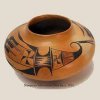
This group of Native American items was found in the booth of Martha J. Hueglin of Atlanta, Georgia. Martha trades as Southwest Indian Artisans. She offered a circa 1910 decorated pot from the Zia Pueblo in north central New Mexico, priced at $3500. A worn pair of Plains Indian moccasins, probably Sioux, dating from the 1920’s, was tagged $1200. The black pot by Tonita Roybal of the San ­Ildefonso Pueblo near Santa Fe, New Mexico, was $850.

Mark Teller of Wallingford, Pennsylvania, spread out this display on one of his tables in the Fishersville infield. The scene offers a snapshot of the variety of smalls that are encountered at the show. The three-drawer chest with mirror was $250. The brass candlesticks were $150. The Art Nouveau plaque was $125. The white top hat, decorated with a Second World War VE Day “V” and “45” was marked $250. The leather and brass powder horn was $45; and the covered wooden pail, $50.

Warren Burls and Mel Madsen are regulars at Fishersville. They trade as Antiques of London with addresses in London, England and Williamsburg, Virginia. Here they have assembled a group of similarly decorated Chinese export papier-mâché desk pieces that date 1880-1910. The gold and black lacquered items ranged in price from $95 to $165.

Lewisburg, Pennsylvania, antiques and collectibles dealers Patricia Kaler and D. Edward Seidel had a display case full of miniature baskets. The baskets were available in all of the shapes usually associated with their full-size relatives. Many of the baskets were made by Native American craftsmen. The tiny baskets ranged in price from $30 to $300.


Originally published in the February 2013 issue of Maine Antique Digest. © 2013 Maine Antique Digest

comments powered by Disqus