













See All Ads

Precious Metals and Precious Ducks

Mark Sisco | November 5th, 2012

The Charles Marion Russell (1864-1926) bronze, Watcher of the Plains, from the Roman Bronze Works foundry, sold for $115,500 to a New York City gallery, underbid by a private collector.

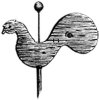
Two early Monhegan Island decoys in their old, dry original paint sold to the same private buyer from Cape Cod for $16,500 and $15,950.

Bruce Gamage, Jr., Rockland, Maine

by Mark Sisco

At Bruce Gamage's August 20 auction in Rockland, Maine, the market for precious metals, like gold and bronze, was up. And so was the market for precious ducks.

First the ducks. It was a pair of Monhegan Island, Maine, eider duck decoys that took off and flew. Gamage found them in a Monhegan boathouse in their original paint. Each was estimated at $1500/2500, but Gamage commented before the sale, "The hottest thing is on the two eiders. I've got eight phones on them. They're not signed, but the paint is just old paint, and a lot of people like them. I got a feeling my estimate was off."

On that last, he was correct. At least five phone bidders were still hanging in as bidding passed the $10,000 mark on each one. They cruised all the way to $16,500 (includes buyer's premium) and $15,950. The winning bidder of both was a private buyer from Cape Cod, Massachusetts. "They're dry; they're original," he commented. "Good Maine birds from Monhegan." He didn't know who the maker was, but "I'll find out. I'll search them out," he promised.

A rare Spanish gold coin almost hit five figures. The eight-escudo coin was minted in 1711 and lost in the hurricane of 1715 that destroyed the Spanish plate fleet off the coast of Florida. The name of the fleet is derived from the Spanish word plata for silver. Eleven ships and nearly 700 men were lost in the monumental hurricane on July 30, 1715, near present-day Vero Beach, Florida. Many of the survivors were trapped on an inhospitable island, filled with disease-carrying mosquitoes, rattlesnakes, and bellicose natives.

By 1718, over five million eight-escudo coins had been salvaged. This single piece of the treasure easily passed its $4000/8000 estimate and finished at $9350. It came with a certificate of authenticity from Chests of Gold Jewellery, Ltd., dated April 5, 1989.

It was a Charles Marion Russell (1864-1926) bronze, however, that topped everything by a wide margin. It was estimated at $60,000/80,000 and didn't disappoint. Cast at the Roman Bronze Works foundry and titled Watcher of the Plains, it depicted a lone Native American, seated and armed with a rifle. When the hammer came down, it closed at a strong $115,500.

Beginning around 1898, Russell worked exclusively with the Roman Bronze Works, as did Frederic Remington. The family of Ernest Quantrell was the consignor, and Gamage commented, "Ernest knew Charles Russell and hunted with him." Later, as the runner lifted it off the podium, Gamage cracked, "Don't trip on the way out with that!"

Among the most interesting artworks was a darkly haunting graphite drawing by artist Vasily Sitnikov (1915-1987). Sitnikov is considered a pioneer of the nonconformist art movement in the former Soviet Union. He has a story that is as grim and eerie as his graphite drawing of an androgynous figure sold here. In his native Russia, he barely escaped execution by Soviet authorities, and he was declared insane in 1941. He was committed to an asylum, where he endured four years of torture, starvation, and deprivation. Many of his works, such as this one, evince a shadowy, surreal eroticism with elaborate ghostly shading. He immigrated to Austria in 1975 and then in 1980 to New York City, where he lived until his death. The drawing sold for $2090 (est. $3000/4000).

For more information, call (207) 594-4963 or visit the Web site (www.gamageantiques.com).

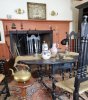
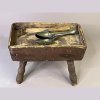
A country tavern table in maple, dating to the 18th century, with a dark and much-used two-board top and appropriately worn stretchers, retaining its full original height, fetched $1210.

A small Queen Anne lowboy in maple, untouched and all original, with top veneers laid in matching crotch mahogany quadrants with mitered borders and herringbone inlays, fell well short of the $15,000/20,000 estimate, bringing $5610 from Rockport, Maine, dealer Scott Fraser.

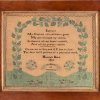
A handwritten document, dated 1840 and granting freedom to a slave named Godfrey, sold for $247.50. It read in part, "I George Brittain of the County of Harlow and State of Kentucky have manumitted emancipated and set free...a certain negro man slave named Godfrey...Godfrey is hereby emancipated and entirely liberated from slavery and entitled to all rights and privileges of a free person with which it is in my power to vest him...."

"The more they're worn, the better they like 'em," Gamage joked as this Persian Bakshaish rug came up. Estimated at $6000/8000, it finished at $5500.

An oil on canvas by French artist Léon Giran-Max (1867-1927), approximately 18" x 22", of a young girl strolling through a hillside field of poppies, sold for $2640.

This eight-escudo gold coin was minted in 1711 and lost in the hurricane of 1715 that destroyed the Spanish plate fleet off the coast of Florida. It brought $9350.

A Riley Whiting wooden works tall clock with a tenuous connection to the General Henry Knox mansion in Thomaston, Maine, featured a full-column bonnet, three tall wooden finials, and a simple black and gilt-painted case. The painted face was marked "R. Whiting/ Winchester," and it sold for $1100. "It's got some problems," Gamage admitted. "It needs to be tuned up and made ready to go." It came to auction through the estate of a local physician, who is believed to have purchased it directly from Montpelier, the General Henry Knox mansion in Thomaston.


Originally published in the November 2012 issue of Maine Antique Digest. © 2012 Maine Antique Digest
comments powered by Disqus