












See All Ads

Quinn & Farmer Offer New Approach to Old Game

Walter Newman | November 3rd, 2012


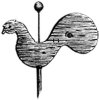
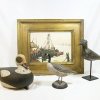
This redhead duck decoy is attributed to carver B.P. Holland and probably dates from the 1930’s. Holland practiced his craft in the Back Bay area along the Atlantic coast at the Virginia and North Carolina border. The decoy measures 9" x 13" x 7" and exhibits cracks and chips associated with both age and gunshots. The decoy sold to an Internet bidder for $767 (est. $150/250).

The high lot of Quinn & Farmer’s inaugural catalog auction was this exceptional circa 1810 Virginia tall-case clock. The clock is constructed of cherry with mahogany veneers and with tulip poplar as its secondary wood. Known as the “John Cole” clock, the piece is thought to represent the combined efforts of clockmaker Peter Whipple and cabinetmaker Peter Rife. What sets this clock apart from others is the degree to which the piece is decorated. Various construction and decorating techniques, including inlay, banding, marquetry, and parquetry, are employed to enhance every angle from which the clock is viewed. (See M.A.D., January 2013, p. 11-A). The clock is monumental in size at 105" in overall height. It shares marked similarities to a clock that is in the permanent collection of the Colonial Williamsburg Foundation, leaving many to believe that the two clocks are related. A Virginia collector, bidding in the room, won this piece of decorative arts history for $271,400 (est. $150,000/250,000).


This early 19th-century yellow-painted poplar bench appears to be a match for the seven-chair set that was offered earlier in the sale. The bench displays the same surface paint designs, leg turnings, stenciling, and seat construction. Part of the seat caning is missing. The bench performed much better than the chairs, selling for $885 (est. $400/600).


This handmade silk Civil War flag is a popular 13-stripe and 34-star design. Variations of this Union flag were seen following Oregon’s entry into the war. This flag features a handwritten inscription on its border indicating that it was once presented to the “Scotch Rifles.” The flag measures 33" x 59½" and is presented framed and under glass. Intense bidding pushed the final price to $12,980 (est. $3000/5000) from the phone.

Quinn & Farmer Auctions, Charlottesville, Virginia

Photos courtesy Quinn & Farmer Auctions

When Paul Quinn and Ken Farmer joined forces to purchase the auction house Harlowe-Powell in Charlottesville, Virginia, in October 2012, they may have formalized a new format within the ever-changing auction world. Ken Farmer Auctions and Quinn’s Auction are two firms that have operated at opposite ends of Virginia for years, but one could argue that the dissimilarity between them was far greater than the 275 miles of interstate highways separating the two locations.

Quinn’s Auction, located in the Washington, D.C., suburb of Falls Church, Virginia, enjoys a more cosmopolitan clientele and consignor base than does Ken Farmer’s Radford firm. Quinn’s regularly features Asian and formal items that reflect the tastes of urban and international patrons. On the other hand, the success of the Farmer firm has been a result of its emphasis on items that are decidedly southern and country decorative arts, furniture, folk art, and related items.

While Quinn and Farmer succeeded in worlds that are quite different in many ways, both saw the potential of developing a middle ground as a way to grow their businesses. Charlottesville and the Harlowe-Powell acquisition fit that bill. It offers a “middle ground” both literally and figuratively. With its central Virginia location, it offers geographical convenience. It also allows them to offer traditional antiques and collectibles alongside the more upscale designs associated with metropolitan Washington. The idea that each firm could choose among three locations to offer their consigned items is appealing. Items could be offered at the venue that would most likely attract potential buyers.

For its initial catalog auction on November 3, 2012, Quinn & Farmer assembled a broad array of consignments. Among the 450-plus lots was one that guaranteed that the sale would receive attention. It was an intricately decorated Virginia-made tall-case clock, circa 1810. We have described this clock elsewhere (see M.A.D., January 2013, p. 11-A). Suffice to say, the clock did not disappoint. Known as the “John Cole” clock, it sold to an anonymous Virginia collector for $271,400 (includes buyer’s premium), a record for a southern tall-case clock.

The John Cole clock would have been a show-stopper whenever and wherever it had come to market. So, how did the rest of the sale fare?

The first hour of the sale moved rather slowly. It began with a consignment of more than 70 lots of carved shorebirds and duck decoys. With some exceptions, the birds were estimated at $100/200 each. Most of them sold below the low estimate. The ducks were followed by 25 quilts. For the most part, they sold within their estimates, with two large examples commanding premium prices. An 1850’s appliquéd Princess Feather design brought $1888 (est. $500/1000), and a pieced and appliquéd Star of Bethlehem design made $1652 (est. $350/850).

Things began to pick up as the sale moved into more familiar territory. Furniture, fine art, folk, and decorative arts items all sold well, but very few lots sold at their high estimates.

Following the sale, both Ken Farmer and Paul Quinn seemed to heave a sigh of relief. Neither had voiced any specific expectations for the sale, but each seemed to be pleased with the day. Paul Quinn summed up his feelings: “We were very encouraged by today’s sale. This inaugural [catalog] sale got us off on the right foot. [Going forward] we see the combination of the two organizations as an opportunity to grow both and still maintain the character that each one brings to the table.”

It will be interesting to see how this format evolves. Several individuals who were regulars at the Farmer auctions in Radford were openly pleased with the fact that the Charlottesville location is much more convenient for them. Today “convenience” is as much a function of one’s Internet connection as it is geography, so it is encouraging to see people take the time to travel and participate in a sale in person. How much the success of an auction house depends on filling chairs in the salesroom remains to be seen. It does appear that both Paul Quinn and Ken Farmer are committed to the success of this venture and the multi-location format.

For additional information, contact Quinn & Farmer Auctions at (434) 293-2904 or on the Web at (www.quinnfarmer.com).

Here is the 74" x 55" headboard of a bed that caused quite a stir among Quinn & Farmer bidders. The bed is assembled from various components that date from the 17th, 19th, and 20th centuries and features decorated panel construction. It was one of the items deaccessioned by Preservation Virginia. Spirited bidding pushed the price to $3245 (est. $600/800) from the phone.

This 94" x 78" x 25½" two-piece Regency-style breakfront dates to 1835. The piece is constructed of mahogany with pine as its secondary wood. The upper case features a bold cornice over a four-door shelf section. Two full-length doors and two shorter center doors, each with a simple central bifurcated mullion, reveal three shelves. The center portion of the upper section has a single arched cubby. The lower section features three drawers. The piece is raised on a pair of piers highlighted by columns with carved paw feet in front and with storage compartments between. An accompanying handwritten note suggests that the top and base may be associated. The massive piece sold to the phone for $5310 (est. $1000/3000).

This Regency-style sarcophagus-form cellarette appears to be from the same maker as the breakfront (shown on the previous page). It features burl mahogany veneers over a poplar frame and measures 28" x 30½" x 29½". It sold to the phone for $8260 (est. $2000/4000).

This circa 1880 oil on canvas is by James Edward Buttersworth (1817-1894) and depicts an unidentified three-masted ship approaching a fortified harbor with a second large vessel and several small craft. The principal ship is flying the Royal Naval Reserve ensign indicating that it is a merchant vessel. The 17½" x 23" (sight size) painting is signed lower right and is in a period gold-leaf frame. The painting received active bidding from several sources and sold for $30,680 (est. $10,000/15,000).


Originally published in the March 2013 issue of Maine Antique Digest. © 2013 Maine Antique Digest

comments powered by Disqus