




















See All Ads

Skinner's Americana Sale

David Hewett | November 14th, 2012

The 22¼" x 33" oil on canvas by William Allen Wall (1801-1885) depicts the area known as Old Four Corners, at the junction of Union and Water Streets in New Bedford, Massachusetts, circa 1807. Wall's painting has to be a bit conjectural, since it depicts the Four Corners as it was when he was six years old. An Internet bidder got the painting for $45,938.

the pair of 30¼" x 24" oil on canvas portraits in spilt baluster frames by Erastus Salisbury Field (1805-1900) was supposedly sold at Christie's sometime in the 1960's. Estimated at $20,000/30,000, the pair soared to $65,175.

From the collection of Jean Brown, it may be only a simple 32" high storage box with lid, but the construction screams Shaker, and the color equates to money. Shaker colors are interesting-reds are described as lipstick red, yellows are chrome yellow-but Shakers did not wear lipstick or buy chrome-laden stoves or other utensils. The box brought $29,625 from phone bidder Dr. Thomas Pavlovic. The Illinois cardiologist and his wife, Jan, are ardent collectors of Shaker.

In one of those serendipitous happenings that do occur in this business, a nearly identical yellow storage/wood box was cataloged as lot 20 in a Willis Henry Auctions sale of the McCue collection on September 8 at the Hancock Shaker Village in Pittsfield, Massachusetts. That box soared to $78,390. The two Shaker wood boxes sold for a combined total of over $108,000 within a one-month period, and both sales happened in Massachusetts. Remarkable! A collector can go decades without seeing even one of these.

A 17th-century carved and red-stained pine box (also called a Bible box), with chip-carved panel ends, was scratch-carved with the date "1694" within a diamond and the initials "E" and "A." A phone bidder outlasted the floor bidder and took it at $28,440.

This 18" x 26" oil on canvas by James Wells Champney (1843-1903) depicts the view from Mount Sugarloaf, South Deerfield, Massachusetts, and is from the William Hubbard estate. Philip Zea, director of Historic Deerfield, took it at $10,665.

Lots of bidders liked this 22" long brown-painted document box. It had a $1000/1500 estimate, but that was soon eclipsed. An Internet bidder finally claimed it at $2695.

Skinner, Inc., Marlborough, Massachusetts

by David Hewett

Photos courtesy Skinner

If you came to New England for antiques this August, you had to be pretty adept at scheduling.

The Antiques Week in New Hampshire shows in Concord and Manchester were still in progress when Skinner opened its Marlborough, Massachusetts, showrooms for inspection of its annual August Americana offerings. The first day of the sale came on the last day of the New Hampshire Antiques Dealers Association (NHADA) show in Manchester.

Death, divorce, and taxes are the reasons most antiques come to the auction block, according to the old adage, and it's still as true as ever. Skinner's August 11 and 12 sale featured the Shaker collection of Jean Brown (1911-1994), assembled for the most part between 1967 and 1970; the collection of auctioneer William "Bill" Hubbard (1919-2011); and the Americana and folk art collection of New Hampshire dealers Cheryl and Paul Scott, both still with us but now going their separate ways.

Skinner jam-packed 1406 lots into the event, with the bulk of the sales (805 lots), coming on Sunday. Department director Stephen Fletcher led off at the podium, followed by deputy director Chris Barber, LaGina Austin, and Jessica Lincoln.

It was a quite successful event for Skinner, realizing a $2.6 million total for both days (all prices include an 18½% buyer's premium, although lots bought via on-line services include a 22½% premium).

Jean Brown's Shaker collection began in 1967 when she and her husband, Leonard, bought the residence known as the Shaker Seed House in Tyringham, Massachusetts. They chose to furnish it with Shaker material, including an assortment of larger case furniture items, all bought well before the demand for Shaker objects exploded and prices skyrocketed.

The market has changed again, but now the demand is much more selective. Seeking specific objects that have outstanding qualities has become the norm, both in the Shaker field and across the entire spectrum of antiques and collectibles.

Take the part color plays in Shaker products, for example. Some of the brightly painted pieces in the Brown collection did very well under the hammer, while those with weaker colors or stripped of paint did not.

A chrome yellow-painted storage bin on turned legs brought a solid $29,625; a yellow-painted wooden tub sold for $5925; a red-painted pail brought $830; a blue-painted pail, $711; and a blue-painted covered oval box fetched $3081.

Estimates that are too high, however, can negate the color advantage. A chrome yellow-painted three-fingered oval carrier with a shaped ash handle was burdened with a $30,000/50,000 estimate and was bought in at the $22,000 level.

The Browns' case furniture was refinished for the most part, and bidders had a lukewarm response to it. A desk with doors over drawers sold for $2133; a Sister's cupboard over side-by-side drawers, $4740; a pine and poplar cupboard over six drawers, $3555; a pine glazed-door hymnal cupboard over drawers, $2370; and a Mt. Lebanon work counter with door and drawers in the base, $5925.

Many of those case pieces sold on a single bid either from a phone bidder or the left bid book. The Sister's cupboard over side-by-side drawers, for example, had an $8000/12,000 estimate and went to one phone bid at $4740.

Bill Hubbard's collection reflected the tastes of the highly literate former educator, a member of Phi Gamma Delta, Omicron Delta Kappa, Theta Alpha Phi, and Pi Delta Epsilon and adjutant general of the Australia Air Depot of the 5th Air Force from 1943 to 1945.

Hubbard had been principal of the South Deerfield Grammar School, followed by ten years of teaching English, history, and public speaking at Greenfield High School. He left teaching to open a retail antiques business, William L. Hubbard Antiques Inc. He had been a bank director, president of the Pioneer Valley Antique Dealers Association, officer of several western Massachusetts town and historical societies, and an incorporator of the Franklin County Trust Company.

He was a very capable auctioneer who savored the history told by an artifact. He could also be a severe critic. Hubbard did not suffer fools, fakers, or fakes gently. His personal collection was well defined and drew collectors and dealers to Skinner's sale of the same.

Philip Zea, director of Historic Deerfield, bought a James Wells Champney oil on canvas view from Mount Sugarloaf, South Deerfield, Massachusetts, for the institution for $10,665. Zea underbid the following lot, a small cherry and pine tavern table with a solid Deerfield provenance that sold to a phone bidder for $14,220.

There were several treasures among the Hubbard collection. One of those was a brown-painted Queen Anne armchair from the Connecticut River valley that sold to a phone bidder for $10,665, roughly ten times the estimate. A single phone bid took an Ammi Phillips portrait of a young boy wearing a plaid dress for $17,775.

Dealer George Spiecker took Hubbard's Chippendale cherry bonnet-top chest-on-chest for $10,073; dealer Jonathan Trace got a Connecticut River valley cherry serpentine-front four-drawer chest for $5629; and a floor bidder claimed a Queen Anne cherry fan-carved two-part high chest of drawers for $4740. A left bid of $13,035 took Hubbard's cherry tall clock with mahogany segmented oval paterae on the waist door and lower panel, an unusual piece that may have originated in nearby Springfield, Massachusetts, Skinner noted.

The Sunday session opened with the collection of Cheryl and Paul Scott, covered elsewhere in this issue (see page 8-B). Cheryl Scott is still actively dealing and had a booth at the NHADA show that ended the day before the sale. Paul plans on returning to dealing.

There was some very good stuff among the lots that followed the Scott collection, including two 17th-century furniture pieces. One was an oak and pine Hadley lift-top chest over two drawers bearing the initials "KW" that had been carved overall with scroll and foliate designs. According to Clair Luther's 1935 book The Hadley Chest, it appears to have been carved by the same hand that made "the AW chest at the Boston Museum." An Internet bidder took it at $28,175.

The other was a carved and red-stained pine box (for years commonly called a Bible box), with chip-carved panel ends and scratch-carved with the date "1694" within a diamond and the initials "E" and "A." Dealer Stephen Corrigan wanted the box, but a phone bidder was determined and finally took it at $28,440.

Other case pieces bringing decent prices were a Dunlap-attributed maple chest-on-chest at $29,625; a Queen Anne tiger maple flat-top highboy from Rhode Island at $22,515; and two blockfront chests at $24,885 and $17,775.

A Cushing & White copper and zinc "Dexter" horse brought $7110; an A.L. Jewell & Co. rooster sold for $10,073; molded copper cow vanes brought $7110 and $9480; a molded copper ram went at $7703; gilt molded copper dogs, both setters, sold for $4740 and $5036; and a painted and gilt four-door convertible touring car realized $5036.

If there was a surprise in the long Sunday sale, it had to be a piece of early furniture that went to the podium roughly 200 lots after the Scotts' material sold. The French-Canadian bombé commode (chest of drawers) in butternut carried an estimate of $8000/12,000. It was consigned by someone who needed the funds to help pay his daughter's college tuition, a Skinner source said. New York state dealer Mario Pollo was on the lot immediately, with much competition from either a phone bidder or left bid. Pollo was determined and took the commode for $77,025, the highest price of the sale.

We found the Canadian collector who commissioned Pollo to buy the commode, and he told us quite a story (see sidebar).

For more information, contact Skinner in Boston at (617) 350-5400 or in Marlborough at (508) 970-3000; Web site (www.skinnerinc.com).

The 33" high painted whirligig has passed through a Skinner auction before. It brought $18,400 at the Ken and Brenda Fritz sale in 2001. This time it went to a left bid at $14,220.

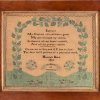
The 16½" x 14" sampler, "Mary Talbots Work Providence September 1796," was done at the Mary Balch school and is shown in the exhibition catalog Let Virtue Be a Guide to Thee (1983), written by Betty Ring. This well-known work by the nine-year-old brought $41,475.

The 41" diameter painted wooden hat is a very heavy advertising piece with the legend "Black & Brown Stiff Hats/ All Sizes Up To 7¾." A strong left bid claimed it at $4444.


Collector Wins "Deal of the Century"

One lot sold on the second day of Skinner's August 11 and 12 sale caused a stir in the gallery when bidding rose to almost ten times its low estimate. Lot 1032 was a bombé commode with sensuous lines and old finish, described in the catalog as French Canadian and made in the late 18th century. The estimate was $8000/12,000. It had been consigned by someone who needed the funds to help pay his daughter's college tuition, a Skinner source said.

Bearsville, New York, dealer Mario Pollo bid on the 18th-century commode early and never hesitated until it was his for $77,025. Pollo bought it for a client. That client gave us his name but did not want it used in print. He is a collector, a professional in the medical field, and lives in Canada.

His comments, with minimal editing for clarity and style, follow.

"I think I got the deal of the century. I don't think there's been a piece of that caliber in an American sale since 2000.

"The bombé commode is one of the rarest of all the Canadian forms, especially those made in the Louis XV style. There are four references to them in Jean Palardy's book The Early Furniture of French Canada, published in 1963.

"The commode predates 1780 and was probably made between 1750 and 1780. The wood is butternut.

"The books that show the form say that the ones made after 1780 have an openwork cutout at the bottom of the skirt. Mine doesn't, making it one of the earlier examples.

"There is nothing to indicate that the hardware is not original. One would not expect forged iron hardware on a piece of this sophistication. The cast rococo brasses could easily have been made in Quebec at that time. The hardware is definitely not American."

(For those with access to newer references than Palardy, go to Michel Lessard's 2002 book Antique Furniture of Quebec and look at illustration 249 on page 189. There is a full-page color photo of a bombé commode with a cutout at the middle bottom of the skirt, as displayed in the governor's apartment at the Fortress of Louisbourg in Cape Breton Island, Nova Scotia.)

"According to Donald Blake Webster [author of Rococo to Rustique: Early French-Canadian Furniture in the Royal Ontario Museum (2000)] and the late Jean Palardy, at the time their books were written..., there were only six examples of bombé-form commodes in existence. I've got the seventh, I guess."

The collector noted that, according to an article by F. St. George Spendlove in the Canadian Collector, May 1967, "There were very few commodes of the tombeau type (called bombeé in Canada) made."

He cited passages from Jean Palardy's book to back up his contention that the Skinner piece was a rare and early example of the bombé form, and added, "Another unique and desirable feature of my commode is the unusual small size [height 30¼", width 31", deep 21"].

"The finest piece in the Royal Ontario Museum's collection of French-Canadian furniture is a serpentine-fronted commode that has an openwork rocaille base in the Louis XV manner. They were made in the Montreal area in the late eighteenth century."

He believes the Skinner example is a superlative example of that form and sums it up in this manner: "So, taken all together, the number in existence, the rarity, the execution of it, and its size, I don't think there's a better example of bombé Canadian furniture around; I think the one I bought is the best one that exists."

He thinks he knows how and when a French-Canadian commode might have traveled south to a Massachusetts home.

He explained, "Prior to the Victorian era there was a huge demand in New England for the French Louis XV and XVI look. To ship examples from France was pretty expensive, so they went north to Canada, and a lot of good pieces ended up in New England. The refinish was done probably around 1860 or 1870, so it looks like the original finish because it's so darned old.

"No one has messed around with it, apart from some carefully done repairs to the drawer lips. This was probably when the brass casters were added. I've got a pretty good library, and I've researched it long and hard. A lot of the dealers are kind of coy about it, they don't want a big kerfuffle, but I thought gee, this is an opportunity to let our colleagues in America know that this is a really sought-after piece of furniture."

The collector ended by saying he's not sure exactly where it was made, "but due to the commode's level of sophistication, the Montreal area, Quebec City area, or Trois-Rivières would be likely, as they were the earliest larger settlements and centers of all the good carvers at the time, so it would make sense."

He wants to research the piece some more.


Originally published in the November 2012 issue of Maine Antique Digest. © 2012 Maine Antique Digest
comments powered by Disqus