Gerrit Thomas Rietveld, aluminum Stoel, 27 3/8" x 19¾" x 19¾", $470,500 (est. $100,000/150,000) to a German dealer in the salesroom who said he was bidding for a private European collector. The handmade chair was produced from a single sheet of aluminum in 1960-62 by Gerrit Rietveld, Wim Rietveld, and Egbert Rietveld to replicate a singular 1940 prototype that was in the Stedelijk Museum. Its history, written by Rob Driessen of Amsterdam, is recounted in the catalog.
Kem Weber (1889-1963) was born in Germany as Karl Emanuel Martin Weber. He became a U.S. citizen in 1924 and changed his first name to Kem. He designed this pair of pewter and ebony candlelabra, 10 3/8" tall, circa 1928, made by Porter Blanchard of Burbank, California. The pair sold to a phone bidder for $98,500 (est. $40,000/ 60,000). Only one other pair of this design is known, and that pair is a promised gift of John C. Waddell to Yale University Art Gallery.
Three phone bidders competed for this single-drawer console table made of cherry by Wendell Castle in 1972. Incised "WC 72," the 38 5/8" x 37¼" x 19½" table sold for $46,875 (est. $15,000/ 20,000).
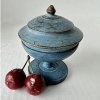
Marianne Brandt designed this 3½" high lidded bowl circa 1924. It was manufactured in the Bauhaus Metal Workshop at Weimar, Germany of silver-plated metal and brass. Impressed "Bauhaus" and estimated to sell for $12,000 at most, it went to the phone at $34,375. |
Sotheby's, New York City
by Lita Solis-Cohen
Photos courtesy Sotheby's
The June auctions of designs of the 20th and 21st centuries come at the end of the season, when collectors have already headed to Europe for the art shows at Basel and Düsseldorf and auctions in London. Nevertheless, collectors are presented with some special opportunities, and while the sales are not well attended, they are not ignored. There is plenty of bidding by phone and on the Internet, and the market seems alive and well.
Sotheby's sale on June 13 struck a high note when the cover lot, Gerrit T. Rietveld's aluminum Stoel, a chair made of a single sheet of aluminum, sold for $470,500 (includes buyer's premium) to a German dealer in the salesroom, who said he was buying for a German collector. Two phone bidders were his competition, but with a cell phone to his ear he stayed in the bidding until it was his. The estimate was $100,000/150,000. The price was an auction record for a work by Rietveld.
As Deyan Sudjic, director of the Design Museum in London, wrote in the Financial Times in June, "There are chairs that sell at auction for the price of a major piece of art, and there are disposable chairs...Unlike almost any other piece of domestic equipment, you don't just buy chairs, you collect them."

This is a special chair. According to the essay in Sotheby's catalog, written by art historian Rob Driessen of Amsterdam, Rietveld (1888-1964), a Dutch designer and architect and a principal member of De Stijl, was fascinated with the concept of a chair made out of a single sheet of material. That idea became apparent as early as 1927 when he introduced his ground-breaking Birza chair, cut out of a single piece of fiberboard. That same year, Rietveld conceived the Beugelstoel-a seating shell made of shaped and painted plywood on silver-painted metal legs, which was put into production. (Four Beugelstoelen were offered at this sale as lot 77 with a $70,000/90,000 estimate and sold on one phone bid for $80,500.)
Rietveld's signature Zigzag chair, conceived before 1930 as part of his quest, is made of four wooden segments, not a single piece of material. During the war he got hold of a piece of aluminum and collaborated on a chair with his son Wim (1924-1985). Wim made a device that pierced the thin metal sheet with holes, which strengthened the construction and enhanced its design, giving it an industrial appearance. The chair was never put into production.
By 1960 Rietveld's fame had become widespread. Delft University of Technology granted him an honorary degree and sought to acquire a representative collection of his chairs for its reference collection. The only example of the single-sheet aluminum chair was already in the Stedelijk Museum, so Rietveld offered to make another. With the cooperation of two of his sons, Wim and Edbert (1915-1981), he made three of these aluminum chairs. One went to the Delft University of Technology, and the other two were kept by his son Jan (1919-1986), who was an avid collector of his father's furniture.
When Jan died, he left his collection to his niece Paula Rietveld. She sold one of these chairs at Christie's in Amsterdam in 1987, and it is in the Vitra Design Museum in Germany. The chair that sold at this auction is the other one.

Of the seven lots of Rietveld furniture offered at the sale, five sold. A rare Zigzag highchair sold for $25,000 (est. $8000/12,000), and an end table with an edgy design and painted in primary colors brought $16,250.
Eight of the top lots were made by Tiffany Studios. Seven of them were lamps or chandeliers; five of them sold for over $200,000 each.
An Elmslie and Purcell clerestory window from a Minnesota bank in the Prairie school style sold for $182,500, an auction record for the work of George Grant Elmslie and William Gray Purcell.
A so-called Sculpture Front room divider by Paul Evans (est. $100,000/150,000) sold for $122,500 to a collector who left a bid with the auctioneer. When it sold at a Rago auction in October 2005, it hammered down for $90,000, and for a few months was a record for a work by Evans. (The Evans auction record is $228,000 paid in April 2008 for a two-door Sculpture Front cabinet trimmed in gold leaf with a scarlet interior with gold-leaf drawers that sold at the sale of the collection of Dorsey Reading, who ran the Evans shop.) The buyer of the room divider was asked to lend it to the retrospective Paul Evans: Crossing Borders and Crafting Modernism, scheduled at the James A. Michener Art Museum in Doylestown, Pennsylvania, for the fall of 2013.
A dramatic Fish Lamp (a glass sculpture lit from within) by Frank Gehry, circa 1983, sold to a collector for $122,500 (est. $100,000/150,000). A rare 1928 pair of pewter and ebony candelabra designed by Kem Weber sold for $98,500 (est. $40,000/ 60,000). Only one other pair is known, and that is in the John C. Waddell collection and a promised gift to Yale.
A collection of 130 pieces (65 individual designs) of spun-aluminum table articles by Russel Wright sold for $25,000 (est. $20,000/30,000) on the phone. At the preview independent curator David Hanks, with his client George Kravis of Tulsa, Oklahoma, in tow, said Kravis was interested. Kravis, a collector of 20th-century design, was the buyer. The collection had been put together one piece at a time by Robert and Mazal Schonfeld and had been shown in Russel Wright: Creating American Lifestyle, an exhibition at the Cooper-Hewitt, National Design Museum, November 2001-September 2002.
Sotheby's offered 129 lots, of which 90 sold for a 69.8% sold rate. The biggest disappointment was the failure of a Conoid bench, 1974, by George Nakashima from Mrs. Nelson Rockefeller's Japanese House at Pocantico Hills, New York. It was estimated at $150,000/ 200,000, but there was no interest. In 2007 it sold at Sotheby's for $240,000 to Sebastian + Barquet, dealers in New York City, and then sold to the consignor. Of the 13 lots of Nakashima furniture offered, six sold. There is interestbut at the right price.
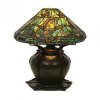
Sotheby's Jodi Pollack said the market for Tiffany is "strong, stable, and global." She said that she often holds major examples for the December sales, which she views as a "stronger platform for twentieth-century sales when more people are in New York." So stay tuned.
For more information, phone (212) 606-7000; Web site (www.sothebys.com).
|
|
|
|
|
|
|
|