

















The 30" x 52" hooked rug depicting a barnyard scene with a rooster was $895. The small trunk painted to resemble rosewood was $595. Both were offered by Pewter & Wood Antiques, Enfield, New Hampshire.
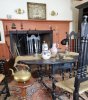
This Boston Classical mahogany drop-leaf table, 72" long x 44" wide when open, is an unusual form. It has drawers at each end, with ash and pine secondary woods, and brass paw casters. Norman Gronning Antiques, Shaftsbury, Vermont, asked only $4800 for this updated version of a harvest table. The pair of globes, by Merriam & Moore of Troy, New York, circa 1850, was $20,000 the pair.
American Empire Antiques, Essex, New York, offered the 74" long New York caned sofa in bird's-eye and tiger maple for $9500. Look at the feet; they have the head and wing of an eagle and the foot of a lion. Owner David Hislop also offered a pair of grain-painted cane-seated side chairs paint-signed by maker "C.S. Travers, S. Gardner," priced at $495 the pair. Travers was born in 1815 in Gardner, Massachusetts.
Gardiner's Antiques, Falls Church, Virginia, showed a chest in alligatored putty-colored paint. It had two drawers on top, split columns horizontally at the top and bottom of the case, and full columns at sides. The 44" high x 34" wide chest was tagged $975.
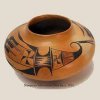
Dealer Joseph Martin of Brownington, Vermont, always mounts a very sparse booth, preferring to offer a few very choice pieces that are usually fairly expensive. The Native American wooden bowl is 27" long x 19" across and $22,000.
John Bourne of Pittsford, Vermont, showed the Victorian tin and wire birdhouse, 27" tall x 31" wide (with great simulated diamond-shaped slate shingles on the roof), with a $725 price tag. The three-piece tin train plant holder at right was $250, and the horse and wagon toy was $225. |
Woodstock, Vermont
by David Hewett
Vermont doesn't have an Antiques Week for several good reasons. It does have something of that type, with a number of shows held in southern Vermont during foliage season, but a week-long combination of auctions, shows, and shop happenings under official state blessing? No, the Green Mountain State doesn't have that.
Vermont is half as populous as New Hampshire to the east (estimated population in 2011: Vermont, 626,431; New Hampshire, 1,318,194) and attracts far fewer visitors from the heavily populated areas in eastern Massachusetts.
The disparity in population reflects in the number of antiques shops too. There are 116 members of the Vermont Antiques Dealers' Association (VADA), compared to the just under 300 members of New Hampshire's association (NHADA).
VADA held its 38th annual show in Woodstock on July 28 and 29, and while there was nothing comparable to the crowds waiting for admission to the annual NHADA show that followed in under two weeks, those who made it through the doors began making purchases almost immediately.
What was important wasn't the numbers; it was that the stream of visitors remained steady throughout the first three hours of the Saturday opening. And many of them bought.
The number of sales we observed during the time we were in Woodstock's Union Arena seemed to indicate that the event had the potential of being one of the more successful VADA shows of the last 20 years.
We took the question about attendance to VADA President Greg Hamilton, owner of Stone Block Antiques in Vergennes, Vermont. "The show looked fabulous, and attendance was up by at least one hundred this year. The Sunday numbers were up too. Several dealers told me that this was their best show ever," Hamilton said the day after it closed. "I've only ever had one better VADA [show] than this year's," Hamilton added.
Because of a last-minute cancellation, Hamilton had to stretch his stock to fill two booths. He sold a patio suite from the second booth within an hour of opening. He also sold a Vermont landscape painting with a $1500 price tag that was snapped up by a collector.
Another Vermonter, Mike Winslow of West Rutland, said he'd had the best VADA show of the last four years since he returned to the Green Mountains after several years in Italy.
"I only sold a few pieces that were American," he noted, "but the Continental stuff went very well. Both American pieces were fabric, a yarn-sewn rug and a linsey-woolsey, and it is interesting that my best sales came during setup and on Sunday.
"Go figure, other exhibitors moved a lot of pieces on opening day, Saturday," Winslow said, "but we'll take sales whenever they happen. Let's see, I sold a seventeenth-century Dutch leather screen, an eighteenth-century painted Continental mirror, and a pair of cast-iron Japanese storks, among a lot of other things."
About selling during setup, Winslow laughed as he explained, "There used to be a mantra among dealers, 'If you didn't sell well at setup, you were dead in the water for that show.'"
Winslow said he'd observed a change in showgoers. "There's a lot more retail interest. People seem confident enough to step up to the plate and make substantial purchases, even if they come un-escorted by decorators and advisors."
Exhibitor Lee Hanes of Hanes & Ruskin, Old Lyme, Connecticut, said they had sales that verified Winslow's comments. "We had a really good show and not all American material, either. We had three big sales that really helped the total. These were sales to three retail people we've never seen before. They all spent serious money, and they were easy sales. There was no arm-twisting or 'I'll think about it.'"
Lee Hanes answered our question with: "What did we sell? Well, we sold some Mexican jewelry and a piece of Pratt pottery, a very rare English piece. Our big sale was a chest-on-frame, a really nice Queen Anne maple and tiger maple piece, which was priced under $8000 and went to a collector. We sold a paint-decorated server, English, an unusually nice one, about 1840, that also went retail.
"Oh, there was one retail sale that really does stand out," Hanes said. "People came in and saw a pair of portraits that we had just picked up from the restorer on Friday morning. They saw them in the morning and really liked them. They came back the same day at the close of the show and bought them."
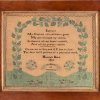
Longtime Vermont exhibitors and keepers of a traditional antiques shop, Nancy and John Stahura, whose business is Mill Brook Antiques in Reading, were in the midst of having a string of sales when we stopped by. They had sold a very clean two-drawer stand, fresh out of a home in Woodstock, at least two samplers, a one-drawer stand, and a large lion pen-and-ink calligraphy drawing.
"We had a great show," Nancy said later. "We even sold the room-sized Oriental rug on the booth floor! We sold two ogee mirrors, three baskets, an armchair, some stoneware, plus the pieces we told you about earlier. I think we sold something from every category possible.
"It was so good to see interest in what we call the bread-and-butter pieces, stuff I felt maybe we shouldn't bring to a high-class show like the annual VADA show, but the woman who bought the biggest of the ogee mirrors said, 'Oh, I've been looking for something like this for so long. It's perfect for the bathroom.'"
Of course, it has to be noted that not every exhibitor had a record number of sales. There were a few who barely made expenses, and there's not always an easy explanation for why that happens.
But for those who hustle, those prepared to take short profits and turn over their merchandise quickly, guys like Greg Hamilton, Mario Pollo, and Bill Quinn (Quinn had racked up 22 sales by noon on Saturday), and dealers like Nancy Stahura, who brought traditional decorative antiques usable in any setting, all reasonably priced, this was as good a market as anywhere.
VADA's annual show in Woodstock has settled into a comfortable routine after years of hunting for the right place and time. The Union Arena is spacious enough for even more exhibitors. It's all on one floor with easy in and out for exhibitors; there are food and beverages available; and there is a huge parking area on premises.
The date, a week before Northeast Auctions kicks off the festivities in Manchester and New Hampshire's Antiques Week commences, appears to be the optimum time for this show, although at least two dealers said they thought the New Hampshire events have hurt attendance more than they have helped.
When we told Lee Hanes that we saw few of the dealers scheduled to participate in the New Hampshire events shopping the floor during the first hours after opening, he said, "That's right. I didn't see them either, and I wondered about that. They have been here in the past."
For more information on the show go to (www.vermontada.com).
|
|
|
|
|
|