














|
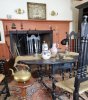
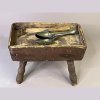
Montgomery County walnut schrank with replaced brasses and original feet and shelving, 82½" x 56½" x 25", ex-collection J. Stogdell Stokes, deaccessioned by the Philadelphia Museum of Art, $52,000 from Philip H, Bradley of Downingtown, Pennsylvania. The walnut wing chair with Russian leather covering from the Moravian Community workshop, 1750-80, was $68,000. George Allen and Gordon Wyckoff of Raccoon Creek Antiques, L.L.C. at Oley Forge, Oley, Pennsylvania, asked $6800 for the Shaker swing-leg work table. The pair of yellow-painted step-down Windsor chairs was $4850. The folk art chandelier was $12,500; the Berks County sheet-iron deer weathervane, $7800; the large Pennsylvania hooked rug on the right wall, 1870-80, 6' long, was $6400; and the three-shelf bucket bench, painted a mushroom color, was $16,800. Newsom & Berdan Antiques, Thomasville, Pennsylvania, asked $18,500 for the Eastern Shore, Maryland, album quilt in mint condition. It was packed away for generations. It may have been made for a minister, and patches in the center may cover his name. The dining table was made in Vermont and was $3600; the seven Windsor chairs are from Maine and priced at $3500 for all seven; the Windsor armchair at the head of the table was $1400; and the “God Bless America” hooked rug from New Hampshire was $1500.
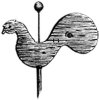
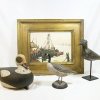
Pair of portraits by Samuel Shute (1803-1856), probably New Hampshire, watercolor, pencil, gouache, and gold and bronze paint, $24,000. The two-part cupboard was made in Lancaster, circa 1830, and has restoration to the left foot and molding and retains its red and yellow paint. It was $28,000. The tin candle box was $350; the oval-top table with remains of white paint, $6500; and the carved bird, $8500, all from Edwin Hild and Patrick Bell of Olde Hope Antiques, New Hope, Pennsylvania.
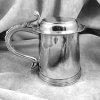
Steven S. Powers of Brooklyn, New York, offered for $2600 a scrimshaw whale’s tooth engraved with a sailor wearing a liberty cap with a cutlass in one hand and a notice in the other espousing “Free Trade and Sailors’ Rights,” the rallying cry of the War of 1812. It sold. The 18th-century horn cup (right) by Nathaniel Spilman of Norwich, England was engraved for a hairdresser whose image and his name, Ino [John] Cupitt, is on it. It was $8500. The elaborately engraved 18th-century horn cup (left) is engraved “Love Ye The Stranger/ For Society of Universal Good Will, Norwich.” Powers offered it along with a copy of the Gentleman’s Magazine, which tells about the Society of Universal Good Will, for $11,500.
Joyce and Ron Bassin of A Bird in Hand Antiques, Florham Park, New Jersey, asked $1100 for the tramp art shelf. The miniature bird carvings by A. Elmer Crowell, Jesse Blackstone, and A.J. King ranged from $300 to $1900. |
Wilmington, Delaware
by Lita Solis-Cohen
For nearly 50 years, the Delaware Antiques Show has been one of the most successful regional shows in the country. Since the mid-1990’s, the profits have gone to the educational programs at the Winterthur Museum. After years of festive parties at country clubs, the Soda House at the Hagley Museum and Library, and private school gymnasiums, ten years ago this show moved to the cold, dark ambience of the Chase Center at the end of an industrial park in the commercial part of Wilmington, Delaware, where an adjacent lot is being excavated to build a new Westin Hotel.
Despite the workaday ambience lacking any charm, those who love the objects make their way to this show because of the quality of the antiques offered, the enlightening conversations with the experts, and the deals to be made. Delaware does not charge sales tax, and if you joined the Winterthur Guild or extended your membership, admission was free.
The show, held November 9-11, 2012, had some high hurdles to jump. Hurricane Sandy left many without electricity and Internet. Cohen & Cohen, British dealers in Chinese export porcelain, could not get their shipment through customs because of hurricane delays and had to cancel. Show manager Diana Bittel called Cheryl Scott in Derry, New Hampshire, on Thursday morning, and Scott packed her van with enough to fill a stand. Everyone helped her set up in time for the preview that began at 5 p.m. on Thursday night.
She was not the only dealer new to the show. The Schwarz Gallery, Philadelphia, and Joe Kindig Antiques, York, Pennsylvania, showed in Delaware for the first time, as did Bette and Melvyn Wolf, who brought an enormous stock of pewter all the way from Flint, Michigan. Christopher Rebollo returned after a four-year absence. They were good additions to the impressive roster of 73 dealers, and they should have sold like gangbusters.
That rarely happens at shows these days. The gate was down partly because I-95, the major highway to Wilmington, was closed for repairs, causing frustrating detours. Those en route, listening to their radios, learned that on Thursday and Friday the stock market had dropped 400 points, and endless talk about the fiscal cliff and raising taxes for the rich put many in a sour mood.
Nevertheless, a good crowd came to the preview; it was not a buying crowd, but a party crowd. The following day, tastemaker Carolyne Roehm, the honorary chair of the show and featured speaker, was very well received. During her 10 a.m. talk she mentioned early 18th-century botanical illustrations by the Dutch artist Maria Sibylla Merian, and then she proceeded to the Philadelphia Print Shop stand and bought five large Merian prints and three small ones, endearing her to proprietor Donald Cresswell.
Although the crowds were not huge on Friday and Saturday, attendance picked up on Sunday. The right people came, and some business was done every day. Mark Allen of Gilford, New Hampshire, said he had his best Delaware show ever. He sold furniture, brass, half a dozen English figural food choppers, and some stellar delft. Malcolm Magruder said, “Business was like the old days. I sold smalls of every sort but no furniture.”
Arthur Liverant sold furniture: a New England high chest and matching dressing table, a Connecticut Tracy-Allen school Windsor bench, 1800-10, and a curly maple drop-leaf table, plus framed pictures and decorations. Philip Bradley sold a marble-top table, a looking glass, a high chest, a small chest of drawers, and a lantern clock owned by the Wister family. James Price sold a corner cupboard, a tall chest, rugs, silver, and paintings. Chris Rebollo sold a Queen Anne chair, a Philadelphia card table, a portrait of a child, and a small slipware dish. Polly Latham sold a lot of Chinese export porcelain, some made for the American market and some with the arms of Europe’s aristocracy. Spencer Marks sold enough silver to be happy with the show. Judy Loto, who had shelves full of rare books from the estate of Massachusetts dealer Bruce Sikora, said Delaware is always one of her best shows, and books on furniture, metals, and needlework were in demand at this show. The crowd was three deep at Arthur Guy Kaplan’s antique jewelry stand until closing time on Sunday.
Nearly every dealer reported making half a dozen sales and felt positive about the show, but many said they were counting on deals in the works to make a profit. Some said that they were offering furniture for less than they had paid for it or that with the cost of conservation to get the pieces ready to sell their profits were slim.
Some wondered aloud how long the trade can support these shows that bring real treasures to a dwindling audience. Those who came to Delaware were awed to find the finest balloon-seat walnut side chair made in Philadelphia in the early 18th century at Philip Bradley’s booth; it was marked $75,000. The maker was recently identified as Edward Wright, a cabinetmaker who was living on Fourth Street between Chestnut and Market Streets in May 1749. A label pasted on the seat rail indicates that it was the property of a family of Upper Freehold, Monmouth County, New Jersey, showing that New Jersey residents who could afford it bought Philadelphia furniture.
A needlework picture illustrating Rachel and Jacob ($230,000) and a tiny piece of monochrome Dresden work by Sara Marriott, silk on linen, made in Philadelphia in the first quarter of the 18th century (price on request) were masterpieces at Stephen and Carol Huber’s stand. The Woodlands Indian bowl with heart-shaped handles on Donald Heller’s stand is one of the best bowls of this type to be found ($52,000).
For every piece that was fresh to market, there was another that had been seen at shows in the last few years. It is not that these pieces have flaws; they are fine examples. This demonstrates how hard it has been for dealers to find enough fresh material that measures up to the highest standards demanded at this show. They should not be faulted for bringing things that have been out before, nor should those few dealers who show in New York City in January be criticized for keeping their best for that venue; their second best has merit also and generally is priced more reasonably.
Many wondered aloud when more people are going to discover the joys of collecting Americana. If a Ken Burns documentary on the achievements of American craftsmanship arrived on iPads and TV screens, would that fuel a reawakening of appreciation for the brilliance of the arts during the years of the founding our country? Perhaps.
If this show could be held at Winterthur, its beneficiary, perhaps more people would be reminded of the pleasures of living with antiques and what good taste is all about, and a new generation of collectors would embark on a pastime the previous generation found so much fun.
For more information, go to (www.winterthur.org).
|
|
|
|
|
|
|
|
Originally published in the February 2013 issue of Maine Antique Digest. © 2013 Maine Antique Digest