
















Jon Eric Riis, the Atlanta, Georgia, fiber artist who in 2011 was named a Windgate Fellow by United States Artists, citing his research into pre-Columbian Peruvian, Imperial Chinese, and Russian textile traditions to create tapestries. One of his forms is the "universal coat," which he meticulously weaves with metallic thread, silk, beads, and semiprecious stones, often with sociopolitical content hidden in the interior of the piece. On the wall are antique Chinese Imperial robes. The black one on the right, the most formal, was $60,000; the central piece, 18th century, a birthday celebration, was $125,000; and the orange one at left, made for the heir apparent, was $50,000. The "universal coat" by Riis in front was $50,000, and the green one behind it, $87,000. The square Chinese insignias on the floor ranged from $2000 to $11,000.
A 17th-century English stumpwork picturing Charles II and Henrietta was $18,000 from Marilyn Garrow of London, England.
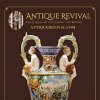
Exhibiting at the Baltimore show for the first time, Cara Antiques, Langhorne, Pennsylvania, asked $12,500 for this French majolica plaque with fishes. They also brought along an entire case full of Clarice Cliff ceramics.
Marvin Baer of Ridgewood, New Jersey, offered these two Japanese Fukagawa porcelain chargers decorated with brocade chrysanthemums, 1880's, at $3800 the pair.
Steven Martin of Sonny Ideker, Bookseller, Woodstock, Georgia, offered books in fine bindings. This ten-volume set of The Writings of Thomas Jefferson, published by G.P. Putnam's Sons, 1892-99, #210 of an edition of 750, was $10,000.
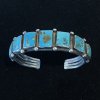
A Day in the Village by Franciszek Streitt (Polish, 1839-1890), oil on panel, 9" x 16", was $35,000 from McCarty Gallery, Philadelphia Drucker Antiques, Mount Kisco, New York, asked $48,000 for the Jean Arp necklace at left, #23 from an edition of 100; $8500 for the Georg Jensen leather and silver necklace No. 300 (center), designed and made in 1979 by Anette Kraen; and $24,000 for the circa 1950 Harry Bertoia sterling silver necklace at right. |
Baltimore, Maryland
by Lita Solis-Cohen
"This business used to be so much fun; I hope it will be fun again," said New Jersey dealer Bonnie Heller, a longtime dealer in decorative accessories. "This is my first show in five years."
For her reimmersion, Heller picked the Baltimore Summer Antiques Show, the largest hard-wall show in America, which is run by the Palm Beach Group. CEO Scott Diament and his nearly silent partner, Robert Samuels, are also partners in a jewelry business called Provident with seven stores in Florida, and they take stands at the shows. Last year they bought out their third founding partner, jeweler Kris Charamonde, who also takes a stand at their shows.
They were a triumvirate when they bought the Baltimore show seven years ago and began transforming it from a flea market into a fancy carpeted hard-wall show. Diament and Samuels manufacture the felt-covered walls and reuse them at other shows. They run a Web site for their exhibitors (www.CollectorsNet.com), and they recently bought the LA Art Show, bringing their show stable to five: Dallas, Naples, Palm Beach, Los Angeles, and Baltimore.
For this 32nd edition of the Baltimore Summer Antiques Show, held August 23-26, they rounded up more dealers than ever before; 572 was the final count, of which 90 were new to the show, and dealers came from Canada, France, Spain, Italy, Ireland, Great Britain, Denmark, China, and Japan. Eighty-five antiquarian book dealers set up in their own special section.
The show filled the sprawling 245,000-square-foot exhibition space at the Baltimore Convention Center at the Inner Harbor, right next to the Baltimore Orioles' famous Camden Yards. The $15 admission was good for all four days. The publicity stated that they get 30,000 people through the doors, but dealers said the gate was down this year, though serious buyers did come.
There was a lot of bling. "There is more jewelry here than at Palm Beach," said Scott Diament, referring to the group's flagship Palm Beach Jewelry, Art & Antique Show. He said there were 100 jewelry dealers, and about 90% of their sales were retail.
That did not mean that jewelry dealers didn't do a lot of shopping during the two-day setup; they did. The big-time dealers, however, put out their diamonds and pearls just before the show opened. Apparently, collectors in the know find this to be the place to shop for Tiffany and Cartier in the secondary market; dealers sell previously owned jewelry at big discounts, a third or more below retail prices for the same designs new. There is also plenty of brand-new jewelry; well-displayed strands of freshwater baroque pearls, yellow diamonds, and polished quartz were showstoppers.
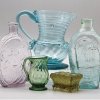
The Baltimore Summer show used to be known as the silver show, but there was less silver this year than in the past. Several of the top London and New York City dealers were absent, and the mom-and-pop silver dealers don't do this show anymore because they can't afford it. Nevertheless, there was a broad selection of Georg Jensen designs offered by three dealers, including Gregory Pepin, whose company, Danish Silver, commissions new Jensen and sells a full line of vintage Jensen.
Spencer Marks Ltd., Southampton, Massachusetts, offered a selection of Arts and Crafts silver by the Kalo Shop, including the largest Kalo platter and cover known. There was Russian silver, English and Irish silver, and American hollowware and flatware. Some dealers offered napkin rings, sterling, and silver plate.
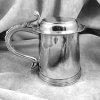
Fairfield, Connecticut, dealer Martin Chasin said he made 18 sales during setup, including a Regency silver tankard. During the show he sold a Georgian coffeepot, two sets of English flatware, three pairs of English candlesticks, and four Georgian master salts, but most of his sales were of English and Irish glass.
"High-end material was moving. It was my best show in the past twenty years. People were buying silver and crystal to use, and anything wine-related was in demand," Chasin said. "The clientele at this show has changed; shoppers were well educated, and they knew what they wanted."
One collector wanted figural silver-plated napkin rings. Sandra Whitson of Lititz, Pennsylvania, sold 19 to one woman. "She had thirteen in her collection when she came to the show and left with nineteen more," Whitson said.
There were ceramics from every country and period-Chelsea to Clarice Cliff, Palissy to Picasso, and Meissen to majolica. Half a dozen dealers offered Victorian majolica, including Nick Boston, the scholarly Irish dealer who specializes in exhibition Minton majolica as well as Coalport and Copeland from the Gilded Age. New Jersey dealer James Infante and New York City dealer Jason Jacques offered turn-of-the-last-century Art Nouveau porcelains (Infante) and pottery (Jacques), and Jacques was one of the few who offered works by contemporary art potters along with art jewelry.
There were plenty of art dealers with mostly 19th- and 20th-century pictures. New York City dealer Alexander Acevedo showed a group of small American 19th-century landscapes, all unframed, and during setup he bought a 16th-century portrait of a very rich German woman wearing multiple rings and gold chains. He said he likes her so much, he hopes to keep it for a long, long time, but he might take it next year to the Masterpiece show in London, where he shows only old masters.
There was a selection of sculpture, mostly bronzes, on several stands, and prints of every sort could be had in a broad range of prices. Collectors had their choice of Hermès and Chanel handbags, and Nula Thanhauser offered her signature evening bags. Louis Vuitton luggage could be found on half a dozen stands.
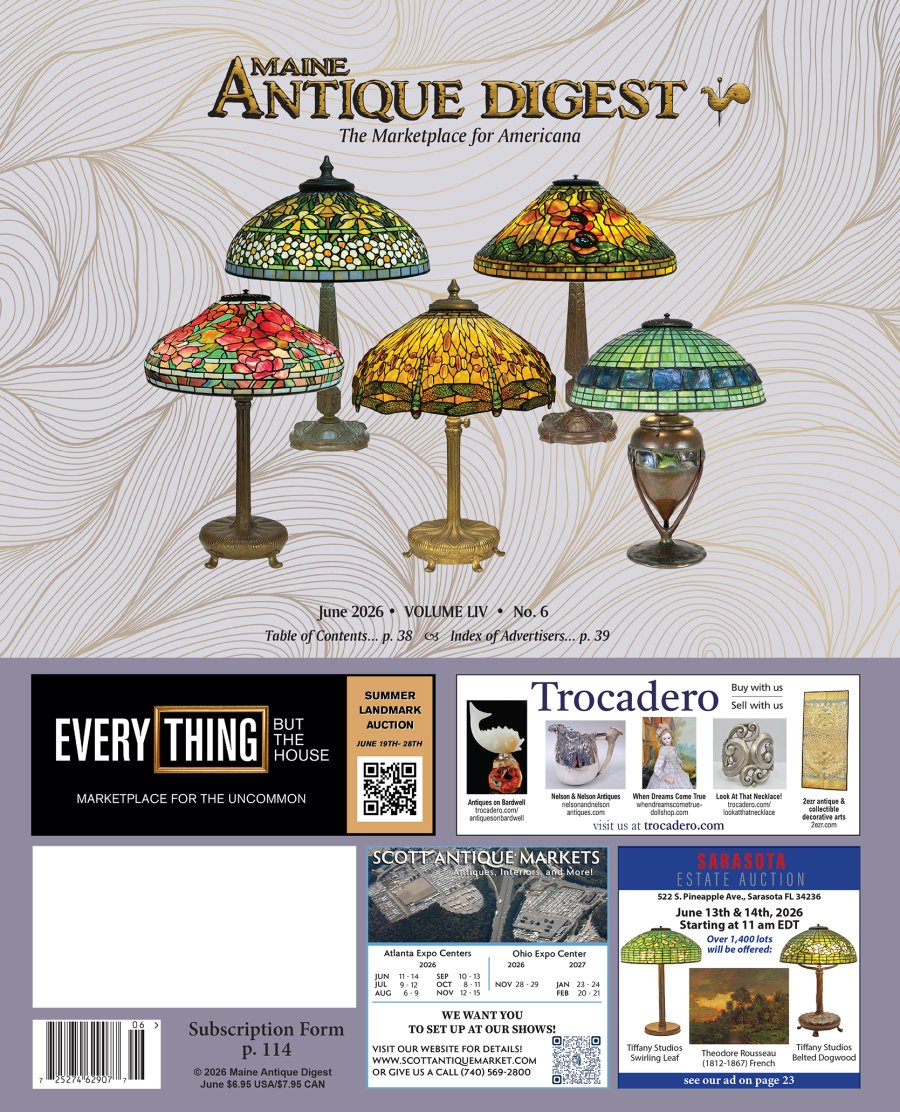
Lighting is always sought after. A selection of Czechoslovakian glass lamps, Tiffany lamps, and Murano glass lamps was available, and there were sconces made by Caldwell & Company before the turn of the 20th century to the specification of architect Horace Trumbauer for Lynnewood Hall. Only a few stands offered 20th-century design.
Asian works of art were in abundance, but at least three dealers from China brought scant displays. They had come in order to buy early and may not be invited back.
Peter Rosenberg of Vallin Galleries, Wilton, Connecticut, had a selection of Chinese export porcelain along with Chinese textiles and scholars' objects, but most stands with Asian art offered textiles, snuff bottles, jade, furniture, scrolls, enamels, and other works of art. One stand had only Japanese netsuke, including a hare with an amber eye. Orientations Gallery, New York City, offered a full range of Japanese lacquer, ivory, enamels, and other works of art, and Ridgewood, New Jersey, dealer Marvin Baer offered Fukagawa ceramics from the turn of the last century.
There was not much Americana at the show. Exhibiting were Jeffrey Tillou, Don Heller, Ed Weissman, Stella Rubin with quilts and jewelry, Jeff Bridgman with flags and political printed textiles, and the Van Andas and the Norwoods with some folk art. Stella Rubin, showing at Baltimore for the first time, said two-thirds of her business was to dealers and that she sold more jewelry than quilts, but she said she was offered a good Baltimore album quilt and would do the show again.
Print, poster, and book dealers offered American material, and there was enough Americana to bring serious shoppers Rex Stark from Massachusetts and Sumpter Priddy from Virginia. Both said they found picking to be good.
Stark was first in line at the Charles Street entrance. The line was longer at the West Pratt Street entrance, where there seemed to be more dealers than collectors, including some well-known New York City dealers who took an early train and got to Baltimore in plenty of time for the noon opening on Thursday.
For collectors and dealers, the Baltimore summer show is the rock that should not be left unturned. It does bring fun into the business. It is a giant treasure hunt and is more casual than the fall and winter shows; only big-time jewelry dealers wear coats and ties. It takes the four days to see it all carefully, because it is five shows rolled into one with the widest variety anywhere. It's worth an overnight stay in one of the nearby hotels that offer discount rates if you book early and mention the Baltimore Summer Antiques Show.
Dealers said the booth rent was higher this year, but the hall was air-conditioned for setup and pack-out. The Palm Beach Group did a spectacular job of advertising and instituted a dealers' lounge stocked with drinks and snacks. Yet with the gate down, business was off for most dealers, who, when they heard that the management did not have to use union workers, thought the savings should have been passed on to them.
Those who didn't make it to the show can log on to CollectorsNet.com, where exhibitors can post their stock at no extra cost. The problem is, nine out of ten of the dealers you are looking for don't bother to post because they have their own Web sites, or they post on other sites, or they don't want to bother with the photography that went on all during the show. CollectorsNet would be really useful if it would list the dealers' contact information, especially locations, e-mail addresses, and phone numbers. For most of the dealers, none of this information is given in the small show catalog, which has an unreadable floor plan with print too small to see without a loupe. It is hard to find a dealer again at this show if you forget to get a business card or forget a name.
For more information, contact the Palm Beach Group at (561) 822-5440; Web site (www.baltimoresummerantiques.com).
|
|
|
|
|