See All Ads

The Merchandise Mart International Antiques Fair

Danielle Arnet | August 27th, 2012

Because the Mart houses designer showrooms, three booths showcased in-house talent. This is the "Designing with Antiques" space of Ramsey Jay Prince Designs.

This vignette booth highlights the work of designer M. Grace Sielaff.

Designer Summer Thornton used classic antiques in her vignette.

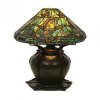
Zachary Skarda of Skarda Gallery, Grafton, Wisconsin, brought an array of lamps from Tiffany Studios. From left, a Daffodil table lamp ($55,000) and a 28" diameter circa 1910 hanging Autumn Leaf ($275,000). Skarda told us he'd sold a Nasturtium lamp on Saturday.

Classic Antiques brought a selection of Chanel suits. The pink suit with ruffles at front was $2950. At back left, the black velvet suit with jewel buttons is $3500. Both are size 42, which translates via conversion chart to a U.S. size 12. A very small 12.

Scott Thomas of Deco 2 Mid-Century Furniture, Pennsylvania and New York City, brought the Art Deco burl chest that looks French but is American, made in the 1930's in Wisconsin. It was priced at $3850. The Machine Age fan from the same era is $675; the Art Deco round table to the left, $2450; and the lamp on it, $775. Note the etched glass room divider screen. From a Philadelphia restaurant, it is from the 1940's and came as three pieces. Thomas designed the custom bases. It was tagged $7800.

Chicago, Illinois

by Danielle Arnet

When the annual Merchandise Mart International Antiques Fair reached its 15th anniversary this year, it had already been through several lifetimes.

The Mart's October show in 2007 was the first to use the full title. In spring of that year, the Mart launched a four-day art extravaganza dubbed "Artropolis." A huge undertaking, Artropolis was a full-fledged international event with five shows on four floors. An antiques show filled another floor. At that time, antiques fairs happened each spring and fall.

Artropolis came about because Art Chicago, founded at the Navy Pier in 1980, was in trouble. In 2006 international sellers arrived to set up and found an empty site. At literally the last moment, Merchandise Mart Properties, Inc. (MMPI) stepped in and offered the show a place to set up.

MMPI bought the show, pumped it up, coined it Artropolis, and everything was good. When we covered the new event for M.A.D., we noted a lot of traffic between the art shows and the antiques fair.

But the economy and times changed. The art fair market solidified on both coasts, and in February 2012 MMPI announced that it was leaving the Chicago art fair scene to concentrate on shows it owns in New York, Los Angeles, and Basel, Switzerland.

So it happened that as we approached the Mart for this first post-Artropolis fair, held April 27-30, we saw far less foot traffic entering the building, and it seemed to be an older, less backpack-style crowd.

For this fair, Mart elevators took viewers directly to the fair floor, where they opened on a vista of the show. At previous shows, one disembarked from different banks of elevators, which proved confusing when trying to retrace steps.

Mart staffers on the main floor were plentiful and helpful, directing visitors to the elevators. It helped that most visitors already had printed the $15 tickets. The prepay tickets were available via the Internet before the show.

The four-day fair was widely advertised and had unified signage of antiques superimposed on a Tiffany blue triangle bearing the fair name and subtitle, "Art, Antiques and Jewelry from BC to 20C."

Tickets for opening night access from 8 to 10 p.m. were $25. Lisa Simonian, Mart VP of marketing, told us that in addition about 1000 visitors attended a preview party to benefit the Rehabilitation Institute of Chicago (RIC). Show partners included RIC, the Chicago Tribune, Chicago's classical music and PBS TV stations, and Terlato Wines, plus several shelter and gallery publications.

A presentation on Friday's Young Collectors Night was at capacity and will rate a bigger venue next year. Many had to be turned away, but those who made it in heard from M.A.D.'s "The Young Collector" columnists, Andrew Richmond and Hollie Davis, as well as Chicago designer and antiques specialist Todd Schwebel.

Another especially popular event was a booth talk by tramp art specialist Clifford Wallach. So many came that chairs had to be placed in the aisle outside the booth.

Speaking of aisles, the first thing that struck us about this show was how narrow the aisles were. We noticed, but dealers we queried had no problem with the setup. Several liked it, telling us that the closer quarters made for a cozier show.

"We changed the layout," Simonian added. Moving to the north side of the floor instead of using the entire floor provided a better sense of arrival. At over 40,000 square feet, this was no small show. There was some awkwardness about the setup-barricades and curtains led the way to one women's restroom—but regular fixtures of Mart antiques fairs, including huge urns of fresh flowers, cafés and food stations manned by Foodstuffs, and benches for the weary, were there.

Where it counts, the show was a success. Scott Thomas of Deco 2 Mid-Century Furniture, Pennsylvania and New York City, sold so much that by the time we arrived at Sunday's opening he'd totally restocked. An American Art Deco dressing table still on the floor was destined for Singapore. A set of parents came to his booth on Saturday, took a photo, sent it to an offspring there, and poof-the sale was done! Time of entire transaction: about five minutes.

Colleen Doyle of Crescent Worth Art & Antiques, Lake Forest, Illinois, told us, "This is a price point year." People were buying, but carefully. She noted that most of her sales were to the public, not to dealers. On a happy note, "More designers are coming back, with clients from the Midwest." Overall, "in all of our shows we do in the Midwest, we're doing well." She had a very successful show.

At the fair for the first time, with cases and cases of Chanel and Hermès handbags, New York City seller Charles Virgil Rogers was more guarded. "Buyers here," he told us, "like to get to know you." Perhaps in this case, flatland reticence is tied to five-figure prices.

We counted 14 U.K. dealers, more than we remember seeing at earlier fairs. London seller Linda Gumb said she had sold primarily Georgian jewelry and works by modern emerging artists. How's that for eclectic?

The only negative that we saw happened on Sunday when supplies for complimentary mimosas ran out. One minute there was a bar with ready-to-go filled stemware and smiling staffers popping corks; the next minute, about a quarter-hour before cutoff time, everything was gone but the bare table. In the larger scheme of things, that was a mere blip. In all, sellers seemed happy, as did fairgoers.

"We're committed to this event," said Simonian. But the fair will become a yearly event held only in the spring. Calling it "one of the top antiques events in the industry," she cited the Mart's interest in the "synergy of design and an affluent audience," and the fact that the fair "adds value to all our other businesses."

Then we asked, considering the Mart's success with international art fairs, does MMPI plan to take the fair international? To make it a traveling affair, not anchored to the Mart? "It's not out of the question," she replied.

For more information, call (312) 527-7069 or check the Web site (www.merchandisemartantiques.com).

We had visions of women swooning as they came upon the rows of cases filled with Chanel and Hermès bags at Only Authentics, New York City. Charles Virgil Rogers told us he'd sold "a handful" by Sunday. No wonder, when inventory is priced at $10,000 to $72,000 a bag.


Originally published in the September 2012 issue of Maine Antique Digest. © 2012 Maine Antique Digest
comments powered by Disqus