See All Ads

WADA Antiques Show and Sale

Danielle Arnet | October 5th, 2012

Waukesha, Wisconsin

WADA Antiques Show and Sale

by Danielle Arnet


Ted Slaton of Ripon, Wisconsin, had great success with an eclectic mix of merchandise. The $595 anchor rests against five units of 1800’s iron fencing from a Berlin, Wisconsin, estate, priced at $125 each.


Gerald Shafranski of Raven Nest Antiques, Cleveland, Wisconsin, collects bits and pieces of lace and crochet work that he takes to a craftsperson who puts them in glass and solders the frames. Admitting that the sideline “pays booth rent,” Shafranski told us that his framer cannot keep up with demand. The pieces look great on mirrors and walls, he added. We saw larger ones at $24 and smaller ones at $14. The ladle is $95.


We spotted Mark Amato of Mequon, Wisconsin, showing his wife, Marge, and seller Shirley Klamm of Weather Vane Antiques, Cedarburg, Wisconsin, a child’s spooner that caught his eye. Having discovered children’s pieces for the first time, the Amatos fell in love with the $65 piece of Sandwich glass. “It books for a lot more,” Klamm told us, “but hey, we’re midwesterners.”


Viewing the booth at Grape and Cable, Lombard, Illinois, we felt a time warp effect. It seems like decades since we’ve seen this kind of merchandise in such variety. On the top shelf, the Meriden double-handle basket with blue bowl was $1295, and next to it the heron card stand with vase was $425. At bottom, a Tufts frame with blue basket was $395; a Reed & Barton nut bowl (filled with nuts!), $325; a Pairpoint square basket, $265; and a large Wavecrest dresser box, $950.


Schoolmaster Antiques, Baraboo, Wisconsin, brought the 1800’s chicken hooked rug tagged $995 and the Pennsylvania Central Airlines clock from the 1940’s, $800. A tag stated that the airline operated from 1936 to 1948, and the clock works. The star rug was $275; the Overland cast-iron circus wagon shown in a Plexiglas box was $650.


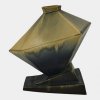
The Wisconsin Pottery Association (www.wisconsinpottery.org) featured several large cases of American art pottery. Dorothy Russ of Madison, Wisconsin, was on duty when we passed, ready to answer questions about pieces loaned for display. Samples included Stangl, Pauline, Grueby, Red Wing, Durant, Teco, and more. Russ told us she’d fielded several offers to buy.

In a long stretch of covering shows and auctions, we’ve learned to keep expectations low. Better to be pleasantly surprised than disappointed.

Well, we’re here to tell you that the fall Antiques Show & Sale of the Wisconsin Antiques Dealers Association (WADA) on October 5 and 6, 2012, was a real tonic. After months of dispirited events, where we saw dealers trot out their best while buyers yawned, we were thrilled to find a show crowded with buyers actually eager to buy. And buy they did. To tell the truth, we thought that, like Alice, we’d fallen through a rabbit hole. It got us thinking about what made this event so different and why it succeeded so well. We’ll get back to that in a while.

Held in the Waukesha County Expo Center in a city about 18 miles from Milwaukee (about two hours from Chicago), the event was the 61st fall show for WADA. Its 39th annual winter show will be held February 1 and 2, 2013. In addition to this show’s being its 61st in the fall, WADA (pronounced “wah-dah” by members) is, according to the group, the oldest still-standing state antiques organization in America. That’s some record.

Debbie McArdle, who is responsible for show publicity, said that 55 dealers participated. That’s maximum capacity for the venue. One dealer has been with the show for 40-plus years. Most members have exhibited for an average of ten to 20 years. That consistency was seen in the way many customers entered and then made a beeline for their favorite sellers.

Traditionally, the show had run from a Friday through Sunday, but this year it was a two-day show. The stated reason for the change was a hike in hall rent (two days being cheaper than three), but McArdle allowed that “there’s always a sports conflict on Sunday in Wisconsin.” Cheese Heads (you’ve seen the yellow foam cheese wedge hats worn by fans?) live for football. When push comes to shove, the Green Bay Packers come first.

The decision on which day to cut was a no-brainer. Friday is opening day, when serious buyers storm the hall. So Sunday, with its potential conflicts, had to go. As expected, Friday’s open was a barnburner.

One seller told us almost everything sold out on Friday, and everything we saw in the booth on Saturday was restock. We learned that sellers save their best all year for this show, so all merchandise is fresh no matter how often attendees have shopped with their favorite sellers.

McArdle called the display “something for everyone, for the beginning to advanced collector.” We call it varied, but not a stale mishmash. Many pieces are specially chosen to reflect regional tastes and origins.

Overall, we found pricing reasonable. Sellers were friendly and willing to deal. A large number of attendees knew what they were looking at, and dealers had to be on their toes to keep up with questions.

Conspicuously missing were precious objets at stratospheric prices. At the booth of Weather Vane Antiques, Cedarburg, Wisconsin, we heard Shirley Klamm quote a Sandwich glass child’s spooner for what seemed a bargain. “It books for a lot more,” she told us, “but hey, we’re midwesterners.” Precisely. This is Wisconsin, where collectors know their stuff and don’t need to buy status for validation.

Most sellers were WADA members. According to show manager Rick Kojis, two new members were elected into WADA this year. They exhibited as well. The 53 members are mainly Wisconsin dealers with a few from Illinois and Minnesota. For this show, dealers came from six states, all Midwest or upper Midwest.

Most sellers we polled were enthusiastic about the show, even a first-timer set up in a hallway. Seller Joyce Anderson of Midwest Antique Gallery, Oshkosh, Wisconsin, told us, “I would dump another show to do this one.”

Kojis would not release attendance figures, but he did say that attendance for the two-day show was up 15% from the three-day October show last year. See what we mean about happy news?

Our impression of the crowd on Saturday noon was that it was a congregation of older, experienced collectors. But Friday was a surprise. Show hours were changed to 11 a.m. to 9 p.m. on that day, making it a late close. The result, according to McArdle, was that young buyers came after work and/or dinner. And they bought. She said their numbers “were a good thing.” That crowd (everything from pierced noses to student types) proved enthusiastic. Whether they came because they’d seen old things touted on value-driven TV programs or because it was something to do on Friday night doesn’t matter. They came. The wisdom of accommodating young buyers was not lost on WADA.

Another Friday factor was the caterer, who agreed to serve an old-fashioned Wisconsin Friday fish fry with a choice of baked or fried fish. “We had to offer something to entice people on Friday evening,” said McArdle.

When it comes to Wisconsin mores, two things are sacrosanct––the Friday fish fry and the supper club with a relish tray. Make it three and add the Packers. Such a success that food ran out early, the fry should return, starting earlier in the day and with enough provisions for an onslaught.

What astounded us about this show was the type and variety of merchandise. There was more Victorian silver in the booth of Grape and Cable, Lombard, Illinois, than we’ve seen in decades. Observing seller Steve Gehring wrap a piece, we heard the buyer say, “I can’t believe how reasonable this was. I’d have to pay a lot more for it in Chicago.”

Noting “Sold” red tags on small Victorian furniture in the booth of Pierce Regal, Milwaukee, we lost it. “You soldVictorian furniture?” we blurted. Seller Don Mueller looked at us as if we were speaking in tongues. “I have customers who come to me,” he kindly replied. Truth be told, everything he sold was special and pristine.

It wasn’t until we hit the booth of Ted Slaton of Ripon, Wisconsin, that we finally got the gist of what all the buying was about. When we commented on his unusual Fire Chief gas pump ($2800) and a large brass anchor ($595), Slaton told us about the $300 Mercury outboard motor from the 1940’s and a large Borden sign he’d sold the day before to customers for their man caves.

Of course. It’s all about personal choices and pleasing number one. It’s been a while, but buyers were finally allowing themselves some pleasure. There in Wisconsin on a beautiful fall day, happy days seemed to be back. And it was great.

For more information about WADA, see the Web site (www.wisconsinantiquedealers.com).

The $2800 Texaco Fire Chief gas pump from the 1940’s came with Ted Slaton. The Casite rack at right from the same era was $125.

We were stopped dead in our tracks by the number of sold tags on Victorian furniture in the booth of Pierce Regal, Milwaukee, Wisconsin. Each sold piece was on the small side and pristine. The three-drawer rosewood dressing table, tagged $1795, was in astounding condition. Circa 1860, it sold to a collector who was still considering the $435 re-covered seat. The glass bowl in silver frame on top was $395. The standing mirror was $225.


Originally published in the January 2013 issue of Maine Antique Digest. © 2013 Maine Antique Digest

comments powered by Disqus