



























Americana Sells Well at Semiannual Auction
June 22nd, 2019
Jeffrey S. Evans & Associates, Mt. Crawford, Virginia
Walter C. Newman
Photos courtesy Jeffrey S. Evans & Associates
Jeffrey S. Evans & Associates held its 36th semiannual auction of Americana and fine antiques in two sessions on June 21 and 22 at the firm’s gallery in Mt. Crawford, Virginia. Nearly 1500 lots crossed the block during the sale. While virtually all categories were well represented, the sale was definitely skewed toward folk art.
The first session consisted of more than 500 lots from the collection of Jack and Tommie Marsh of Columbia, South Carolina. From needlecraft to basketry to trade signs to model ships to wooden boxes and game boards, the Marsh collection offered something for everyone.
Many of the significant lots offered in the second session were associated with the Clopper-Hutton family of Montgomery County, Maryland. That family figured prominently in 19th-century Maryland history.
The Colonial Williamsburg Foundation was both a consignor and a buyer in the sale. Among the deaccessioned lots were 45 figural ceramic items that collectively brought more than $39,000, far in excess of high estimates. On the purchasing side, the Colonial Williamsburg Foundation won an early portrait attributed to John Gadsby Chapman (1808-1889) of Virginia. The portrait of 14-year-old Maria Graham Koontz was executed when Chapman was only 17 years of age and, as the catalog notes, “on the cusp of a great artistic career.” Chapman is probably best known for his monumental painting Baptism of Pocahontas, which hangs in the U.S. Capitol building. The Chapman portrait sold for $15,210 (including buyer’s premium).
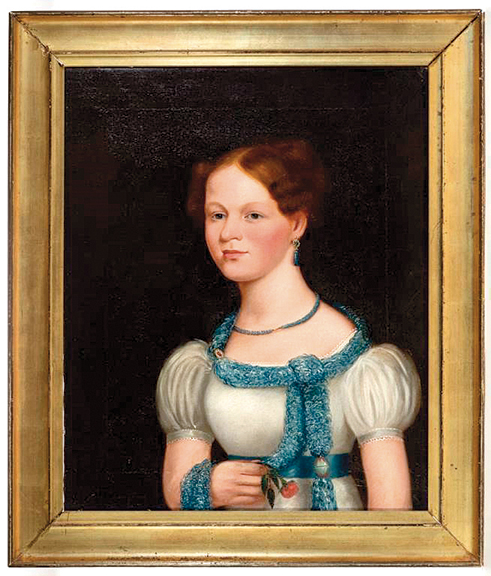
This unsigned oil on canvas is attributed to John Gadsby Chapman (1808-1889) of Virginia. The sitter is Maria Graham Koontz of Rockingham County, Virginia. The painting was executed in 1826, when Chapman was only 17 years old and Maria was but 14. At that time Chapman and Koontz were students at neighboring academies in Alexandria, Virginia. Koontz, with auburn hair and rosy cheeks, is depicted wearing a stylish Empire-style gown, holding a rose in her right hand and accessorized with earrings, a necklace, a knit wrap with an oval clasp, and an egg-shaped pendant. A note attached on the reverse written by the sitter in 1882 identifies the specifics of the portrait and its artist. The 26¾" x 22" (sight size) painting, in a later 19th-century frame, sold on the phone to representatives of the Colonial Williamsburg Foundation for $15,210 (est. $5000/8000).
The high lot of the sale was an inlaid walnut cellaret/bottle case from eastern North Carolina. The late 18th- or early 19th-century cellaret was attributed to Micajah Wilkes and sold to a private collector for $87,750 (est. $20,000/30,000).
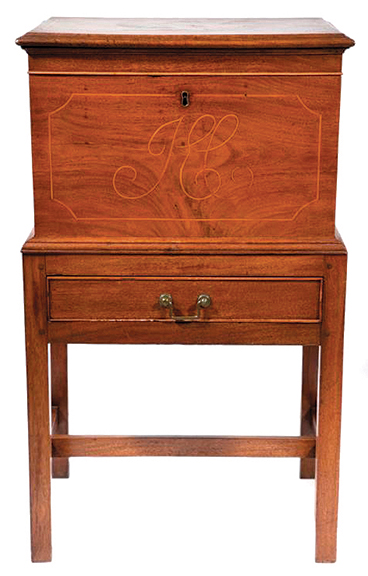
The high lot of the sale was this inlaid walnut cellaret/bottle case dating from the late 18th or early 19th century and attributed to Bertie County, North Carolina, cabinetmaker Micajah Wilkes. The lid is constructed in a manner that resembles a simple cornice of a large piece of case furniture; the top board has a molded edge, with applied molding below, and is attached to a shallow frame that resembles a frieze and trimmed with a cockbeaded strip. The case, divided into 12 square bottle compartments, rests on a single-drawer stand with square legs joined with an H-form stretcher dovetailed into the side rails. The front panel displays a stylized script inlaid monogram, “JEC,” centered within an inlaid cut-corner frame. A similar frame is inlaid on the highly figured top board. The cellaret is 34½" x 20½" x 15½" overall. Active bidding from all quarters pushed it to $87,750 (est. $20,000/30,000). The winner was a private collector bidding on the phone.
Aside from the exhausting number of lots that crossed the block, a couple of things stand out about the sale. First, the sheer volume of folk art smalls was amazing. Nearly half of the offerings in the two catalogs could easily fit into that subcategory of Americana. There was ample opportunity to purchase fine examples at reasonable prices, even when they exceeded the published conservative estimates. Second, Evans uses three online bidding platforms in addition to telephone bidding and his book of absentee bids. While the gallery was packed, a majority of the winning bidders originated from among those inanimate sources. That is certainly a sign of the times.
For additional information, contact Jeffrey S. Evans & Associates at (540) 434-3939 or online at (www.jeffreysevans.com).
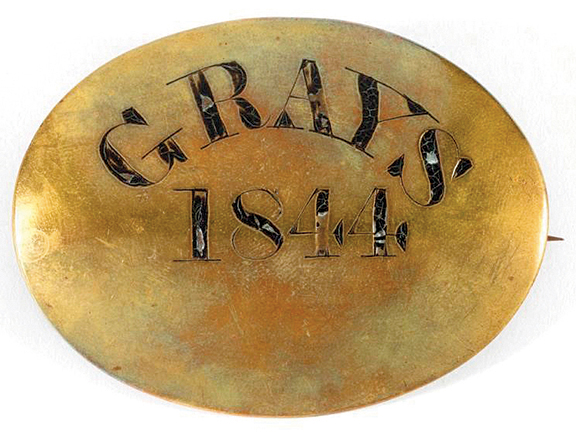
The Richmond Grays was a unit of the Virginia militia formed in 1844, joining the 1st Virginia Regiment in 1851. This belt plate was the property of Captain Edwin White Branch (1838-1863), who joined the Virginia 12th Infantry Regiment in 1861 and rose to the rank of captain in 1862. He was killed at the Battle of Brandy Station near Culpeper, Virginia, on August 1, 1863. The 2½" x 3¼" convex oval disk, engraved and enameled “GRAYS / 1844,” sold for $4680 (est. $800/1200).
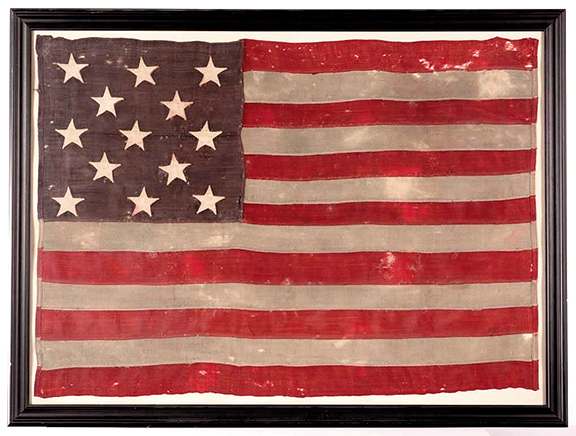
The canton of this American flag displays 13 five-point stars arranged in a 3-2-3-2-3 pattern, one of several configurations of our national flag from 1777 to 1795. The catalog notes that this example is machine stitched and was likely created for a centennial celebration. In overall good visual condition and mounted under glass, the flag sold for $819 (est. $100/150). Jack and Tommie Marsh collection.
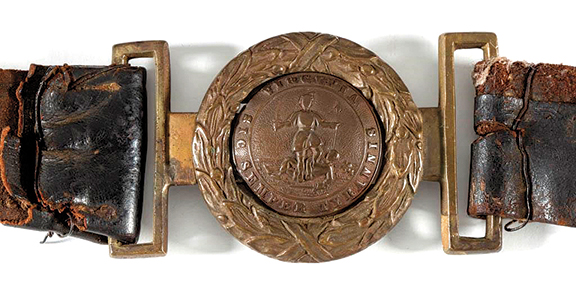
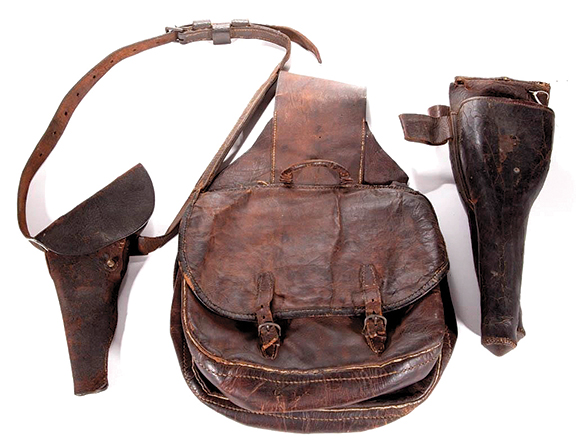
These two lots consisted of battle-worn personal items of a Confederate cavalryman. On July 10, 1864, Private William D. Scott (1843-1864) of Company D, 14th Virginia Cavalry, was severely wounded while serving as part of a six-man scouting party in Frederick County, Maryland, following the Confederate victory at the Battle of Monocacy, which had occurred one day earlier. Scott was able to elude his Union pursuers for a short time and took refuge with a sympathetic Unionist family. In spite of the efforts of the family and those of a Confederate surgeon who tended to Private Scott, he died shortly thereafter. The family buried the young man on the grounds of a nearby Catholic church. These items were taken from his body and horse and kept by the family. The belt and buckle sold for $7605 (est. $2000/3000); the saddle bag and three pistol holsters brought $4680 (est. $400/600). Clopper-Hutton family collection.
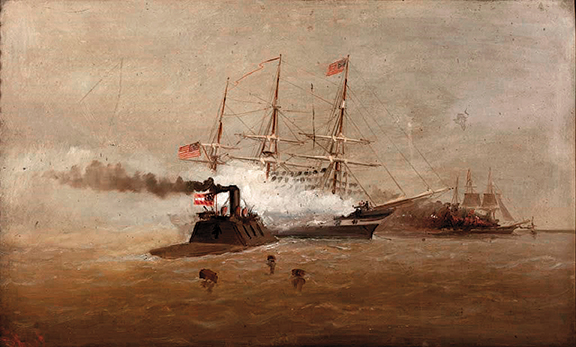
This oil on academy board by Alexander Charles Stuart (Scottish/American, 1831-1898) depicts the Confederate ironclad C.S.S. Virginia engaging the Union frigate U.S.S. Congress on March 8, 1862, the first day of the Battle of Hampton Roads, the Confederacy’s offensive effort to clear the Union’s naval blockade at the mouth of the Chesapeake Bay. In this encounter Virginia was victorious, with Congress being burned to the waterline. The significance of the event is that the following day the legendary battle occurred between Union and Confederate ironclads, the so-called Battle of the Monitor and the Merrimack [C.S.S. Virginia]. The battle itself was a draw, but it resulted in a decisive victory for the Union since its blockade of the waterway was maintained. The 14½" x 24" painting sold to an Internet bidder for $6435 (est. $6000/9000).
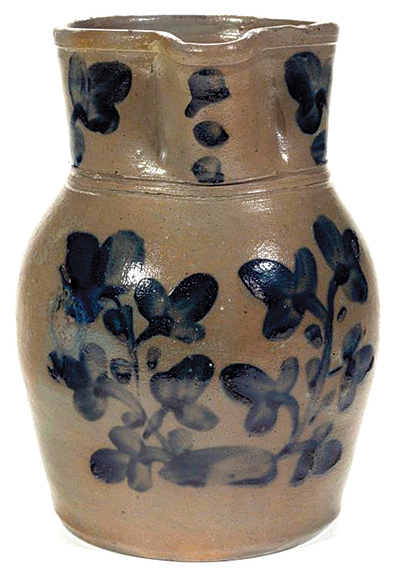
The decorated stoneware pitcher is a rare example attributed to Thomas and John Ducey’s Petersburg, Virginia, stoneware manufactory. The 8?" high pitcher has an approximate half-gallon capacity and dates from the third quarter of the 19th century. The body is decorated with bold brushed cobalt tulips. The pitcher is undamaged and exhibits minimal manufacturing imperfections. The catalog notes that this is possibly the only known example of a pitcher from the Ducey pottery. Its rarity may have been reflected in its selling price of $4972.50 (est. $1000/1500).
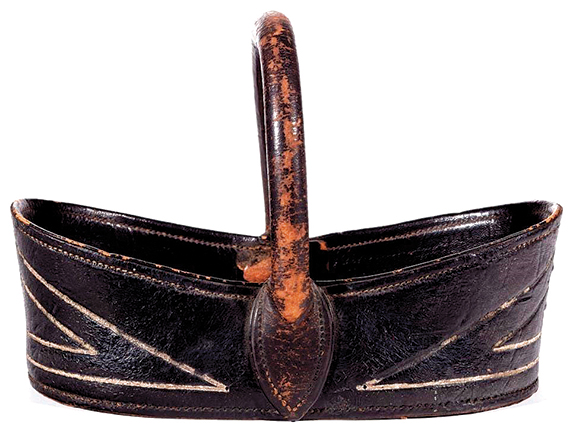
Key baskets are a reminder of the detailed leatherwork of the mid-19th century. This boat-form example features a geometric pattern on its body, a rounded arched handle, a leather-covered interior, and a wooden bottom. The basket is 6¼" high to the top of the handle and 8¾" wide overall. It sold for $2457 (est. $1000/2000).
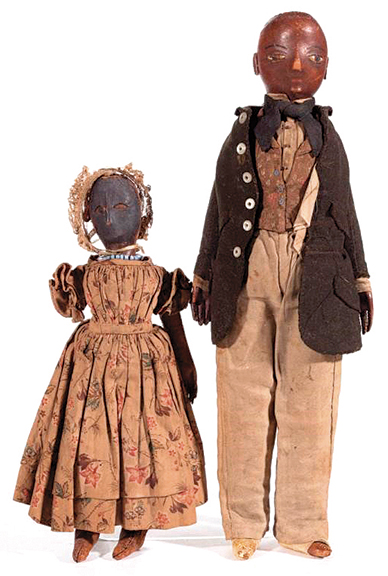
These 19th-century folk art dolls are reported to be from coastal North Carolina. The black figures are made from leather, with applied ears and cutout and painted eyes, and retain their original clothes. The male figure stands 14¼" high, and the female is 10" overall. She is missing one arm and an ear; otherwise the dolls are in good condition considering age and likely use. The dolls sold to a phone bidder for $8775 (est. $1000/2000).
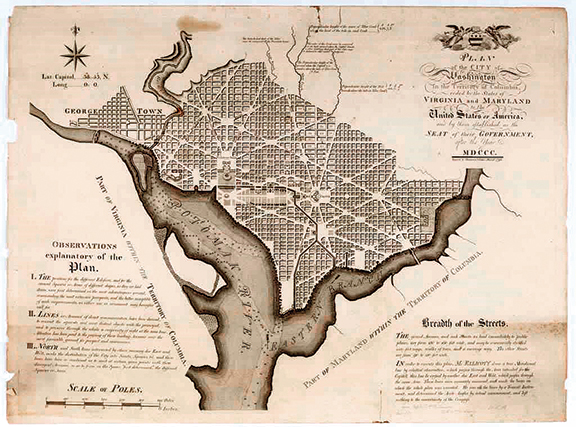
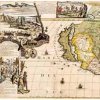
This previously unrecorded map, “Plan of the City of Washington in the Territory of Columbia…,” is by Andrew Elliott (1754-1820). Published by Thackara & Vallance of Philadelphia, the engraving is dated on its front “MDCCC.” The plan is based on Ellicott’s continuation of the work by Pierre Charles L’Enfant during the contentious and highly politicized events involved with mapping the new capital. The 20¾" x 28" engraving in overall very good condition sold to a phone bidder for $12,870 (est. $2000/3000). Clopper-Hutton family collection.
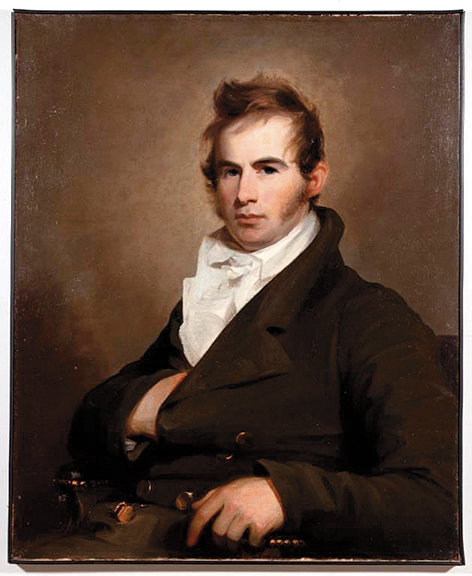
This portrait, unsigned but attributed to Thomas Sully (1783-1872), depicts Francis Cassatt Clopper (1786-1868), a successful Montgomery County, Maryland, businessman. The portrait was likely painted while Clopper was living in Philadelphia. The 32½" x 27" painting descended through the Clopper family. It sold to a phone bidder for $14,040 (est. $4000/6000). Clopper-Hutton family collection.
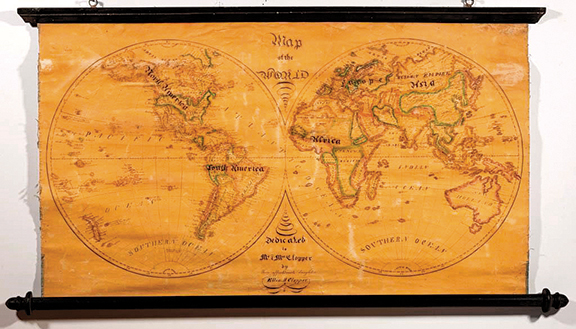
Here is a circa 1825 schoolgirl map of the world, watercolor and ink on paper, laid down on linen/canvas and fitted to a wooden roller frame. The piece was created by Ellen M. Clopper as a gift to her parents while she was attending St. Joseph’s Academy in Emmitsburg, Maryland. The map is 21½" x 28" overall and sold to a phone bidder for $9360 (est. $800/1200). Clopper-Hutton family collection.
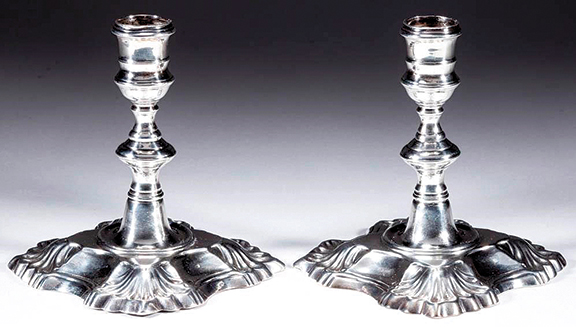
According to Jeff Evans, this pair of Georgian sterling silver dwarf desk/toilet candlesticks was found at a yard sale in Page County, Virginia. The 5" high candlesticks rest on squared bases with shell  motifs at the corners. They are marked “EG” for British silversmith Elizabeth Pantin Buteux Godfrey (circa 1700-1771). The silver marks indicate that they date to 1762, previously believed to be out of the maker’s date range. Extensive research by Janine E. Skerry of Colonial Williamsburg Foundation confirmed the date to be accurate, leading to publication of her article in Silver Studies: The Journal of the Silver Society, number 34, 2018, pp. 75-88, “Beyond the Working Dates: Reconstructing the Life and Career of Elizabeth Pantin Buteux Godfrey.” This yard sale find brought $7020 (est. $3000/5000).
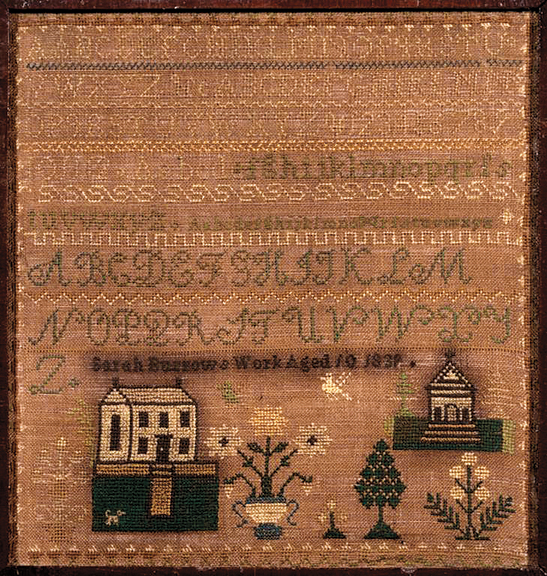
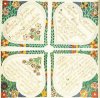
The Tennessee silk on linen needlework sampler is dated 1839. The field consists of seven rows of letters and numerals, each separated by a row of decorative stitching. The border is a repeating row of small flower urns. The lower portion features a house with a dog in the yard, a small chapel, birds, plants, a tree, and a five-stem flower urn. The center tablet reads “Sarah Burrows Work Aged 10 1839.” The 11½" x 12¼" (sight size) sampler sold to a phone bidder for $4095 (est. $800/1200).
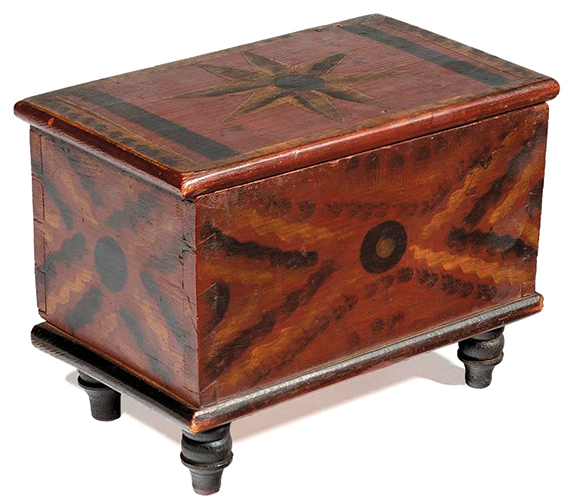
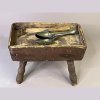
Another member of the Stirewalt family of diminutive paint-decorated boxes has surfaced. This example of the popular folk art creations exhibits all of the characteristics associated with the group. It is constructed of yellow pine, the case is dovetailed, and the three leading edges of the lid and the base are rounded and extend slightly beyond the perimeter of the box. The feet are turned and mortised through the bottom of the case. There is evidence of its original leather hinges. The box displays a deep red ground, painted only on three sides. The decoration is both freehand and stencil, featuring an eight-point star on the lid; the three decorated side panels feature a dark circle in the center, with undulating stylized bands extending from it creating an X design. The circa 1840 box, 5?" x 7?" x 4¼", sold to a phone bidder for $12,870 (est. $8000/12,000).
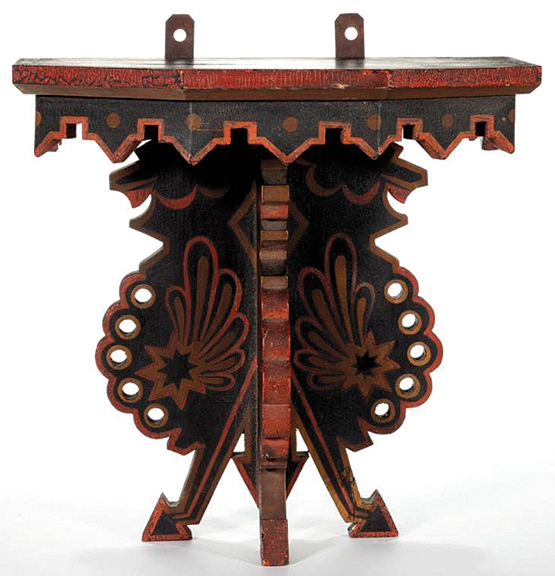
This carved and painted folk art wall shelf, 12" high overall, is possibly Virginia in origin. From the last quarter of the 19th century, the shelf features an elaborate array of cutouts. Each of the three red-, black-, and gold-painted panels displays a starburst design, a series of five decorated holes, and an arrow/lightning foot. The shelf board is trimmed with a notched apron. This shelf is not signed, but it closely resembles the work of John Walter Nail (1853-1938) of Winchester, Virginia. It sold for $1170 (est. $500/800).
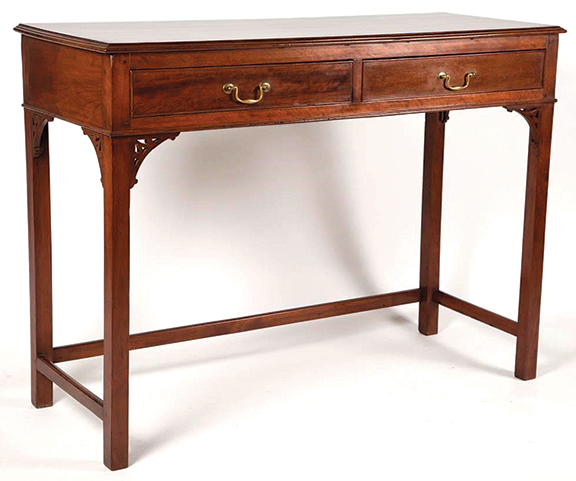
The nicely proportioned sideboard table, 37¼" high with a 51" x 19½" top, is most likely from Virginia or North Carolina. In the Chippendale style, the table dates from the fourth quarter of the 18th century and is constructed of walnut, with yellow pine as its secondary wood. It has a two-board top with a molded edge and two short drawers below. The table is raised on square legs connected with a three-sided box stretcher. The rear stretcher rail and the corner brackets are replacements, and the proper left drawer face is also likely replaced. Despite those replacements, the table generated intense bidding and sold to a phone bidder for $9945 (est. $5000/8000).
Originally published in the September 2019 issue of Maine Antique Digest. © 2019 Maine Antique Digest