





















Bonhams, Marlborough, Massachusetts
Photos courtesy Bonhams Skinner
Bonhams Skinner mounted “American Stories: Celebrating 250 Years of Independence” commemorating the 250th anniversary of the signing of the Declaration of Independence. The June 30 sale of 34 lots of historic objects saw the combination of unique military and art objects bring strong results. While six lots failed to sell, the overall sale total, $2.4 million (including buyers’ premiums), exceeded presale estimates.
High lot of the day, selling for $610,100, was the original 1945 Iwo Jima monument by the Austrian-born sculptor Felix De Weldon, which he created over the summer of 1945. Felix de Weldon (1907-2003) arrived in New York City in 1937 after fulfilling a commission in Ottawa for a bust of the Canadian Prime Minister William Lyon Mackenzie King. When King was summoned to a meeting in Geneva, he suggested that De Weldon explore the United States before returning to Europe and the rest is history.
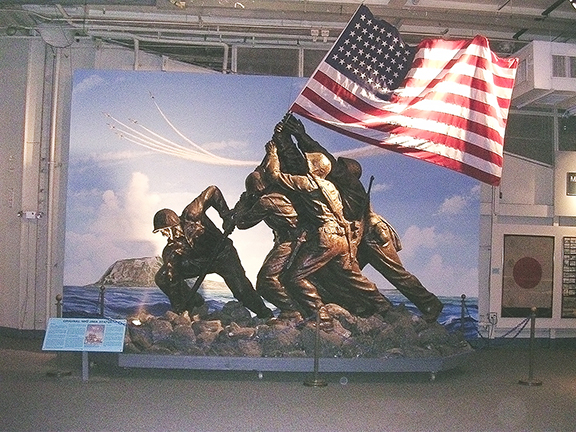
The original Iwo Jima monument created by Austrian-born artist Felix De Weldon in 1945 brought $610,100 against the estimated $250,000/450,000. De Weldon was inspired by photographer Joseph John Rosenthal’s image of the second raising of the American flag on Mount Suribachi, Iwo Jima, in February 1945, for which he received the Pulitzer Prize. Rosenthal (1911-2006) had been rejected as a war photographer by the U.S. Army because of his poor vision; instead he served as a combat photographer with the merchant marine and later as an Associated Press correspondent. De Weldon saw the photograph when it arrived at the naval base where he was serving and began a maquette. He sculpted the monument in Washington, D.C., over the summer of 1945. Of cast stone over a steel skeleton welded to a steel base, 20' x 18'7", and weighing 10,000 pounds, it was finished with a bronze lacquered layer. Because of the costs of the war, there was little available for the monument, De Weldon built it at his own expense and lent it to the government and was on display outside the Navy Department Building. Two years later when plans for an even larger version overlooking the entrance to Arlington National Cemetery were in process, De Weldon was asked to remove the statue to make way for a new building. It was returned to his studio, where it was discovered in the 1980s. It was acquired by Rodney Hilton Brown’s War Museum and restored by Sculpture House Castings in Princeton, New Jersey. June 30.
Another lot of interest was the painting Columbus’ First Landing in America by Emanuel Gottlieb Leutze (1816-1868) commemorating the event that many contemporaries viewed as sacred, if not, miraculous. The painting sold for $445,000.
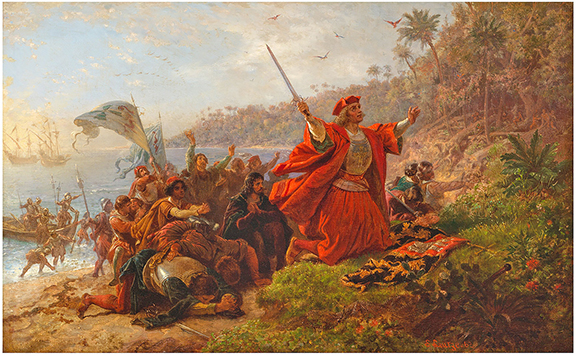
The magic of the story of Columbus’s discovery of America was exemplified in the Emanuel Gottlieb Leutze painting, Columbus’ First Landing in America. Born near Württemberg, Germany, he was brought to the U.S. as a child and returned to Germany at 24 to attend art school. He settled in Düsseldorf and began painting historical scenes. Leutze completed Washington Crossing the Delaware in 1850 and a replica in 1851. The U.S. Congress asked him to return to the U.S. to paint the mural Westward the Course of the Empire Takes its Way, which he did in 1861. He painted Columbus’ First Landing in America, oil on canvas, 24½" x 39½", in 1863 in which Columbus is presented as a deity. Leutze made a series of Columbus paintings, drawn from Washington Irving’s 1828 A History of the Life of Christopher Columbus. The painting sold for $445,000 against the estimated $400,000/600,000. The painting’s whereabouts was unknown until it turned up in the Pennsylvania collection of Andrew J. Sordoni (1887-1963) whose name is stenciled on the back of the canvas. It passed through a private collection and was sold at The Potomack Company in 2019 ($17,500), from there it sold to two other private collections. June 30.
Online auctions included August Americana: Art and Objects held August 3 through 13. The top lots of which were two paintings by Bob Ross—his 1978 Alaska Landscape that sold for $406,900and his circa 1993 Seascape in the Shape of a Tropical Fish that sold for $108,450. The Ross pictures beat out 19th-century artists such as Matthew Harris Jouett, Lydia Field Emmet, and Emil Carlsen, to name just a few.
Bonhams Skinner announced in late August that the company will be known henceforth as Bonhams. The company will continue to maintain its gallery in Marlborough, Massachusetts, at (508) 970-3000 and its Boston gallery at (617) 350-5400. Robin Starr continues as general manager.

Bob Ross’s Alaska Landscape, his 1978 painting, depicts a cabin in the woods, a body of water, and distant snow-covered mountains. The oil on canvas, 12" x 24", is inscribed on the reverse, “Bob Ross / 5050 A Polaris / EAFB, AK” and his telephone number. The Florida native spent over 18 years at the Alaska base having taken classes there in the early 1960s. He adopted the wet-on-wet technique that allowed him to complete a canvas in about 30 minutes. The painting, a gift from the artist to the consignor’s family in 1978, sold for $406,900 (est. $30,000/50,000). It retained a certificate of authenticity from Bob Ross, Inc. August 3-13.
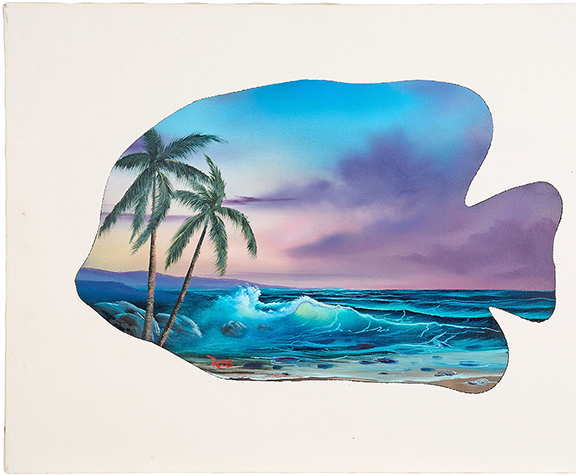
Seascape in the Shape of a Tropical Fish by Bob Ross was painted around 1993 when he experimented with landscapes cut into a shape relevant to the subject. Catalog notes describe the tropical fish shape as extremely rare. The oil on canvas, 18" x 24", sold for $108,450 against the estimated $20,000/30,000.It was acquired from the artist’s widow, Lynda Freeman-Ross of Orlando, Florida, and was accompanied by a letter of authenticity, signed by her and dated February 28, 2003. It was also accompanied by a certificate of authenticity from Bob Ross, Inc. August 3-13.
For information, visit the website (www.bonhams.com).
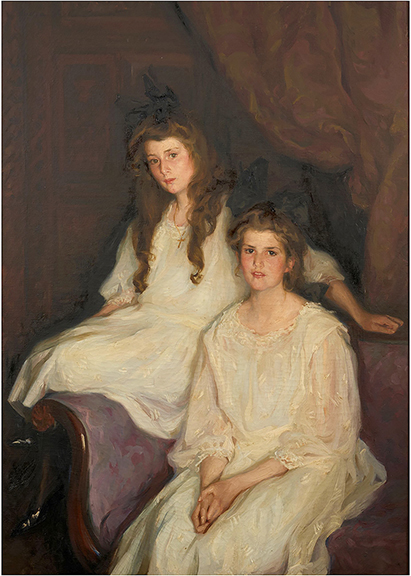
New York artist Lydia Field Emmet (1866-1952) painted The Sisters (Portrait of Maria and Anna Agassiz), the daughters of Rodolphe Louis Agassiz (1871-1933) of Boston and Hamilton, Massachusetts. Emmet is reported as having sold her illustrations at age 14. The oil on canvas, 58" x 42", was estimated at $2500/3500 and realized $46,080. Provenance included D.B. Butler & Co., New York. August 3-13.
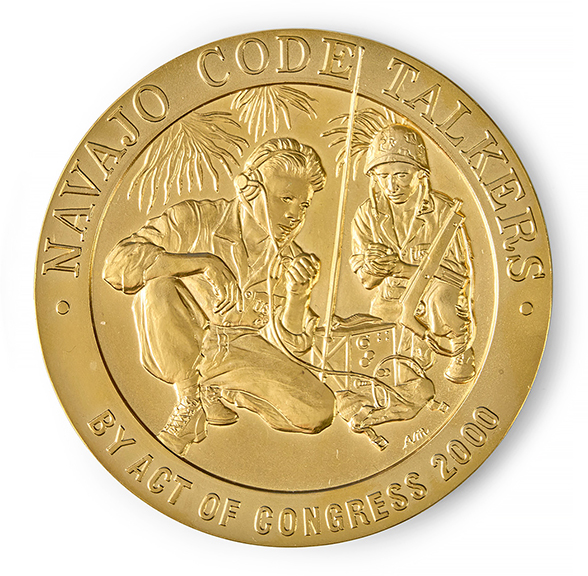
A 24k gold medal, 14.175 troy ounces, presented by Congress in 2000 to Corporal James Dixon, one of the original World War II Navajo code talkers, sold for $140,200 (est. $80,000/100,000). 29 men from the Navajo nation were recruited by the U.S. Marines in 1942 to develop an unbreakable code for transmitting military information, and the medal bears a code talker speaking into a radio with a marine at his side. The other side bears Navajo imagery and the inscription, “USMC WWII / Diné Bizaad Yee Atah Naayéé Yikèh Deesdlii.” The Code Talkers program remained classified until 1968. In 1982 Ronald Reagan was the first to acknowledge the program and awarded the participants a Certificate of Recognition, declaring August 14 to be National Navajo Code Talkers Day. Bill Clinton signed a law awarding the medals to the original 29, and in 2001 George W. Bush presented the medals to the four surviving code talkers and posthumously to the families of 25 of the men. June 30.
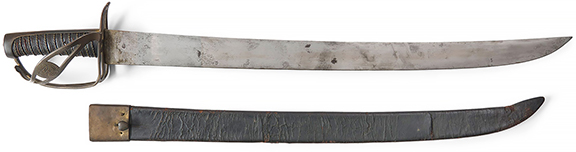
A rare Continental light infantry sword and scabbard made in France and marked U.S.A., circa 1780, was used by a sergeant of the Marquis de Lafayette’s Corps of Light Infantry. It realized $176,250 ($50,000/70,000). When the Marquis de Lafayette arrived in America in 1777, he was eager to support the American struggle for independence. He volunteered to serve without pay, but Congress took into consideration his military experience and commissioned him a major general. He returned to France in 1778 and worked with Benjamin Franklin to raise 6000 soldiers who were to be sent to America to aid in the fight. At the same time, he ordered swords and military trimmings as gifts to his officers and men. The present example is one of those. June 30.
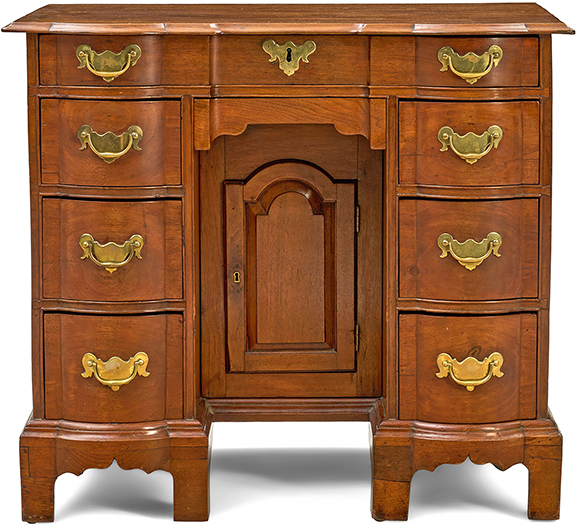
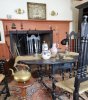
The Meikleham family Queen Anne figured walnut block-front kneehole bureau table, 29¼" x 32¾" x 20¾", likely made in Boston around 1750, sold for $25,600 (est. $20,000/40,000). It was made with a single board walnut top over a conforming case of dovetailed white pine drawers, with a removable cabinet section with a locking prospect door, and shaped period brasses. The feet had significant restoration, and the piece had been refinished. Similar Massachusetts mahogany bureau tables are held in the collections of Winterthur Museum, the Metropolitan Museum of Art, and the Museum of Fine Art, Boston. The Meikleham bureau table was on view for 30 years, from 1977 to 2007, in Thomas Jefferson’s bed chamber at Monticello. A copy of the 1977 curator’s report is included with this lot. Provenance includes Thomas Jefferson (1743-1826) and Martha Wayles Skelton Jefferson (1748-1782) to their daughter Martha Jefferson Randolph (1772-1836) to her daughter Septimia Anne Randolph Meikleham (1814-1887) and William A. Meikleham (1839-1889) to their son Henry Parish Meikleham (1872-1937) and Juliet Howel Graves Meikleham (1883-1955) to their daughter Juliet Graves Cantrell (1910-1976) to Emma Kane Jordan (1937-2013) to her daughter Sara Lois Jordan Muschamp. It should be noted that the bureau table was involved in litigation over its attribution and market value during its 30-year loan to the Thomas Jefferson Memorial Foundation, which was resolved in 2016 by the Alabama Supreme Court. It has been published widely. June 30.
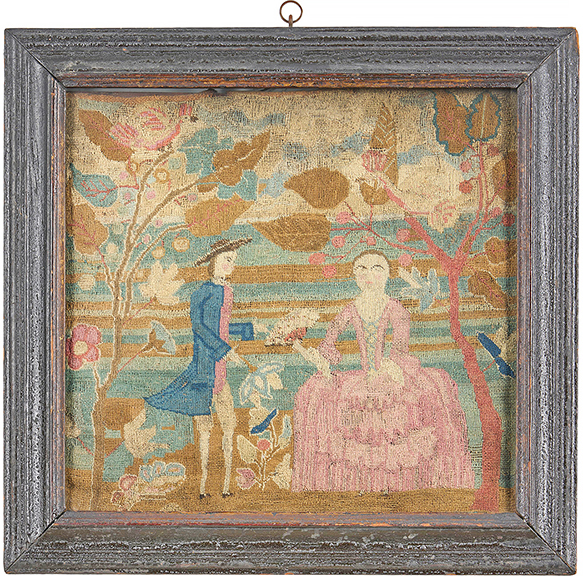
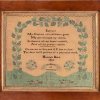
A mid-18th-century needlework picture of a courting scene was worked on tent stitch in wool on linen over a hand-planed backboard. From Marblehead, Massachusetts, in a glazed period frame, 11 7/8" x 12 5/8", and estimated at $5000/7000, it brought $12,800. It was accompanied by the card of Mrs. Malcolm Lawrie Bell stating that the picture descended in the family of Charles Eustis. August 3-13.
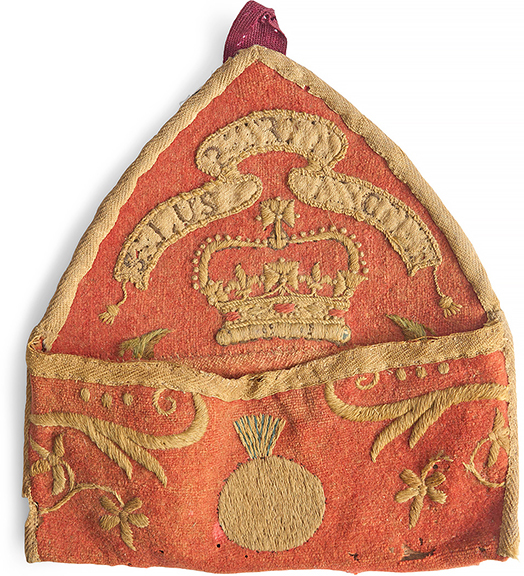
An 18th-century worsted wool grenadier’s cap converted to a comb case or wall pocket exemplifies the old saw, “Use it up, wear it out.” It is thought to be American despite an embroidered crown and the Latin motto Salus Patria Excitat. Estimated at $8000/12,000, it sold for $29,375. An old note related to the cap, 8½" x 8", reads “Comb case made from the cap of a Hessian who was shot at Pleasant Valley in 1780.” The cap is not Hessian style nor is there a record of any 1780 Pleasant Valley battles. June 30.
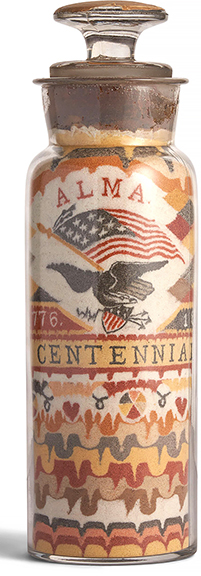
A sand bottle, 8 7/8" high, by Andrew Clemens (1857-1894) of McGregor, Iowa, made around 1876 to commemorate the centennial of the American Revolution is decorated with an eagle, a 12-star flag, the name “Alma,” and the years “1776” and “1876.” Estimated at $15,000/25,000, it brought $53,760. At least three other examples celebrating the centennial by Clemens are known. Provenance includes the General N.B. Baker Library, Sutherland, Iowa. June 30.
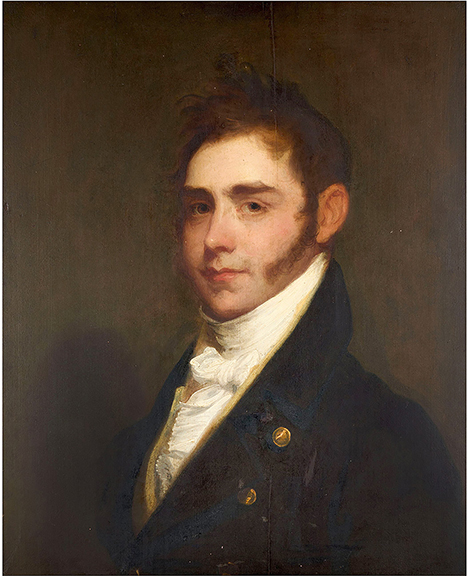
The portrait of Lewis Sanders, an unsigned oil on canvas, 26½" x 21 7/8", was painted around 1812 by Matthew Harris Jouett (1788-1827), and sold for $21,760 against the estimated $6000/8000. Jouett, of Mercer County, Kentucky, studied law, but preferred to paint; he later served in the army in the War of 1812. He returned to Lexington and opened a studio where he painted portraits and miniatures. He later traveled to Boston where he studied with Gilbert Stuart, and returned to Kentucky to paint. The sitter, Lewis Sanders (1781-1861), was a Kentucky entrepreneur, importer of purebred Shorthorn cattle, livestock pioneer, hemp production, and was involved in politics. The Sanders portrait was previously thought to have been painted by Gilbert Stuart. August 3-13.
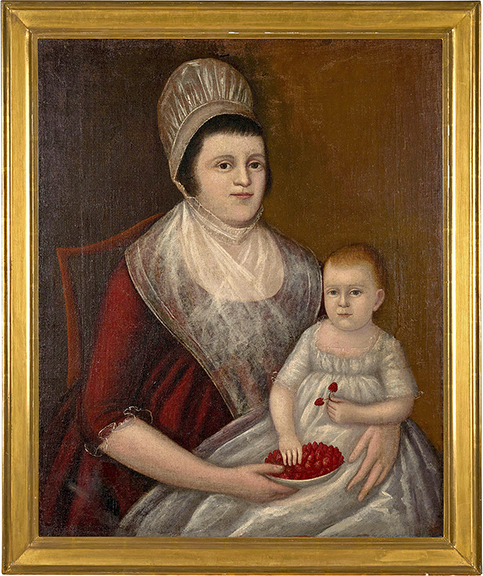
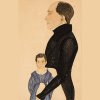
The portrait of Mrs. Thomas Donovan and Elinor Donovan by Joshua Johnson (c. 1763-1824) is unsigned and dates to around 1799. The painting, 30¼" x 25", of Nancy Anne Cole Donovan (1765-1852) and Ellen “Elinor” Donovan Nicholls (1799-1884) of Baltimore descended in the family and was acquired from Peter Tillou (1935-2021) of Litchfield, Connecticut, by the consignor. The artist, Johnson, remains among the earliest and most prolific Black professional painters in the United States, with over 80 portraits attributed to him. He trained as a blacksmith, but worked as a portraitist from around 1795 to 1825 in Baltimore, a city with one of the largest free Black populations in the country. The painting will be included in the forthcoming Johnson catalogue raisonné to be published with the Maryland Center for History and Culture. It sold for $165,600 (est. $80,000/120,000). June 30.
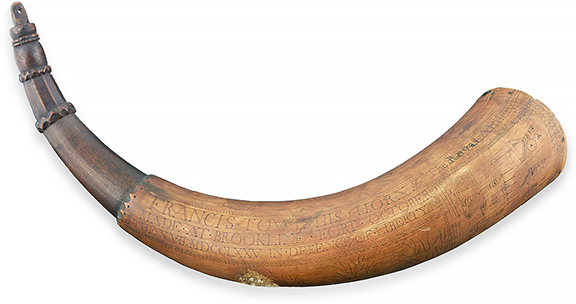
Francis Towl’s powder horn is inscribed “Francis Towl. His horn / Made at Brookline Fort October / the XVII: MDCCLXXV: In Defence of Liberty.” The 16" long horn is further embellished with a panel titled “The Royal Artillery,” which includes images of cannons, field carriages, mortar, a sword, muskets, and sailing vessels. Estimated at $20,000/30,000, it realized $64,625. Towl, of Chester, Massachusetts, enlisted April 24, 1775, and served at the Continental Army camp at Brookline. His horn is one of a small group carved by a talented as-yet unidentified American soldier during the Siege of Boston. June 30.
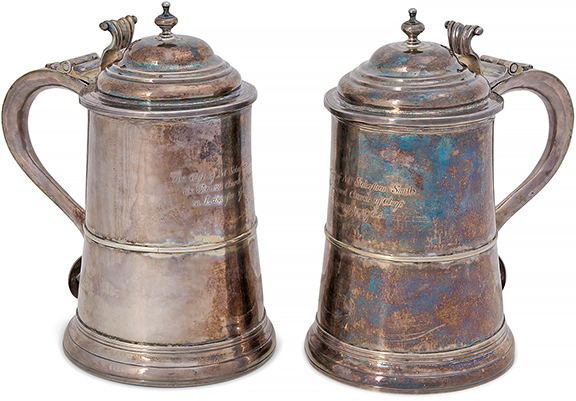
A pair of silver tankards circa 1765, by William Swan (1715-1774) of Boston was the top lot of the online auction “Antique Carpets and American Furniture” August 4-14 when it sold for $53,760 (est. $10,000/20,000). Each is inscribed, “The Gift of Mr. Sebastian Smith to / the Second Church of Christ / in Lancaster, 1765.” Each was also impressed “Swan” in a cartouche on the bottom. The tankards are recorded in Patricia E. Kane’s Colonial Massachusetts Silversmiths and Jewelers.
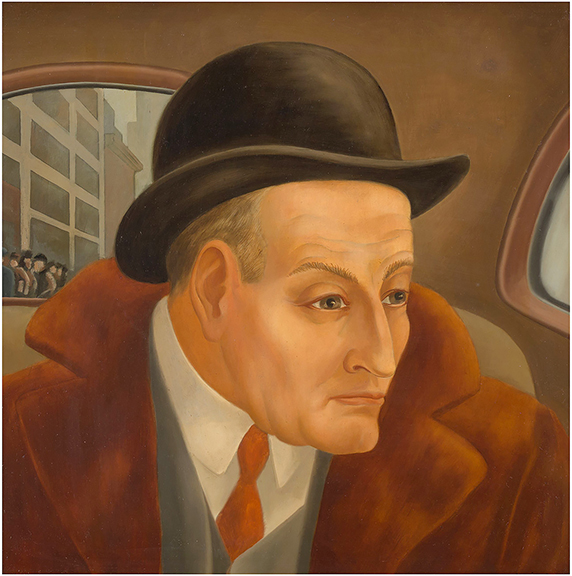
New York artist Henry Billings (1901-1985) painted Mr. Sharp in 1937, which he signed and dated. The oil on masonite, 15 7/8" x 16", brought $15,360 against its estimate $2000/4000. The well-dressed sitter is pictured being driven in a vehicle while a line of men wait against a building. Provenance includes the J.B. Neumann gallery to Mr. and Mrs. I. David Orr, and it descended in the family. Painter, illustrator, muralist, and art teacher at Bard College from 1935 to 1953, Henry Billings was active for most of his career in New York City where his work is in the collection of the Whitney Museum of American Art. August 3-13.
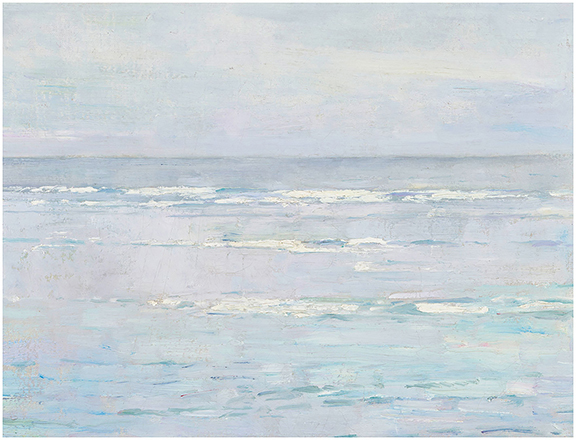
Danish-born artist Emil Carlsen (1848-1932) painted Still Ocean around 1909, an oil on canvas, 12" x 16", that is like a meditation. He studied in Denmark, and later in Paris where he absorbed the spirit of Impressionism. He arrived in the U.S. in 1872, having changed his birth date to 1853 in order to appear younger, and settled in Chicago, then New York, Boston, San Francisco, and back to New York in 1891. The painting is unsigned and sold for $30,720 (est. $2000/3000). It descended in the Carlsen family until 1975 when it was sold by Wortsman Rowe Fine Arts, Inc., San Francisco, into a California collection, and then in 2026 to Bonhams. August 3-13.

Television artist Bob Ross (1942-1995) employed his “wet-on-wet” technique when he painted Mountain Summit on air in 1988 during season 13, episode 10, of his PBS series The Joy of Painting. At 18" x 24", the painting realized $406,900 against the estimated $50,000/70,000. The sale benefited Ball State University in Muncie, Indiana, the owner of WIPB, the PBS station where Ross filmed his episodes. WIPB is now known as Ball State PBS. June 30.
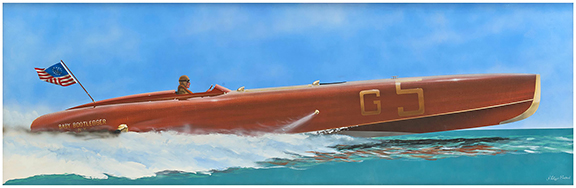
Who could resist a painting by French naval and marine artist Philippe Conrad (b. 1949)? His image of The Baby Bootlegger brings to light the 30' mahogany speedboat designed by George Crouch, built in 1924 by Henry Nevins, and commissioned by aviator and racer Caleb Bragg. Estimated at $4000/6000, the acrylic on canvas, laid on board, 31" x 95½", sold for $5888. August 3-13.

Originally published in the November 2026 issue of Maine Antique Digest. © 2026 Maine Antique Digest